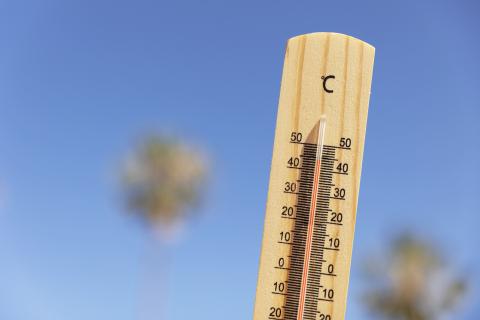
In some regions, global warming may already resemble a world with a 1.5 °C rise in temperature
El Acuerdo de París tiene como meta que la temperatura global no aumente más de 2 °C por encima de los niveles preindustriales y proseguir con los esfuerzos para limitarlo a 1,5 °C. Sin embargo, es posible que algunas regiones del mundo ya hayan experimentado entre el 90 y el 94 % del calentamiento previsto para cuando la media global alcance los 1,5 °C por encima de los niveles preindustriales, y entre el 65 % y el 76 % del previsto con un calentamiento de 2 °C. Es la conclusión de un estudio publicado en la revista Nature Climate Change, cuyos resultados sugieren que el calentamiento regional en 2025 fue estadísticamente indistinguible de los niveles previstos en un mundo 1,5 °C más cálido.

Jorge Olcina - calentamiento 1,5
Jorge Olcina
Professor of Regional Geographical Analysis at the University of Alicante
Does the press release accurately reflect the study?
“Yes, the press release is well written and accurately reflects the content of the study, with rigour and in an informative style.”
Is the study of good quality? Are the conclusions supported by robust data?
“Yes, it is a very high-quality study. The researchers have utilised reliable meteorological data sources and applied an appropriate regionalisation approach. The study’s conclusions are underpinned by robust data.”
How does this work fit in with existing evidence?
“The work reinforces the hypothesis that the rate of global temperature rise has accelerated over the last two decades in relation to the increasing emission of greenhouse gases into the Earth’s atmosphere resulting from ever-higher consumption of fossil fuels to meet the planet’s energy and transport demands. Consequently, the 1.5 °C and 2 °C targets – temperature thresholds that were not expected to be reached until the end of this century – are set to be met much sooner than anticipated.
Various projections from climate research organisations (Berkeley Earth, Copernicus) have emphasised in their latest reports the rapid pace of global warming, stating that by the next decade of this century we will have already reached a widespread 1.5 °C rise, and 2 °C by the 2050s. This is a deeply worrying scenario for humanity because it necessitates the acceleration of mitigation and adaptation policies, which, for the time being, wherever they are being implemented, are not resulting in a reduction in global warming or its direct atmospheric effects".
Have the authors taken confounding factors into account? Are there any significant limitations that need to be considered?
“Yes, they have taken them into account. Although we now know that a key factor in global warming is the heat accumulating in the ocean basins, and the study does not address this issue. It focuses on the land-based component, which is, moreover, where the world’s population lives – a population that is already experiencing, and will experience even more so in the future, the effects of the temperature rise resulting from the current process of global warming.”
What are the implications for the real world?
“Climate projections for the coming decades must be adjusted to reflect the new reality of rising temperatures as shown in this study. It is no longer credible that the global temperature rise can be limited to 2 °C by the end of the century. In fact, there are already international and European organisations that are highlighting in their reports on the impact of climate change the need to develop climate models based on a 3 °C and 4 °C rise in the global average temperature by the end of this century. As evidenced in this study, the socio-economic impact caused by climate change will result in significant annual losses to the global economy and a very high death toll (due to heat and the effects of extreme weather events).
In the case of Spain, given these projections, it will be necessary to allocate between 1 and 2 per cent of annual GDP to implement measures for mitigation and, above all, adaptation to climate change, which will help to reduce the impact of this process that cannot be halted. These are worrying figures, in an increasingly complex world, with climate change on the rise.”
Víctor Resco - 1,5
Víctor Resco de Dios
Lecturer of Forestry Engineering and Global Change, University of Lleida and researcher at Agrotecnio
Gil de Biedma once said, ‘It is only later that one begins to realise that life is a serious matter.’ I fear that something similar is happening to us with climate change. We will not accept its reality until it is too late. Because accepting climate change does not merely mean acknowledging its existence and its anthropogenic origin, but also developing and implementing mitigation and adaptation plans. In the famous Paris Agreement, various countries committed to limiting the temperature rise to 2 °C and to striving not to exceed 1.5 °C of warming. The new article indicates that it is now impossible to stay below 1.5 °C, and that we are dangerously close to 2 °C. The article also confirms that warming in the European Mediterranean is above the global average, having already exceeded 1.7 °C.
It is worth remembering that, with the mitigation plans currently in place, warming by the end of the century will likely be closer to 3 °C than to 2 °C. Be that as it may, we must remember that the climate is not like yoghurt, which has a use-by date. It is not too late, and we can still do a great deal, particularly in the area of adaptation, which is within our control. Let us start preparing now for new wildfires, new floods, new droughts, new heatwaves, new demands on the energy sector, and so on.
It is not within our power to prevent emissions from rising, but we can prepare ourselves. Because, to quote Gil de Biedma once more, sooner or later we will see that ‘time has passed and the unpleasant truth is coming to light’. We’d better be ready when it does.
Li et al.
- Research article
- Peer reviewed