The remains of Ötzi, the ‘Iceman’, harbor modern and ancient microorganisms
The so-called ‘Iceman’, Ötzi, who lived approximately 5,300 years ago, was discovered in 1991 in the Ötztal Alps, on the border between Austria and Italy. His mummified remains were preserved at -6°C in a museum to replicate the conditions in which they were found. Now, a team from Italy has discovered that he contains communities of both ancient and modern microorganisms, some of which may be metabolically active or capable of replicating under the current preservation conditions, although, for the moment, no damage has been detected. According to the researchers, this demonstrates that “the ‘Iceman’ is not a static relic, but a dynamic biological interface.” The results are published in Microbiome.
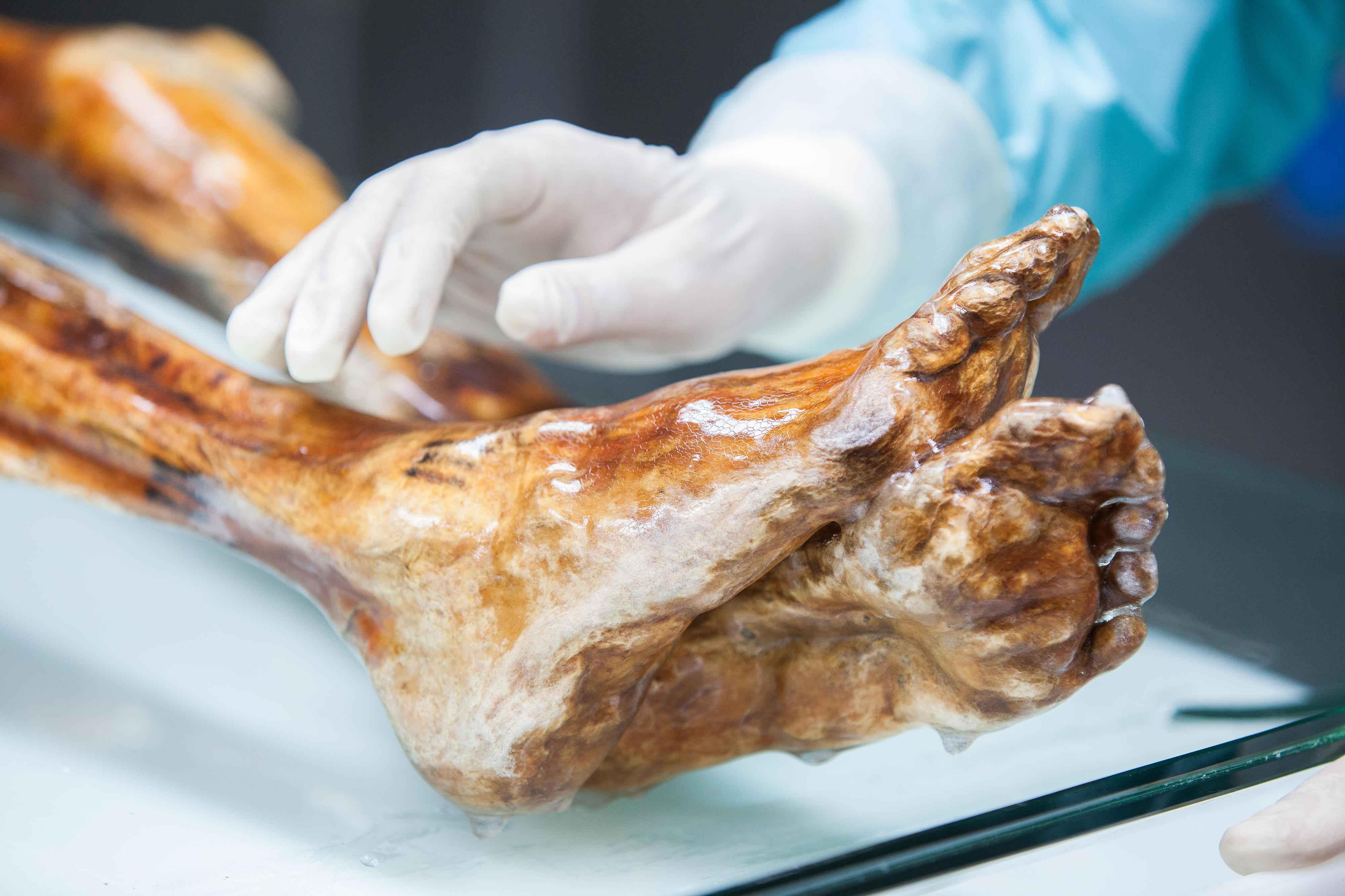
The Iceman mummy is preserved in a refrigeration chamber at a constant temperature of -6°C and a relative humidity of 99% and sprayed regularly with water to prevent moisture loss. Credit: South Tyrol Museum of Archaeology/Eurac Research/Marion Lafogler.
Gabaldón - Otzi
Toni Gabaldón
ICREA research professor and head of the Comparative Genomics group at the Institute for Research in Biomedicine (IRB Barcelona) and the Barcelona Supercomputing Center (BSC-CNS).
The article by Sahan and colleagues investigates the microbiome of the mummified remains of the famous Ötzi the Iceman, 5,300 years old, preserved for three decades in the Tyrol Museum (Austria) at low temperatures (-6°C). The question they attempt to answer is relevant: can the preservation conditions preserve the ancestral microbiota or, on the contrary, do they allow the survival and growth of microorganisms that may have colonized the mummified remains? To this end, the team employs appropriate techniques combining metagenomics, isolation by culture, and detection of DNA damage characteristic of ancient samples. The methodology used is appropriate, and although the study has obvious limitations (such as the small number of samples and lack of replicates), the results are conclusive.
The main results are clear and demonstrate that the studied sample has not remained unaltered over time. Rather, communities of microorganisms, particularly yeasts adapted to cold conditions, have colonized and proliferated on the mummy, despite the low temperatures at the original site or in the museum. It also shows that museum conservation practices, such as spraying water to maintain humidity or applying disinfectants, have altered the microbial communities, introducing or selecting for certain organisms. The study is important because it sheds light on how to interpret microbial findings in ancient samples. It also casts doubt on studies of ancient samples that assume the sequences obtained belong to ancient microbes associated with the individual or the original environment. It reminds us that microbes, including yeasts, thrive in environments as extreme as sub-zero temperatures.
The study not only throws a bucket of cold water (literally) on our hopes of understanding ancient microbial communities; It also provides possible solutions to improve the preservation of ancient samples or to discern between the original microbial composition of an archaeological sample and subsequent colonizations.
260603_David Velázquez_Ötzi
David Velázquez
Senior Lecturer in the Department of Biology at the Autonomous University of Madrid
The study clearly shows that Ötzi is not a system frozen in time, as we tend to think when we talk about mummies. Although the mummy’s conditions of preservation have been quite extreme, with temperatures below 0 °C, this has not been enough to halt all biological activity. The study clearly demonstrates that microorganisms specialised in cold environments, known as psychrophiles, can thrive under such conditions.
The mummy acts as a biological substrate on which, as might be expected, microbial communities of different origins and ages intertwine depending on the conditions to which it is exposed. The authors have succeeded in sequencing remnants of ancient gut microbiota, microorganisms associated with the glacier, and others that appear to originate from the museum where the mummy is preserved. The identification of ancient gut bacteria provides a valuable reference for studying what the human microbiome was like some 5,300 years ago and for comparing it with current, less Westernised human communities. However, from an applied perspective, this has important implications for the conservation of archaeological remains containing biological tissues. Ötzi is an exceptional mummy and also a micro-ecosystem in an unstable equilibrium, and his conservation requires consideration not only of physical factors such as temperature and humidity, but also of microbiological factors.
Sarhan et al.
- Research article
- Peer reviewed