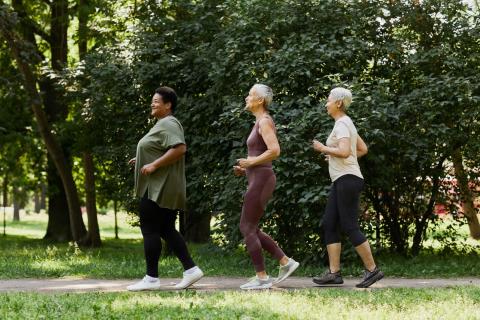
Small and feasible changes in physical activity are associated with lower mortality risk
Moderate-intensity physical activity, such as walking at an average speed of 5 km/h for an additional five minutes per day, is associated with a 10% reduction in all-cause mortality among most adults, according to a study published in The Lancet. The research also found that reducing sedentary time by 30 minutes per day was associated with an estimated 7% reduction in all-cause mortality if adopted by most adults. The study analyzed data from more than 135,000 adults from Norway, Sweden, the United States, and the United Kingdom, with an average follow-up of eight years.

Olga Monteagudo - ejercicio
Olga Monteagudo Piqueras
Head physician of the Preventive Medicine Department at Reina Sofía University General Hospital (Murcia) and associate professor in the Department of Social and Health Sciences at the University of Murcia
In general, this is a study of significant scientific interest in the field of public health related to healthy lifestyles, characterized by a robust methodological design that strengthens and expands the existing body of evidence.
Specifically, this work presents up-to-date estimates that provide evidence on health outcomes associated with small changes in physical activity patterns and sedentary behavior in high-income countries. The authors highlight two key issues: first, they clarify that these results are intended to help understand general benefits for society and should not be used to provide advice or personalized exercise plans for a specific individual. Second, they emphasize the need to further develop research in low- and middle-income countries, where demographic structures, levels of physical activity, and epidemiological risk profiles may differ substantially from those observed in the study cohort; it would also be necessary to assess the feasibility and viability of replicating a study with similar characteristics in these countries.
Helios Pareja - ejercicio
Helios Pareja Galeano
Lecturer at the Autonomous University of Madrid specialising in Exercise Physiology and Physical Activity and Health, Director of the Exercise Physiology and Nutrition Research Group and Vice-Dean of Employability, Postgraduate Internships and Physical Activity and Sports Sciences
This study has strong methodological quality, as it is a meta-analysis with individual-level data from several prospective cohorts in which physical activity and sedentary behavior are measured objectively using accelerometry devices. This approach reduces self-report bias and allows the dose–response relationship to be modeled. The focus of the work is not to demonstrate actual changes in each individual, but rather to estimate the potential impact of shifting the population distribution based on observed levels—for example, what proportion of deaths could be prevented if the least active individuals accumulated 5 or 10 minutes per day of moderate-to-vigorous physical activity, or if sedentary time were reduced by 30–60 minutes per day. This scenario-based logic is clearly laid out by the authors and helps convey that small goals could yield meaningful public health benefits.
That said, the article itself addresses the main caveats: although deaths in the first two years are excluded to reduce reverse causality, and sensitivity analyses are conducted excluding individuals with mobility limitations, the authors acknowledge that residual confounding or reverse causality cannot be completely ruled out in an observational study. In addition, they emphasize an important point for interpreting the message of “small changes”: exposures are measured only at baseline, so it is not directly observed whether these hypothetical increases actually occur and are sustained over time, which may affect the estimation of the effect (discussed as a limitation related to baseline measurement and the assumption of consistency).
Overall, the study reinforces a cautious message: moving a little more and sitting less is likely associated with lower mortality, especially among the least active, but the percentages should be communicated as potential impact under certain assumptions, not as an individual-level causal prescription.
Isabel Aguilar - ejercicio mortalidad EN
Isabel Aguilar
Full Professor of Preventive Medicine and Public Health at the University of Zaragoza
This study published in Lancet presents the results of a meta-analysis of published studies analysing the effects of physical exercise on mortality. To this end, the authors selected and analysed individual data from various follow-up studies in Norway, Sweden, the UK and the USA.
The authors describe several interesting findings. The main one is that small increases in vigorous or moderate physical activity appear to reduce all-cause mortality. In addition, they studied two possible scenarios: a “high-risk” scenario in which they studied the effect of physical activity on those who exercise the least, which would maximise the individual benefit in the most inactive people; and a “population” scenario in which the entire population would be targeted, except for the most active 20%, which would have a greater impact in absolute terms.
This study reinforces existing evidence of the benefits of physical activity in reducing mortality, emphasising that modest and realistic changes can bring significant benefits. However, it should be noted that these observational studies have numerous limitations. Among the main ones is the fact that there may be other factors not taken into account by the authors that have confounded the study results (the existence of what is known as “residual confounding”). In addition, the study only analyses all-cause mortality. It would be interesting to expand it by studying specific causes of death and other outcomes, such as the reduction in the incidence of certain diseases or disabilities.
Luis Cereijo - ejercicio mortalidad EN
Luis Cereijo
Assistant professor of Physical and Sports Education and researcher in Epidemiology and Public Health at the University of Alcalá
The study led by Professor Ulf Ekelund is an exceptional study that shows that higher levels of moderate to vigorous physical activity have a significant impact on reducing mortality. This study consolidates the existing evidence with an extensive population sample, providing enormous scientific and social relevance in a context in which pharmacological approaches seem to be receiving more attention than the proven relevance of living conditions.
Although the study follows an observational design, limiting causal confirmation, the authors have taken steps to reduce reverse causality bias. In addition, physical activity was measured objectively using accelerometry devices, which provides much greater rigour than other population studies that are often based on self-reported questionnaires. However, its main limitation is that physical activity was only measured at the start of the follow-up, which prevents the analysis from considering possible changes in the physical activity habits of participants over time that could influence the results.
Two comments should also be added to the analysis of this study which, without limiting its quality and relevance, are important for a complete discussion. Firstly, the study only considers the socioeconomic status of participants as an adjustment variable (without delving into the differences), which prevents us from knowing to what extent this effect differs according to inequality. Given the existing evidence, it can be expected that the effect could be greater for populations with low socioeconomic status because their baseline health status is, in general terms, lower than that of those with higher socioeconomic status, which further highlights the relevance of this type of research. Secondly, the study does not include the Spanish population or other southern European countries. This is relevant because there are significant differences in physical activity patterns, eating habits, mortality risk profiles, and social and urban contexts that could show different associations.
Beyond the above, Professor Ekelund's team's study is undoubtedly a wide-ranging piece of research with a highly rigorous methodology that consolidates the evidence of the importance of moderate to vigorous physical activity habits in improving the health of the population and, ultimately, reducing premature mortality among citizens. This highlights the importance of placing actions to promote equitable access for all people at the centre of public policy, especially those with lower socioeconomic status and higher mortality risk.
Ekelund et al.
- Research article
- Peer reviewed
- Observational study