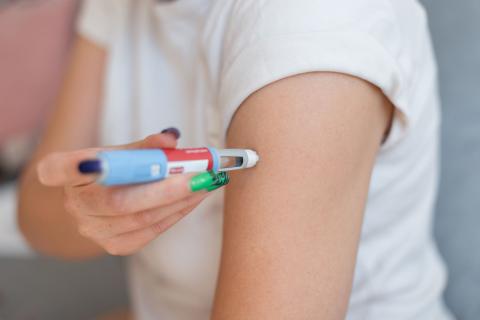
Both the drug orforglipron and a probiotic supplement help patients with obesity maintain their weight loss, according to two independent clinical trials
In the treatment of obesity, maintaining weight loss is the most difficult phase. Two independent clinical trials published in Nature Medicine have adopted two different strategies to achieve this. The first is a phase 3b trial involving the GLP-1 drug orforglipron, administered orally on a daily basis for 52 weeks. This trial included 376 adults in the United States who had already completed 72 weeks of injectable treatment with tirzepatide or semaglutide. Almost 75% and 80% respectively of patients on each injectable drug maintained their weight loss. The second trial involved 90 obese adults from the Netherlands who followed a low-calorie diet for eight weeks and then received a daily supplement of the bacterium Akkermansia muciniphila for 24 weeks, alongside a healthy diet. Although those who received the supplement regained more than 13% of the weight initially lost, those who took the placebo regained almost 33%.

2026 05 13 orforglipron Cristóbal Morales EN
Cristóbal Morales
Head of the Metabolic Health, Diabetes and Obesity Unit at Vithas Hospital in Seville and member of the Spanish Society for the Study of Obesity (SEEDO)
This study is very important because it focuses not so much on losing weight, but on maintaining the benefits, something we are currently concerned about. Previous studies showed that stopping the medication could lead to a rebound effect if things weren’t done properly. That is why we are so committed to incorporating certain key concepts into obesity therapy that allow us to understand and treat it effectively, such as the fact that, as a chronic and complex condition, it requires long-term treatment and sustained support over time. That is why the maintenance phase is so important.
In this trial on orforglipron — I prefer not to comment on the other one as I am not as familiar with it — it is demonstrated and published how strategies based on oral obesity therapy using a small molecule that acts on GLP-1 receptors maintain that benefit over time (52 weeks). It is true that longer studies are needed, but these will surely be reported in due course. This is very good news because what we want is to maintain that benefit. We currently have clinical trials underway with different alternatives for that maintenance phase.
Conflicts of interest: “I am a researcher working on orforglipron and with pharmaceutical companies conducting clinical trials on diabetes and obesity, such as Lilly, Novo Nordisk, Amgen, Boehringer and Pfizer.”
Jose M Ordovás - mantener pérdida peso EN
José M. Ordovás
Senior scientist and scientific advisor at the Jean Mayer USDA Human Nutrition Research Center on Aging and professor at the Gerald J and Dorothy R. Friedman School of Nutrition Science and Policy at Tufts University.
These two trials are significant because they address one of the most challenging aspects of obesity treatment: not so much losing weight, but maintaining the weight lost. The orforglipron trial is a phase 3b, randomised, double-blind, placebo-controlled study in people who had previously lost weight with tirzepatide or semaglutide. Its results support the idea that switching from an injectable treatment to an oral GLP-1 receptor agonist may help preserve a substantial portion of the weight loss achieved, which could have important practical implications for treatment adherence, acceptability and scalability. The trial with pasteurised Akkermansia muciniphila is smaller, but also randomised and double-blind, and suggests that targeting the microbiota–metabolism axis could modestly help reduce weight regain following a low-calorie diet, with interesting signals regarding insulin sensitivity and possible differences depending on baseline Akkermansia abundance.
That said, both studies should be interpreted with caution. In the case of orforglipron, the comparator was placebo rather than continued injectable treatment, so it is not possible to conclude whether switching to the oral route is equivalent to continuing with semaglutide or tirzepatide. Furthermore, the follow-up period was one year and the population was from the United States, with limited diversity. In the case of Akkermansia, the sample size was small, the follow-up period was 24 weeks after weight loss, and the effects, whilst promising, are modest and require confirmation in longer and more diverse studies. Taken together, the two studies reinforce an important idea: obesity must be understood as a chronic, biologically defended condition, where maintenance requires sustained strategies. They also point towards a more combined and personalised future, where drugs, nutrition, microbiota, behaviour and individual patient characteristics are integrated to improve the durability of results.
Francisco Jesús Gómez - mantener pérdida peso
Francisco Jesús Gómez Delgado
Coordinator of the Vascular Risk Unit and head of the Internal Medicine Department at the University Hospital of Jaén, Associate Professor of Medicine at the University of Jaén and member of the Diabetes, Obesity and Nutrition Group of the Spanish Society of Internal Medicine
Article 1: Orforglipron
Is this a high-quality study?
“The fact that it is a clinical trial specifically designed for a particular objective ensures the highest possible rigour. Specifically, it is a phase 3b, randomised, double-blind, placebo-controlled trial, with two well-defined cohorts from previous incretin-based treatments, in which the sample size has been calculated to enable the analysis and demonstration of the primary and secondary endpoints defined for this study.”
What are its limitations?
“The main limitation is that it conducts a head-to-head comparison and does not compare orforglipron with continued treatment with semaglutide or tirzepatide, as was done in the SURMOUNT-5 clinical trial from which these patients originated. Furthermore, the study lasts only 52 weeks, which limits our full understanding of its long-term efficacy and safety.”
What are its implications and how does it fit with existing evidence?
“This study reinforces the idea that obesity is a chronic condition requiring a long-term therapeutic approach using the various tools available, including maintenance therapies with orally administered incretins, which are potentially more scalable and acceptable to many patients.”
Article 2: Akkermansia muciniphila pasteurised
Is this a high-quality study?
“This study, as in the previous case, is a randomised, placebo-controlled trial, so we can affirm its methodological robustness for a clinical proof-of-concept. Furthermore, it incorporates biomarkers and mechanisms of interest in understanding metabolic health, such as the gut microbiota, adipose tissue, and lipid and glucose metabolism.”
What are its limitations?
“On the other hand, its sample size is small, the follow-up period is short, and the demonstrated effect on body weight is limited. Furthermore, it does not include other active comparators or biological models that would allow the observed benefit to be confirmed or clarified more precisely.”
What are its implications and how does it fit with existing evidence?
“In this regard, it clearly supports the hypothesis and the role played by our gut microbiota, depending on its profile, in phenomena such as inflammation, dyslipidaemia or diabetes. Similarly, this study identifies the gut microbiota as a real therapeutic target in the management of obesity. Furthermore, it is proposed as a complementary tool to supplement pharmacological, nutritional and behavioural strategies, which makes it an interesting option.”
Conflicts of interest:
- Speaker: Ferrer, Amgen, Sanofi, AstraZeneca, Boehringer Ingelheim–Lilly, Janssen, Novo Nordisk, Daiichi Sankyo, Novartis, Rovi and Vifor.
- Advisory board: Amgen and Sanofi.
- Conference invitations: Ferrer, Amgen, Sanofi, AstraZeneca, Boehringer Ingelheim–Lilly, Janssen, Novo Nordisk, Daiichi Sankyo and Rovi.
- Clinical trial investigator: Ferrer, Amgen, Sanofi, Janssen, Novo Nordisk, Daiichi Sankyo, Novartis, Ionis Pharmaceuticals and Boehringer Ingelheim–Lilly.
José Pablo Miramontes - mantener pérdida peso EN
José Pablo Miramontes González
Internal Medicine Physician in the Internal Medicine Department of the Río Hortega Hospital (Valladolid)
The ATTAIN-MAINTAIN study is a high-quality trial in terms of methodology: a phase 3b, randomised, double-blind, placebo-controlled trial in patients who had previously lost weight with tirzepatide or semaglutide as part of the SURMOUNT-5 study. Its main value lies in answering a highly clinical question: what happens if, following significant weight loss with an injectable treatment, patients switch to an oral option such as orforglipron to maintain the benefit? The results are consistent and clinically relevant: orforglipron enabled a higher proportion of weight loss to be maintained than placebo, following both tirzepatide and semaglutide, with a safety profile dominated by gastrointestinal effects, generally mild or moderate. However, there are significant limitations: it was not compared against continuing semaglutide or tirzepatide; the population was drawn solely from the United States; it was a selected cohort—patients who had already tolerated and responded to incretins; it did not include diabetes; and the follow-up was only one year. Furthermore, the use of orforglipron as rescue therapy in the placebo group partially limits a pure long-term comparison. Overall, the study fits very well with previous evidence showing that obesity is a chronic and relapsing condition, and that discontinuing treatment often leads to weight regain. Its most practical implication is that a sequential strategy—potent injectable treatment to induce weight loss followed by maintenance with an oral GLP-1 receptor agonist—could be a realistic alternative to improve adherence, acceptability and scalability, although it does not yet demonstrate that it is superior to continuing the injectable treatment.
The trial with pasteurised Akkermansia muciniphila MucT also has a sound design: randomised, double-blind and placebo-controlled, with an initial low-calorie diet phase followed by a 24-week maintenance phase. The primary outcome is positive: participants treated with Akkermansia regained less weight than those in the placebo group, with a difference of approximately 2 kg during the maintenance phase, and the effect appeared to be greater in subjects with lower baseline abundance of Akkermansia. Furthermore, the study provides interesting mechanistic data on insulin sensitivity, faecal energy excretion, microbiota and gene expression in adipose tissue, making it biologically plausible rather than merely descriptive. That said, caution is warranted: it is a small, short-term study conducted in a highly selected population and without comparison to current anti-obesity drug treatments. The magnitude of the effect is modest and does not allow us to conclude that this intervention is an alternative to incretin agonists, but rather a possible complementary strategy. Mechanistic questions also remain, as there was no active bacterial comparator or modified strains to allow the effect to be attributed with certainty to specific components of Akkermansia. Therefore, in my view, the study is promising, but it should be interpreted as a clinical and metabolic proof of concept, not as definitive evidence to change clinical practice.
Josefa García Barrado - mantener peso EN
Josefa García Barrado
Full Professor of Pharmacology and researcher in the Neuroendocrinology and Obesity group at the University of Salamanca
This is a well-designed clinical trial evaluating two treatments aimed at addressing one of the main issues with incretin mimetics, such as semaglutide (Ozempic) and tirzepatide (Mounjaro): weight regain following discontinuation of treatment. This occurs particularly when patients have failed to maintain changes in lifestyle and diet, although weight regain can occur even with these modifications.
The study analyses the outcomes following treatment with both incretin mimetics and, once treatment has ended, the switch to oral orforglipron, administered once daily—an option that may facilitate treatment adherence. The results show that combination therapies represent a promising strategy for maintaining weight loss after discontinuing injectable treatments and improving treatment adherence. As seen in the results of the semaglutide trial, continuing with oral orforglipron appears even more effective than when used following tirzepatide.
Key limitations of the trial include the short duration of follow-up, the absence of a group continuing with injectable therapy for comparison purposes, and the limited diversity of the study population. Furthermore, the possibility of receiving rescue treatment has made it difficult to clearly interpret the differences compared with placebo.
Nevertheless, the findings are highly interesting and align with current evidence, which regards obesity as a chronic condition requiring long-term treatment and continuous monitoring. Overall, both trials support the development of combination and personalised therapies as a useful option for improving the comprehensive management of obesity and thereby enhancing treatment adherence.
Louis J. Aronne et al.
- Peer reviewed
- Randomized
- Clinical trial
- People
- Research article
Sarah Mount o et al.
- Peer reviewed
- Randomized
- Clinical trial
- People
- Research article