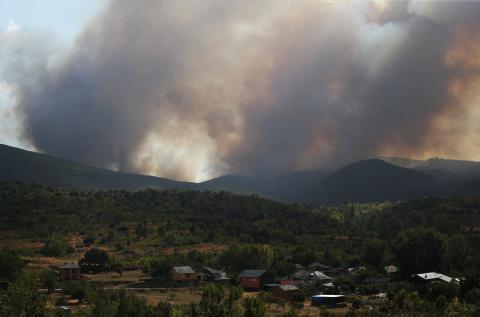
Extreme heat and wind keep numerous fires burning on the peninsula
Four people have died in the fires that began last weekend on the Iberian Peninsula and have spread to different areas of Galicia, Castile and León, Andalusia, Castile-La Mancha, Extremadura and Madrid. The heatwave that continues to grip the country, strong gusts of wind and their changing direction, and the thermal drought are hampering firefighting efforts. The government declared on Tuesday a pre-emergency phase and thousands of people have had to be evacuated.
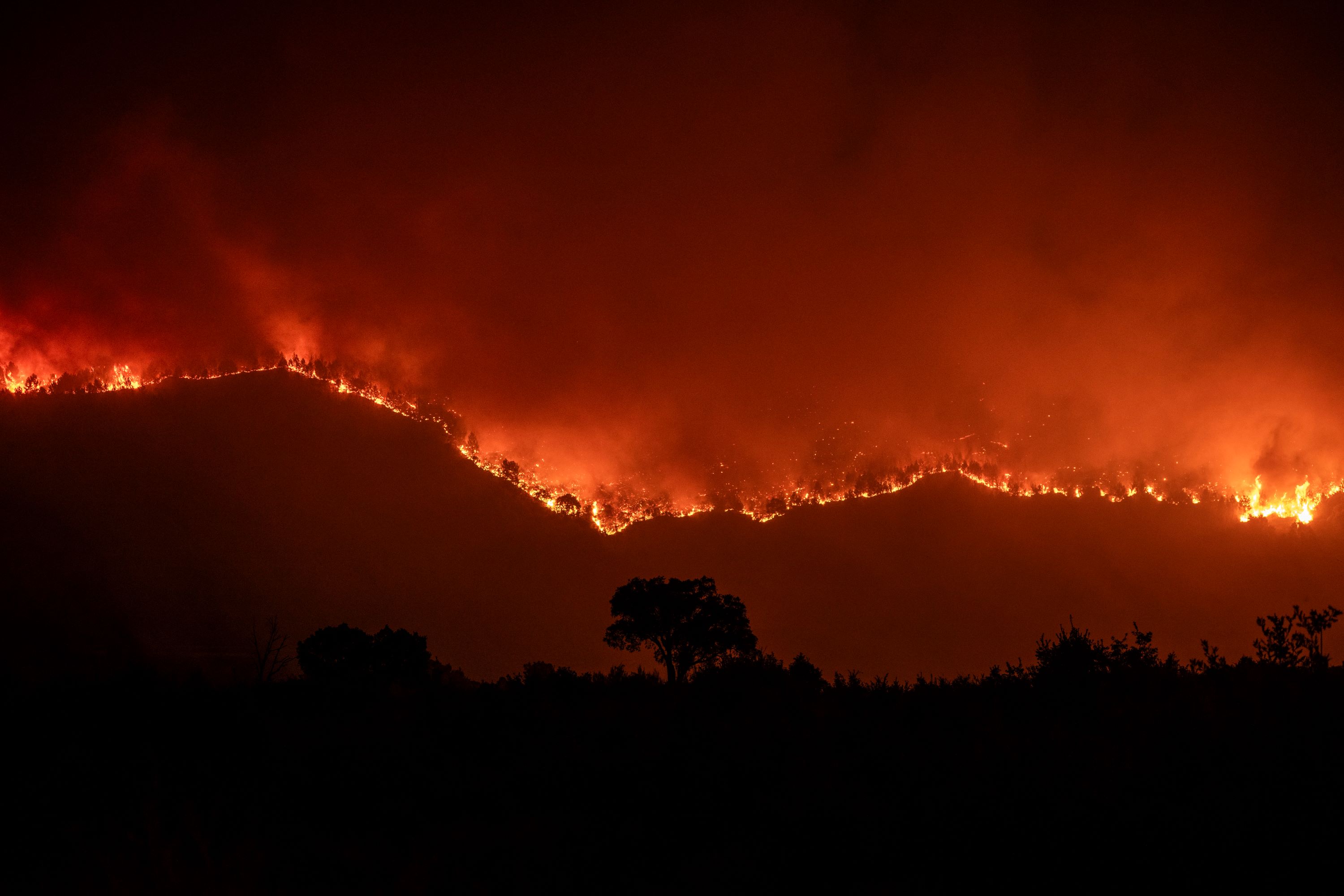
Image of the fire in Oimbra, in the province of Ourense. EFE/Brais Lorenzo.
Fernando Ojeda - incendios península EN
Fernando Ojeda
Professor in the Department of Biology (Botany Section) at the University of Cádiz and researcher with the 'Ecology, Evolution, and Conservation in Terrestrial Ecosystems' (ECOTER) group
The arrival of summer reignites concerns about forest fires, and this year has been particularly dramatic. For society in general, forest fires are catastrophic events that, in addition to threatening people's lives and the economy of a region, reduce biodiversity and trigger soil erosion. They lead to a loss of natural habitats and, ultimately, to the desolation of the landscape. However, while the risk and damage they cause to people and their possessions is undeniable and painful, this negative social perception of fire on the natural landscape and its biodiversity contrasts with scientific information and evidence. Many Mediterranean ecosystems are not only resistant to fire, but dependent on it, as fire has been part of their evolutionary history.
Although it may seem paradoxical, the complete eradication of forest fires in the Iberian Peninsula, something that many nature lovers would sign up for without hesitation, would trigger a biodiversity crisis. Mediterranean ecosystems have the capacity to respond and regenerate after fire. This is the ecological concept of resilience, which is not immediate.
It will take about 20 years to return to the situation before the fire. So what? Why rush? There is talk of restoring and reaching the final situation to protect biodiversity, forgetting that there are species that only live in the first few years after a fire and that they are also part of the biodiversity of these ecosystems. It's like pressing fast-forward on the radio until we get to the song we want, ignoring the rest of the songs. In science, we use the concept of pyrodiversity, which is associated with a mosaic landscape of areas of different ages since they were last burned and different associated species. Pyrodiversity generates biodiversity.
However, the severity and extent of forest fires in recent years are certainly worrying and are not typical of Mediterranean ecosystems. Firefighting experts talk about sixth-generation fires or megafires and point to climate change and human action, whether intentional or accidental, as the causes of their ignition. Rarely is fuel, its continuity and flammability mentioned. People talk about scrubland or vegetation in general, when it has been proven that not all scrubland burns in the same way. Since the mid-20th century, the natural landscape of the Iberian Peninsula (especially its western half) has been extensively forested with plantations of pine and eucalyptus, fast-growing and highly flammable tree species. These plantations are largely responsible for the severity and extent of these large fires, not only in Spain and Portugal, but throughout the Mediterranean basin. The idea that ‘fires are extinguished in winter’ by clearing and thinning forests to prevent large fires should focus on forest plantations, not natural habitats.
As a scientist, I try to understand how ecosystems work and how biodiversity is generated and maintained. I am not a manager, but I admire those who are dedicated to managing the natural environment because, in addition to ecological aspects, they must consider social aspects in their decisions. I advocate an effective forest fire protection policy that protects human lives and minimises material damage. And when the fire is extinguished, we should not think about the destruction and desolation of the natural landscape, but rather about ecological change and natural regeneration. Fire is not necessarily harmful to biodiversity. This does not mean that we should cause it, but rather that, in certain ecosystems, forest fires are not always a threat, but can represent an opportunity for conservation.
Susana Gómez - incendios península EN
Susana Gómez González
Coordinator of the Master's Degree in Conservation and Management of the Natural Environment and researcher in the Biology-IVAGRO department at the University of Cádiz
Much of Spain has a Mediterranean climate with very hot, dry summers, and fires are part of the natural dynamics of its ecosystems. However, climate change is increasing the frequency of heat waves and altering rainfall patterns so that, in very hot summers preceded by very rainy winters and/or springs (as is the case this year), the probability of large fires increases, given that the vegetation has grown a lot and then dried out a lot as well. On the other hand, the dense forest plantations that have been established in some areas of the peninsula make fires more extensive and severe by increasing the fuel load and its continuity. Human pressure, for its part, increases the probability of ignition (whether intentional or accidental), and this is also favoured in the summer season due to the increase in the movement of people and their concentration in natural areas.
Several factors acted synergistically in the fire in the Estrecho Natural Park area: an intense heatwave and strong winds after a rainy winter, which generated a large amount of fine fuel (dry grass), and heavy tourist pressure, which favoured ignition and hampered emergency response. In addition, this region has natural vegetation that is adapted to fire and highly flammable (Mediterranean heathland and scrubland), which favours the spread of fire. In some areas, this vegetation has been replaced by pine plantations, which further increase the fuel load and thus the severity of the fires.
Considering that there is little we can do to mitigate climate change in the medium term, it is important to improve preventive fuel management at the landscape scale to reduce the extent and severity of fires. The establishment of forest plantations should be avoided as far as possible, especially in urban-rural interface areas, where the population will be at greater risk. It is also necessary to adapt land use planning to the climate of the future, creating mosaic landscapes and avoiding the construction of houses in areas at high risk of fire.
Eduardo Rojas - incendios península EN
Eduardo Rojas Briales
Lecturer at the Polytechnic University of Valencia and former Deputy Director-General of the FAO
With so many days of heatwave and extreme fire risk, is it normal to have so many fires at the same time, or is this unusual?
"Firstly, we cannot assess an annual campaign based on a few critical weeks. Almost every year there are a few weeks when the weather is difficult in certain areas. Second, to identify trends reliably, we need to look at a minimum of five years, but preferably 10 years. Unfortunately, MITECORD stopped publishing its ten-year analytical series in 2015, which deprives us of the perspective of developments since 2016."
What is the outlook for how things will evolve?
"I am not a meteorologist. It seems that the weather will normalise at the beginning of next week. It is also key when the autumn rains begin, both in the inland area of the NW (Ourense, León, Zamora, Cáceres, Ávila) and in the Mediterranean.
What is your assessment of the fires so far this summer?
"Firstly, we should point out that of the two fire seasons, the post-winter season (March-April) in the NW mountains and the summer season, which has had virtually no impact on the Cantabrian coast, the former has been exceptionally favourable due to the absence of sustained southerly winds. Secondly, the fires in Torrefeta i Florejacs (Lleida) in June and Tres Cantos recently in Madrid, or earlier in Los Angeles (United States), show that the term “forest fires” has become obsolete and should be replaced by a new one, as is being done in North America with the term “wildland fire”, which is not easy to translate.
The urban-forest interface and agricultural areas are also highly combustible under certain conditions and, in the former case, distract many personnel, often causing fires that could have been extinguished at an early stage to spread due to neglect. Thirdly, the fact that a critical wave of fires occurs during a period with less political or sporting news carries the risk of media overexposure, which encourages the overemphasis of anecdotal aspects, the search for scapegoats and overly simplistic and ineffective solutions, and a loss of focus.
Spanish forests have grown in size since 1970 and, according to the latest figures, from 11.8 million hectares (23.3%) to 18.5 million hectares (36.6%), representing an increase of 57% in 50 years. However, in terms of biomass, the growth has been even more intense, reaching 160%. It should be noted that of this increase of 6.7 million hectares, only a maximum of 1.5 million correspond to reforestation, while the rest comes from spontaneous expansion favoured by rural and agricultural abandonment, especially in mountain areas.
It is obvious that climate change is exacerbating the severity of fires, but it is not responsible to wait for emissions to fall and, decades later, for the atmospheric concentration of greenhouse gases (GHG) to be the sole and exclusive solution to the problem, given that we would be talking about excessive time scales and, moreover, with the climate of a few decades ago, with the continuity and fuel load of today, we would have had considerable problems controlling fires anyway. What fires and floods do in climatic conditions such as those we are currently experiencing is to highlight even more starkly that we have not done our homework, and it is therefore tremendously irresponsible to place all our trust in a vague global fight against climate change.
There is no alternative but to build landscapes — including the entire territory, except for fully urbanised areas and bodies of water — that are truly resilient to fires. To achieve this, the biomass load must be kept at levels that can be managed by firefighting services (10 t/ha of dead fine plant material), together with the necessary horizontal discontinuity of vegetation and sufficient accessibility to enable firefighting personnel to work in safe conditions. This requires reversing rural abandonment, fighting for extensive agriculture and livestock farming, overcoming static, Edenist conservationism, increasing demand for locally sourced materials and food (cork, biomass, honey, game meat, esparto grass, wood, etc.) and integrating prescribed burning as a vaccine that allows the territory to overcome the challenge of fire without it becoming a catastrophe.
This would also reduce water loss due to excessive interception by the population, easily averaging around 500 m3/ha per year, and, just as importantly, it would deactivate the process of population concentration in increasingly saturated cities and coastal areas.
Mariona y Juan - incendios península
Mariona Borràs
Forestry engineer and head of the Social Base and Community department at the Pau Costa Foundation
Juan Caamaño
Head of Training at the Pau Costa Foundation
Spain is experiencing a series of simultaneous fires marked by heat waves and storms. What is happening in Spain at the moment is a situation of simultaneous fires, triggered by a series of factors: a spring with abundant rainfall, which has favoured the growth and accumulation of vegetation (especially grass, where fires usually originate and start), a month of June with abnormally high average temperatures, which has dried out and stressed the vegetation, and a prolonged heatwave since the beginning of August, which has created the perfect scenario for simultaneous fires.
Spain has always experienced summers with heatwaves, this phenomenon is not unusual for our country, but what is unusual is the number of heatwaves that have affected us in recent years, their duration and the average temperatures reached during these waves. These meteorological phenomena have often been linked to very complex fire situations. We need only recall the years 1992 and 1994, when the largest area on record was burned according to MITECO fire statistics, or the years 2005, 2012 and, more recently, 2022. What we are experiencing these days with regard to the simultaneity of fires and the phenomena that drive them is well known to forest fire specialists: a combination of heat waves with convective phenomena that cause storms to form, giving rise to fires wherever they pass. What is different is that forest fires are affecting more and more people, towns and infrastructure, greatly increasing the complexity of their management and control.
Although all these fires we are seeing have originated under the same meteorological scenario of a combination of heat waves and storms, each one has its own particularities and should not all be analysed from the same perspective. Some are affecting urban-forest interface areas, which has required mass evacuations, such as the fires in Zamora and León, the fire in Tarifa in Cádiz and the fire in Tres Cantos in Madrid. Others are affecting less populated areas without becoming a civil protection problem, but they are having a major ecological impact by burning protected natural areas, including World Heritage Sites such as Las Médulas.
The fact is that fire does not discriminate and advances wherever it finds fuel to burn. Spain has always experienced summers with little fire activity and really bad summers with a lot of activity accompanied by high complexity. From our point of view, there is no doubt that this is a summer with fire activity, but not exceptional like others, at least for the moment, as there is still quite a bit of summer ahead.
Despite this phenomenon, we must not lose sight of the fact that we live in a country with a Mediterranean climate, and that forest fires are part of our ecosystems and, therefore, must be part of our society.
The simultaneous scenario we are seeing these days reflects the complexity of forest fire management. This complexity cannot be addressed with simple solutions or by focusing attention solely on improving and strengthening the emergency services that deal with fires, which is also always necessary. We need living landscapes that are diverse, resistant and resilient in order to manage these large forest fires, as we pointed out in the Pau Costa Foundation's Declaration on Large Forest Fires in Spain and as stated in the document published by the Spanish Forestry Institute (INE). diverse, resistant and resilient landscapes in order to manage these large forest fires, as we pointed out in the Pau Costa Foundation's Declaration on the large forest fires in Spain and as set out in the document published by MITECO Strategic guidelines for forest fire management in Spain, developed by the Committee for the Fight against Forest Fires (CLIF), and the Proposals for the comprehensive prevention of forest fires by the Entretantos Foundation.
It will not be until the end of the campaign (there are still weeks to go), and with the relevant data, that we will be able to assess the behaviour of these large forest fires, make comparisons with previous years and draw lessons learned from 2025. Only then will we be able to know how exceptional this scenario is.