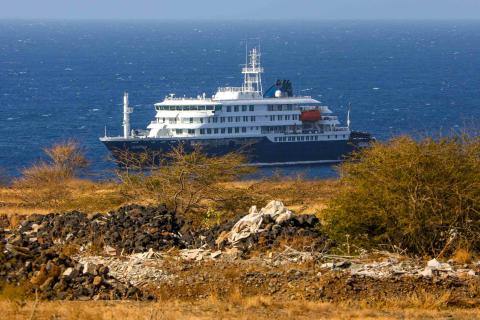
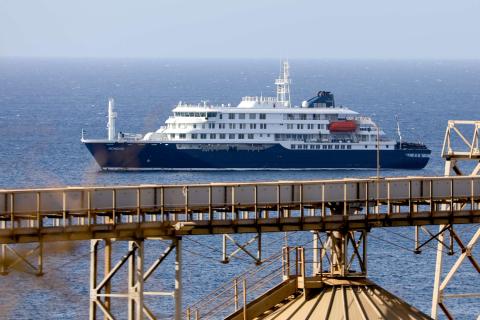
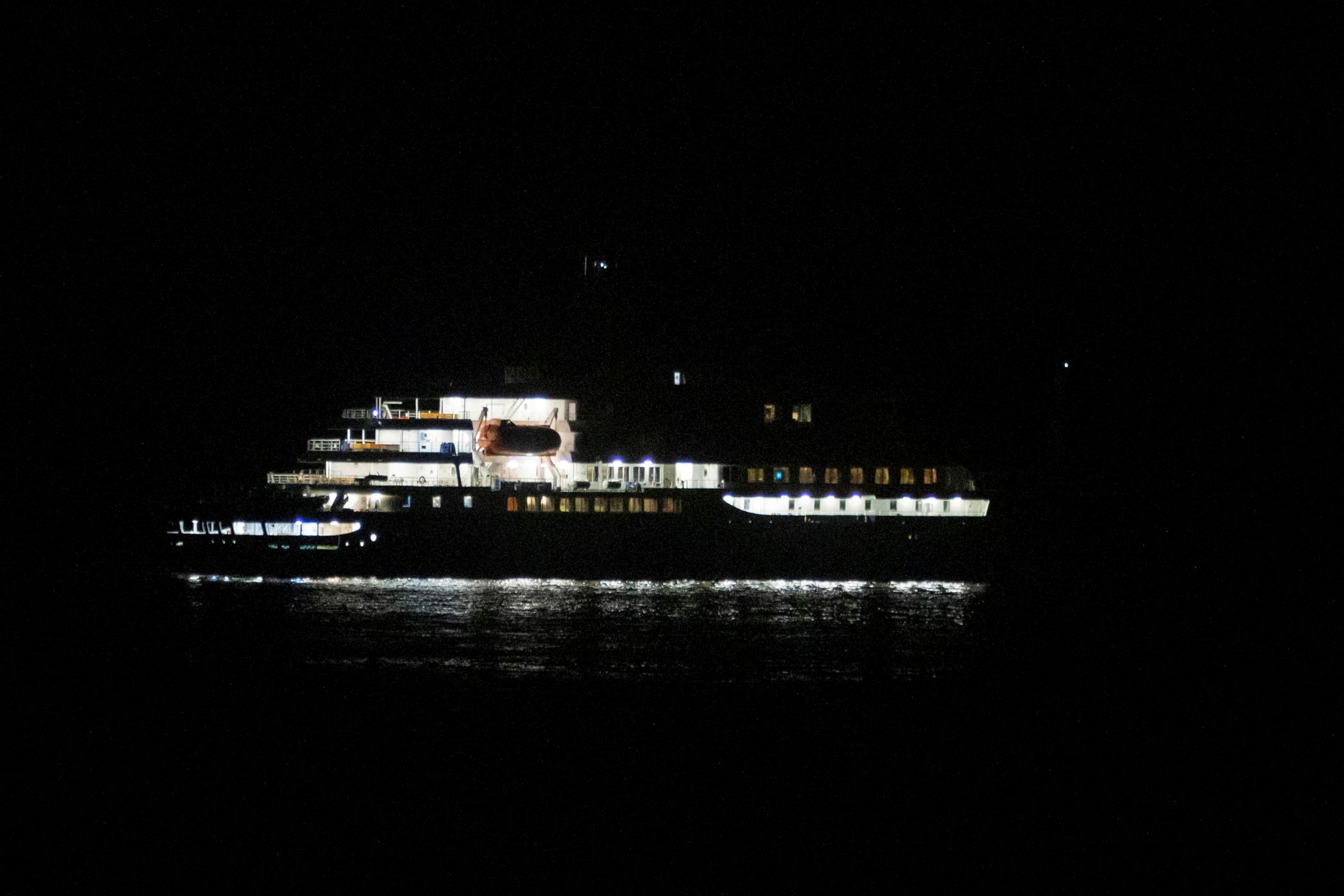
The cruise ship affected by hantavirus has arrived in Tenerife, where it will anchor to facilitate the repatriation of the passengers and part of the crew
Amid an unprecedented international security and coordination operation, the MV Hondius has arrived at the port of Granadilla, in Tenerife, where epidemiologists and members of the Foreign Health Service will examine the passengers and crew, who have not shown any symptoms of hantavirus so far. Once assessed, they will leave the ship, which is moored in a dock, in small boats to the port, grouped by nationality – they come from 23 different countries. From there, they will board military vehicles to reach Tenerife South Airport, from where they will be repatriated on various flights. The 14 Spaniards and a member of the WHO from Africa are bound for Gómez Ulla Hospital (Madrid) to undergo quarantine. Once the process is complete, the cruise ship will refuel and sail to the Netherlands with part of the crew on board and the body of one of the three fatalities.
Salvador Peiró - hantavirus Granadilla EN
Salvador Peiró
Epidemiologist, researcher in the Health Services and Pharmacoepidemiology Research Area of the Foundation for the Promotion of Health and Biomedical Research of the Valencian Community (FISABIO) and Director of Gaceta Sanitaria, the scientific journal of the Spanish Society of Public Health and Health Administration (SESPAS)
The arrival of the cruise ship carrying potential contacts of hantavirus cases – all of whom are currently asymptomatic – is being handled with the utmost caution. Given the way the operation has been organised (specific protocols for disembarkation, isolation, contact tracing and repatriation), the risk to the general public, both in Tenerife and elsewhere, can be considered virtually non-existent.
In the coming days, it is still possible that new cases may emerge in people (closely linked to known cases) who were previously exposed during the cruise or on a flight carrying symptomatic cases. No infections are expected to result from the operation carried out in the Canary Islands or from the isolation measures.
Mar Faraco - hantavirus Granadilla EN
Mar Faraco
Former president and current secretary of the Association of Foreign Medical Doctors (AMSE) and head of the Servicio de Sanidad Exterior in Huelva
The proposed protocol and the measures it outlines ensure safety for everyone. In some respects, it is overly complicated, quite possibly due to the media coverage the outbreak is receiving at local, national and international levels. A landing whilst at anchor is much more complicated for everyone involved and could be carried out safely with the ship berthed. Factors other than the protection of public health will have weighed heavily in this decision. The same applies, in my opinion, to the decision regarding strict quarantines for asymptomatic individuals in a referral hospital.
I understand these decisions—let’s call them ‘exaggerated’—given the difficulty of managing the information situation. Without being the focus of global media attention (and the pressure that such attention entails), safety could be ensured with less complexity.
José Miguel - hantavirus Granadilla EN
José Miguel Cisneros Herreros
Head of the Clinical Unit for Infectious Diseases, Microbiology and Parasitology at the Virgen del Rocío University Hospital and a researcher with the CIBERINFEC Bacterial Resistance and Antimicrobials Group and the Seville Institute of Biomedicine (IBiS)
The protocol sets out high-level measures to prevent and control this outbreak which, in a situation as uncertain as this, are justified, even if they are inconvenient for passengers in quarantine.
Pedro Arcos - hantavirus Granadilla EN
Pedro Ignacio Arcos González
Epidemiologist and Director of the Emergency and Disaster Research Unit at the University of Oviedo
The protocols that the Ministry will use for the arrival and evacuation of passengers from the ship to the Canary Islands are essentially a ‘reinforced’ version of the well-known protocols established in the literature for managing this type of situation. There is nothing new in them and they are correct, except for the extreme level of security isolation introduced, which, in this case, may have been influenced by media and political pressure regarding the handling of the case.
Consuelo - hantavirus Granadilla
Consuelo Giménez Pardo
Senior Lecturer at the University of Alcalá and Member of the Knowledge and Research Management Committee at Médicos del Mundo
Sea voyages have always, by their very nature—with people confined to small spaces in close proximity—led to the spread of infectious diseases, necessitating a period of quarantine in lazarettos before ships could enter safe harbours. The presence of rats, mice, insects and arthropods on ships has been a constant feature, mitigated over the centuries by improvements in hygiene, sanitation and environmental conditions.
However, not all infectious diseases are the same in terms of their transmissibility and lethality. We have recently seen cases of hantavirus on a luxury cruise ship where several people have fallen ill and died, causing widespread alarm; a level of media coverage not seen since the COVID-19 pandemic, indicating that fear remains. However, the movement of people, animals and trade, the increasing encroachment by humans on animal habitats, and the risk of zoonotic disease transmission—but also the speed at which we travel—means we can reach any part of the world faster than the incubation period of an infectious disease. And whilst we are aware of the transmission and low fatality rate of this virus, this will undoubtedly happen again with other pathogens – of course it will – and we must be prepared.
On the one hand, by investing in epidemiological surveillance; on the other, by applying the protocols that exist and are periodically reviewed in light of different emergency situations. Protocols such as those drawn up by this country’s government, which are aligned with the protocols set by supranational bodies such as the WHO; always based on collaboration with the top-level professional experts we have, who possess the training and experience to handle such situations, and with a healthcare system that, though strained, remains strong and capable of responding to these threats. But, above all, there is the fundamental need to work in a coordinated and constructive manner together: politicians, scientists, non-governmental organisations and civil society, understanding that this ‘war’ against infectious diseases is long and will be tough, perhaps with small victories in some battles, but one that will keep us constantly on our guard. Our survival as a species depends on it.