Extreme heat and air pollution expose nearly 40 per cent of the world’s population to dangerous levels of tropospheric ozone
The Atmosphere Watch analysis, published by the Copernicus Atmosphere Monitoring Service, shows how, in 2026, air pollution has crossed borders and caused nearly 40 per cent of the world’s population to be exposed to high levels of tropospheric ozone. This pollutant is produced when other harmful compounds react with sunlight and high temperatures. The report highlights the massive wildfires in France, Spain and Belgium this summer, which generated significant smoke transport, affecting air quality thousands of kilometres away. Furthermore, across Europe as a whole, successive heatwaves between June and August led to an increase in ozone emissions from local sources, resulting in the health protection limit values being exceeded.
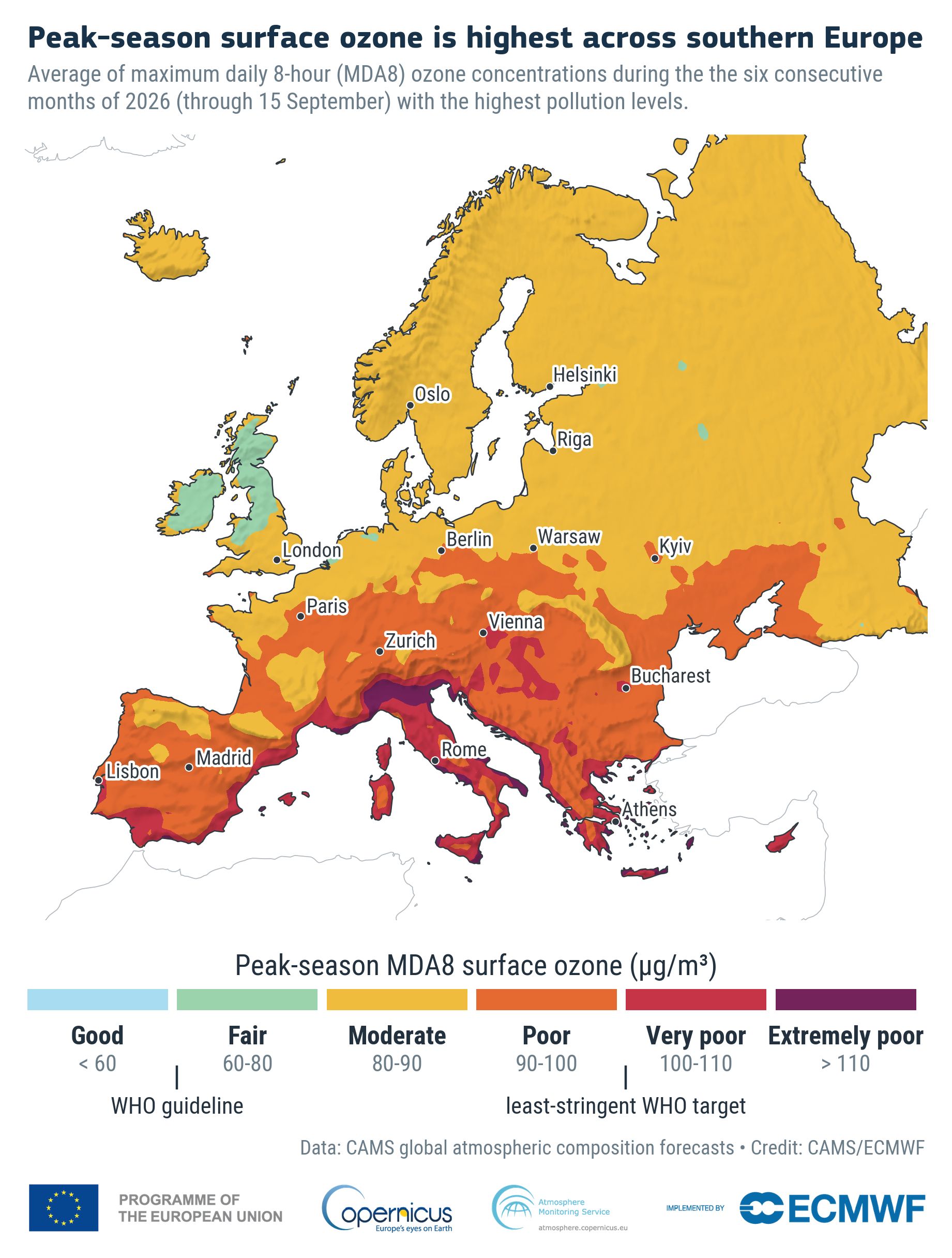
CAMS Atmosphere Watch.
Julio y Cristina - Atmosphere Watch EN
Cristina Linares
Research scientist and member of the Department of Climate Change, Health and the Urban Environment at the Carlos III Health Institute
Julio Díaz
Research professor and member of the Departament on Climate Change, Health and the Urban Environment at the Carlos III Health Institute
This study highlights a reality that is becoming increasingly evident: that global warming and its consequences have a distinctly cross-border nature.
The increase in tropospheric ozone concentrations caused by the emission of its precursors in cities from traffic and energy production, high temperatures and the forest fires themselves – with their emissions of volatile organic compounds – is leading to ever-increasing exposure of the population to this secondary pollutant. These forest fires, whose smoke can travel hundreds of kilometres from the source of the blaze, also carry particulate matter whose impact on health is more harmful than that of the particles emitted in urban environments.
On numerous occasions, in addition to heatwaves and forest fires, emissions of particulate matter of desert origin must also be taken into account. These not only impair air quality due to the increased concentrations of these particles in the air, but have also been shown to be linked to increased levels of other pollutants such as nitrogen dioxide or ozone itself.
We are therefore faced with a problem whose impact on health is not limited solely to the high temperatures associated with heatwaves, but also encompasses the impact of air pollution, the health effects of which, in some circumstances, may be greater than those of the temperature itself.
It is clear that the public health response to minimise the impact on the population must not be limited to measures targeting just one of these factors; rather, it must consist of integrated plans that bring together measures to protect public health in relation to both heat and air pollution as a whole. The cross-border nature of the naturally occurring pollution problems addressed here does not exempt the relevant authorities from taking local action to reduce anthropogenic emissions.
Ana Gamarra - informe Copernicus atmósfera EN
Ana Rosa Gamarra
Researcher in the Energy Systems Analysis Unit at CIEMAT
The report Air pollution knows no borders: what 2026 tells us about ozone, wildfire smoke and dust plumes provides an insight into recent trends in global air quality, focusing on three main topics – tropospheric ozone, wildfire smoke and dust – which are highly relevant to Europe and Spain.
This is a high-quality report, presenting findings based on open data, forecasts and analyses carried out by the Copernicus Atmosphere Monitoring Service (CAMS). The study combines satellite observations, atmospheric models and forecasts, and stands out for its ability to assess recent data on a large scale and to link a wide range of pollutants (more than 50 species), meteorology and long-range atmospheric transport. Furthermore, the report links directly to online tools and visualisers that allow users to interact with the data and results presented. As regards the results, in Europe, the report highlights that emission reduction policies have helped to lower concentrations of particulate matter, nitrogen dioxide and sulphur dioxide, whilst tropospheric ozone remains a persistent problem, exacerbated by heatwaves. In Spain, the report highlights the significance of the fires in Ávila and Madrid, associated with exceptional emissions of carbon dioxide and fine particulate matter, as well as the recurring occurrence of Saharan dust, particularly in the Canary Islands, on the Iberian Peninsula and in the Mediterranean.
A key limitation is that estimates derived from satellites and models are subject to uncertainties and need to be supplemented with observational data from local monitoring networks. Nevertheless, their findings are highly significant, with clear implications for public health. On the one hand, in terms of management measures, they support the development and improvement of early-warning systems, the special protection of vulnerable groups and coordinated fire prevention policies. On the other hand, they highlight the need to tackle sources of ozone precursor emissions, such as road traffic, and to adapt to climate change.
Isidro Pérez - informe Copernicus atmósfera EN
Isidro A. Pérez
Professor in the Department of Applied Physics and coordinator of the Atmospheric Pollution research group at the University of Valladolid
The report presents a new analysis of atmospheric data called Atmosphere Watch, focusing on the current year. Its significance lies in its global scope and its predictive capabilities. Specifically, the report highlights three areas with a potential impact on public health: ozone concentrations, smoke from fires and particulate matter concentrations.
Although the report highlights the cross-border nature of pollution, this is already a well-known fact. Therefore, it does not address new problems, but rather presents a powerful tool that will enable a better understanding of pollution situations. The key element is the significant amount of information the system processes. The report presents findings from around the world, illustrating both continental distribution and the contrasts between different regions. One notable point is that the emissions reduction strategy in Europe or North America has not been effective in reducing ozone levels, perhaps due to adverse weather conditions or forest fires.
Overall, the report’s findings could be considered preliminary, as they appear to be aimed, rather, at highlighting the potential applications of the information processed. Therefore, the data and products, which are publicly available, can be very useful to air quality managers, who will be able to take measures better suited to specific pollution situations. Furthermore, all these resources provide a solid foundation for scientists to analyse this information in greater detail and understand the atmospheric processes at the locations and times of interest.