Solar panels in space could help Europe achieve its net-zero emissions target
Space-based solar power could provide electricity to support Europe's net-zero emissions target if its cost of supply is reduced sufficiently. This is one of the conclusions of an article published in the journal Joule, by the Cell Press group. Space solar panels would allow continuous capture of solar energy, rather than only when light reaches Earth, reducing the need for wind and solar energy on Earth by 80% in Europe. The researchers estimate that by 2050, space-based solar power could reduce the costs of the European electricity system, although this depends on the development of two NASA space-based solar power designs they have used for their research: the Innovative Heliostat Swarm and the Mature Planar Array.
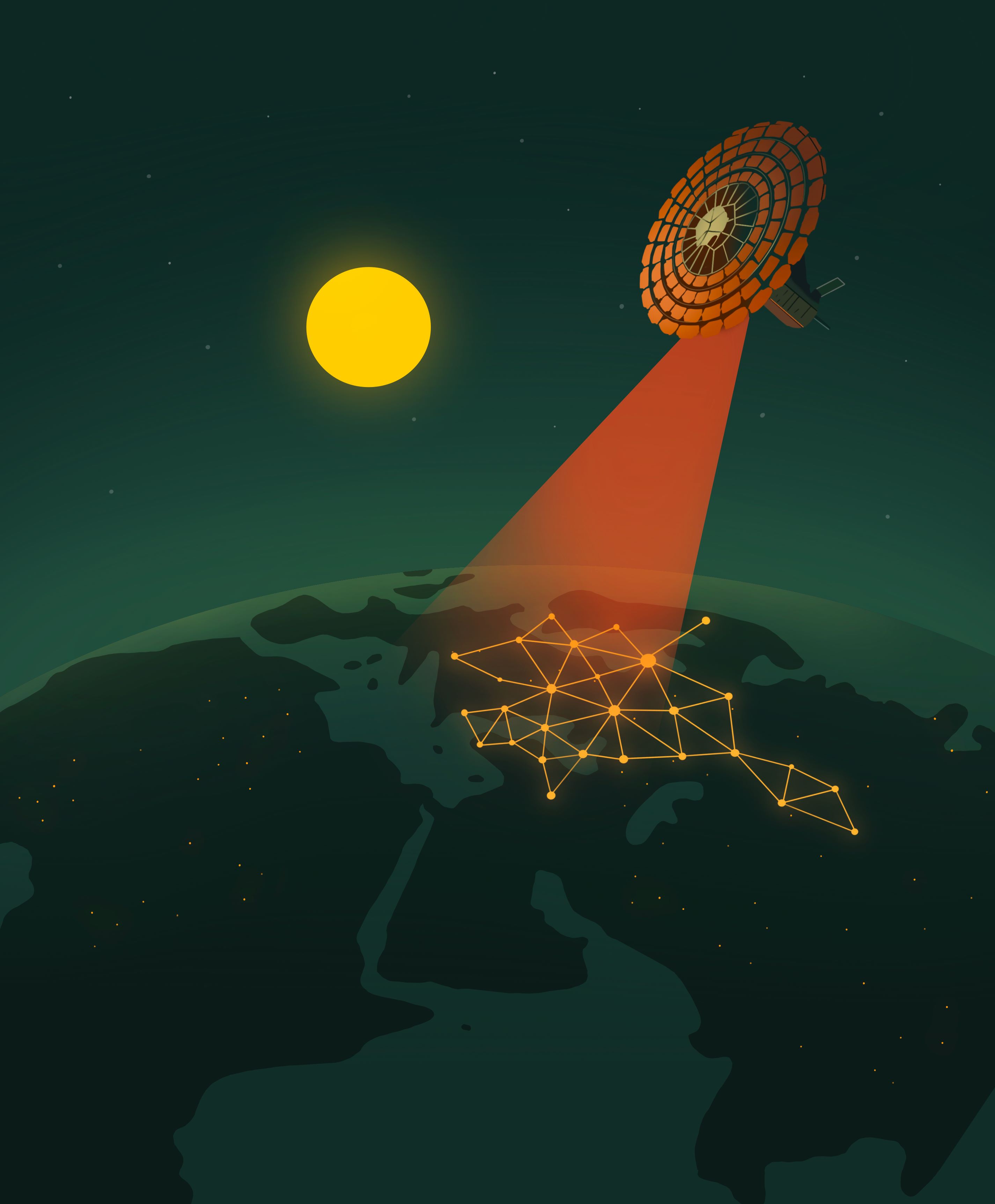
Illustration of solar space technology. Credit: Wei He.
Pep Canadell - paneles solares espacio EN
Pep Canadell
Executive Director of the Global Carbon Project and Senior Research Fellow at the CSIRO Climate Science Centre in Canberra, Australia
Transmitting energy from solar panels in space could be a great solution in our quest to achieve zero emissions. The study presents a strong case for why we should consider supporting the development of these technologies to explore their future viability.
However, the technologies needed to transmit energy from space are far from operational and require a very large investment in research and development, with no guarantee that they will ultimately work. The costs of these technologies in the study are still very theoretical and there is a high risk that they will never be economically competitive with other clean energy sources.
Thus, while it is important to invest in these new energy sources, which will benefit from what is already rapid development in aerospace technologies, we also need to accelerate the deployment of clean energies — solar and wind — that are already available here on Earth today. We know how to cover the millions of roofs that exist in industrial estates and homes, and we know how to build highly efficient wind, solar and battery farms. What we should not do is wait for a possible future technology to solve today's problems.
Olga Zamora - paneles solares espacio EN
Olga Zamora
Support astronomer at the Canary Islands Institute of Astrophysics
The article by Che et al. provides a detailed analysis of the economic viability of two large space designs oriented towards the Sun (11.5 km2 solar panels in geostationary orbit!) proposed by NASA, with the aim of generating solar energy in space and transmitting it to Earth. The idea is very old (1968) and well known in the sector (e.g. the European Space Agency's Solaris project) but had always been considered unfeasible due to the high economic cost and technological challenges. In fact, the article by Che et al. does not address detailed technical issues, such as potential problems in construction, launch, orbit insertion, orbital assembly, space debris generation, the need for new regulatory frameworks, the feasibility of wireless radio transmission to Earth, and the potential impact on astronomy. All of these issues are of vital importance in a project of this calibre.
The most favourable design proposed in the article, according to energy models, is a heliostat with a modular “hive” structure, with multiple hexagonal reflectors operating independently to redirect light towards a central solar concentrator. The modules would offer continuous energy availability of almost 99% per year. The technology required is not easy to develop, although the authors assume that it could be available by 2050, in a fairly optimistic extrapolation. The savings that developing this space-based system would bring to the European energy grid would be 7%–15% by 2050, with energy produced by giant space panels becoming dominant, making its use in the transition of the energy system highly relevant.
Xinyang Che et al.
- Research article
- Peer reviewed