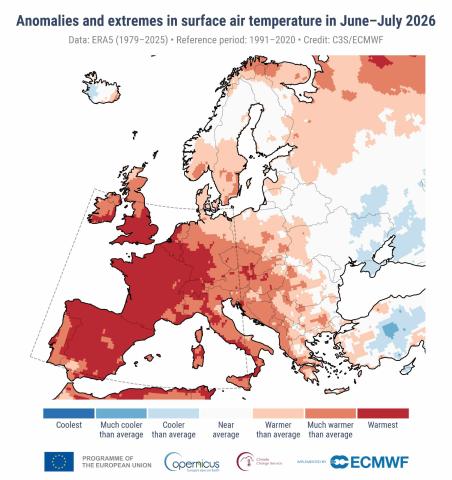
The summer of 2026 resulted in more than 50,000 heat-related deaths in Europe, two-thirds of which were attributable to climate change
More than 50,000 people died as a result of extreme heat in European towns and cities during the summer of 2026 – the highest figure recorded to date – according to two new studies published in Nature Health. After analysing 854 urban areas across 30 countries (the EU-27, the United Kingdom, Norway and Switzerland), researchers from Imperial College and the London School of Hygiene & Tropical Medicine (United Kingdom) have concluded that climate change resulting from the burning of fossil fuels is responsible for two-thirds of these deaths. The five countries most affected were, in this order, Italy, France, Spain, Germany and the UK. According to these studies, 6,824 people died from heat-related causes in Spain this summer — 1,000 more than estimated by the MoMo system — of whom 77 per cent can be attributed to climate change.
David García - muertes calor Europa EN
David García García
The study is highly significant because it presents estimates of heat-attributable mortality in numerous European cities using a common methodological framework. This is a valuable contribution, as it enables results to be compared across regions and allows patterns and differences to be identified on a continental scale, thereby contributing to our understanding of the health impacts of heat and its link to climate change.
However, it is important to bear in mind that these are estimates based on observed temperatures and epidemiological models, which do not incorporate actual data on deaths that occurred in the summer of 2026. Furthermore, the methodology bases the attribution to heat on the temperature associated with minimum mortality, which may result in high estimates. In public health, temperature thresholds associated with significant increases in risk are typically used to estimate the impact; these allow us to identify when heat begins to have a significant impact on mortality. The results are therefore valuable for assessing the potential impact of heat and climate change in Europe, but they should be interpreted with the methodological approach in mind and distinguished from observed mortality data and the estimates provided by official sources for Spain.
Sociedad Española de Epidemiología - muertes Europa
The insightful article Heat-related urban mortality attributable to human-induced climate change in Europe in summer 2026 highlights the record impact of heatwaves on mortality in Europe, with excess deaths exceeding the combined total from the previous heatwaves of 2003 and 2022. The heatwaves of 2026 significantly affected not only the elderly but also young adults. This research highlights a temperature rise of 2.6 °C in southern Europe (which already exceeds the 1.5 °C threshold set by the international Paris Agreement) and covers some 22 million people across 44 Spanish cities, for which they estimate an excess mortality of 6,824 deaths (during the months of June to August), 77 per cent of which are attributable to anthropogenic warming, primarily due to the combustion of fossil fuels.
The authors compare their methodology with the official environmental monitoring systems in Spain, France and the United Kingdom. They emphasise the need for public policies to tackle the climate emergency with a clear ‘zero emissions’ target. It should be recalled that in Spain, the heatwaves of October 2024 and 2026 caused 232 and four deaths respectively; the 21st-century mega-forest fires (covering more than 500 hectares) were associated with around 70 deaths. Furthermore, the Spanish daily mortality monitoring system (MoMo) attributed 4,744 deaths in 2022, 3,009 deaths in 2023, 3,832 deaths in 2025 and 5,807 deaths in 2026 to the high temperatures recorded (all of which occurred between 15 May and 30 September). We hope that future research will examine the effect of heatwaves on specific causes of death throughout the year and that Spain will be in a position to participate
Óscar Zurriaga - muertes calor Europa verano EN
Óscar Zurriaga
Research Fellow Emeritus at the FISABIO Foundation (Valencia), retired senior lecturer in the Department of Preventive Medicine and Public Health at the University of Valencia, and a member of the Spanish Society of Epidemiology
The article carries out an analysis estimating heat-attributable mortality for the months of May to August 2026. It uses estimation methods based on recent literature and previously validated techniques. Estimates are always likely to vary depending on the methods used and, above all, on the underlying data. For this reason, they should never be taken as absolute and immutable figures. Nevertheless, I believe the trend shown in this study can be considered reliable and well-established. This study has only considered 854 cities in Europe, covering 40 per cent of the population across 30 countries; consequently, we have no information on the remaining 60 per cent of the population in those countries, who live in non-urban areas.
What the authors demonstrate – whilst noting that their estimate is conservative – is that this summer has, so far, been the worst experienced by European cities to date, and that the number of additional heat-related deaths has been higher than in other summers previously considered the worst (2003 and 2022). The authors attribute this to the successive heatwaves that have occurred this season.
A notable aspect of this study is that, in many countries, the most extreme episode occurred in June. The authors attribute this to the fact that, at this early stage of the season, the population may be less acclimatised to extreme heat. They mention two further factors to consider in explaining this effect: extremely high humidity and unusually high night-time temperatures.
In short, this study once again highlights the impact of extreme temperatures on mortality across Europe and should spur the institutions responsible for safeguarding public health and combating emissions causing global warming into action. Some of the findings mentioned in this study, such as the possible effects at times almost outside the summer season (the population’s acclimatisation, excessive humidity and nights with high temperatures), should also be taken into account in public advice and measures, as well as in the adaptation of homes and climate-resilient shelters.
Conflicts of interest: ‘My declaration of interests can be viewed here’.
Barnes et al.
- Research article
- Peer reviewed
Barnes et al.
- Peer reviewed
- Research article