AI designs functional bacteriophages from scratch
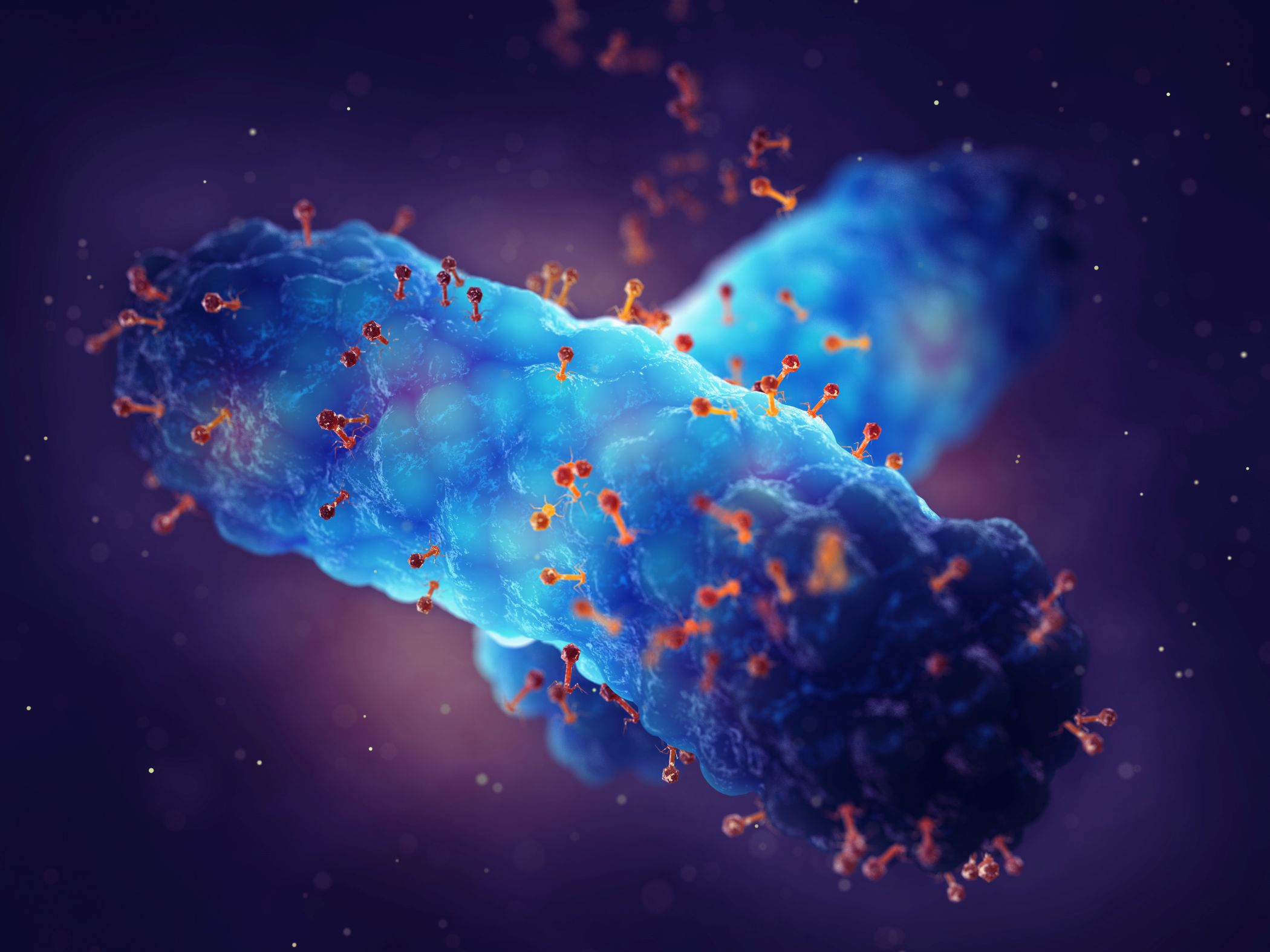
A team of researchers has designed complete and functional genomes for bacteriophages — viruses that feed on bacteria — from scratch using generative artificial intelligence (AI), and has tested them against bacteria that had developed resistance to this type of virus. The study, published in the journal Science, represents a step forward towards generative systems capable of designing complete biological systems. The authors also state that it raises important questions regarding biosafety and biosecurity.
Víctor Lorenzo - Bacterias IA
Víctor de Lorenzo
CSIC Research Professor at the National Center of Biotechnology
The work by King et al. is one of the first examples of the potential of what is beginning to be termed generative genomics: the computational de novo design of microbial genomes — and, predictably, in the future, of eukaryotic genomes as well — to endow them with specific functions. As has been the case at other points in the history of biology, the first demonstrations of this type of advance are carried out in relatively simple systems, in this case bacteria and bacteriophages.
In my view, the study’s most significant scientific contribution is not merely the technical success achieved, but the demonstration of a much deeper principle: natural evolution has explored only a small fraction of the potential functional space. Consequently, it is possible to conceive and construct chromosomes and biological systems with architectures, compositions and functional properties that differ substantially from those we know in nature. This idea extraordinarily broadens the horizons of synthetic biology and redefines our conception of what constitutes a possible genome.
The article describes the rapid development of bacteriophages capable of eliminating pathogens against which the conventional antibiotic arsenal is no longer effective. Against a backdrop of growing antimicrobial resistance, this possibility represents a contribution of enormous biomedical value. However, the same technology also highlights the dilemma posed by disruptive innovations. The ability to design viruses targeted against pathogenic bacteria implies, by the same logic, the possibility of generating viruses targeted against beneficial microorganisms or essential components of the microbiome. Furthermore, if these strategies were to be extended to viruses with tropism for eukaryotic cells, opportunities such as the design of highly specific oncolytic viruses would arise, but so too would worrying scenarios, such as the creation of viruses with selective affinity for certain cell types, tissues or even population groups.
These possibilities do not call into question the enormous scientific value of the work, but they do raise legitimate questions about biosafety, governance and the regulatory framework that should accompany the development of generative genomics. As has repeatedly been the case in the history of science, the same technology can serve to solve problems or, in the absence of adequate precautions, become a source of new risks. The challenge lies not only in expanding our technological capabilities, but also in developing the regulatory and social mechanisms that will enable us to harness its benefits whilst minimising potential misuse.
Jordi Ojalvo - Bacterias IA
Jordi García Ojalvo
Professor of Systems Biology at the Pompeu Fabra University of Barcelona
The press release accurately reflects the content of the article, although it focuses heavily (from the very first sentence) on microbial resistance – which is only part of the findings – and on biosafety issues, which, again, are only part of the discussion. The breakthrough achieved is significant, as it demonstrates that a complete functional genome can be designed from scratch using generative AI, but there are a few points to consider.
Firstly, the efficiency of the process is low: out of thousands of genomes generated, only 16 viable phages are obtained (it could be argued that the rest are ‘hallucinations’ of the model – at least the remaining 300 genomes tested in the laboratory, out of the thousands designed). It is to be hoped that future versions of this procedure will improve efficiency, but it is unclear whether a qualitative leap will be achieved, as the data available to these genomic language models is (and will remain) limited. This low efficiency is reminiscent of Yamanaka’s stem cell reprogramming, for which he was awarded the Nobel Prize in 2012; whilst efficiency has been gradually improving, 14 years on it remains low (in this case, with generative AI, it is more difficult to implement).
Secondly, from a biosafety perspective, in my opinion the risk here is lower than with traditional LLMs, as the designed genomes must be tested in the laboratory one by one, as was done in the article, and, as I have said, the efficiency is low. It is difficult to imagine these models automatically generating viable genomes ‘out-of-the-box’.
Finally, I would also like to emphasise that these advances do not help us understand why some genomes are viable and others are not. Understanding is a human capacity, and in this respect, generative AI cannot replace us.
Marc Güell - Bacterias IA
Marc Güell
Coordinator of the Translational Synthetic Biology research group and ICREA research professor at Pompeu Fabra University (UPF)
The study is of a very high standard. The laboratory leading it is at the forefront of generative AI applied to biology. In my laboratory, Synbio Lab at the UPF in Barcelona, we are regular users of the generative AI tools developed by Hie and colleagues. Their DNA LLMs are the most advanced in the world.
The experiments designed to demonstrate the results experimentally appear to be very well conducted.
This is another step towards the bio-design capabilities of generative AI. We are witnessing a very significant turning point. For the first time in history, we are beginning to design biology on a computer. Until now, we could read and rewrite, but we could not generate new synthetic content. Thanks to AI, we are beginning to move away from relying exclusively on bioprospecting. It has been demonstrated that we can already design relatively small synthetic biological systems such as proteins (synthetic binders, synthetic Cas9, synthetic transposases or synthetic enzymes); here, they go a step further by designing an entire synthetic phage comprising more than ten proteins and a genome of thousands of bases. It is an exciting time.
The study appears to be very robust. Being able to design biology on a computer allows us to dream of exciting possibilities for tackling humanity’s greatest challenges. Synthetic binders have been created that mimic the antibodies used in immunotherapy; for example, synthetic Cas9 enzymes are being applied to treat genetic disorders, whilst synthetic phages could lead to potential antibiotic therapies.
Juli Peretó - Bacterias IA
Juli Peretó
Professor of Biochemistry and Molecular Biology at the University of Valencia
This research represents a step forward in the ability to design synthetic genomes using generative AI tools. It demonstrates that an AI can be trained using natural genomes (in this case, from bacteriophages that attack the bacterium Escherichia coli), in the same way that generative AIs can be trained using text, so that the resulting algorithm is capable of generating new genomes that comply with a set of pre-established rules (for example, that they retain their ability to infect E. coli).
Until now, synthetic genomics relied on ‘plagiarising’ a natural genome (such as the genome of Venter’s minimal cell) into which modifications were introduced. Now, the computational system can draw on thousands of genomes and allows us to explore a vast space of possibilities by generating new genomes that are similar to natural ones but possess new properties. The authors have succeeded in synthesising some of these artificial viruses and demonstrating that they can infect resistant strains of the bacterium. This opens up fantastic opportunities for phage therapy.
The authors do not shy away from biosafety considerations and have themselves followed a very strict working protocol, with precautions going beyond those required by law. Undoubtedly, synthetic biology requires a very rigorous bioethical debate to ensure that research is carried out, as the authors state, for the benefit of science and society.
King et al.
- Peer reviewed
- Research article