Froila M. Palmeiro

Sea surface temperatures have reached record levels for this time of year
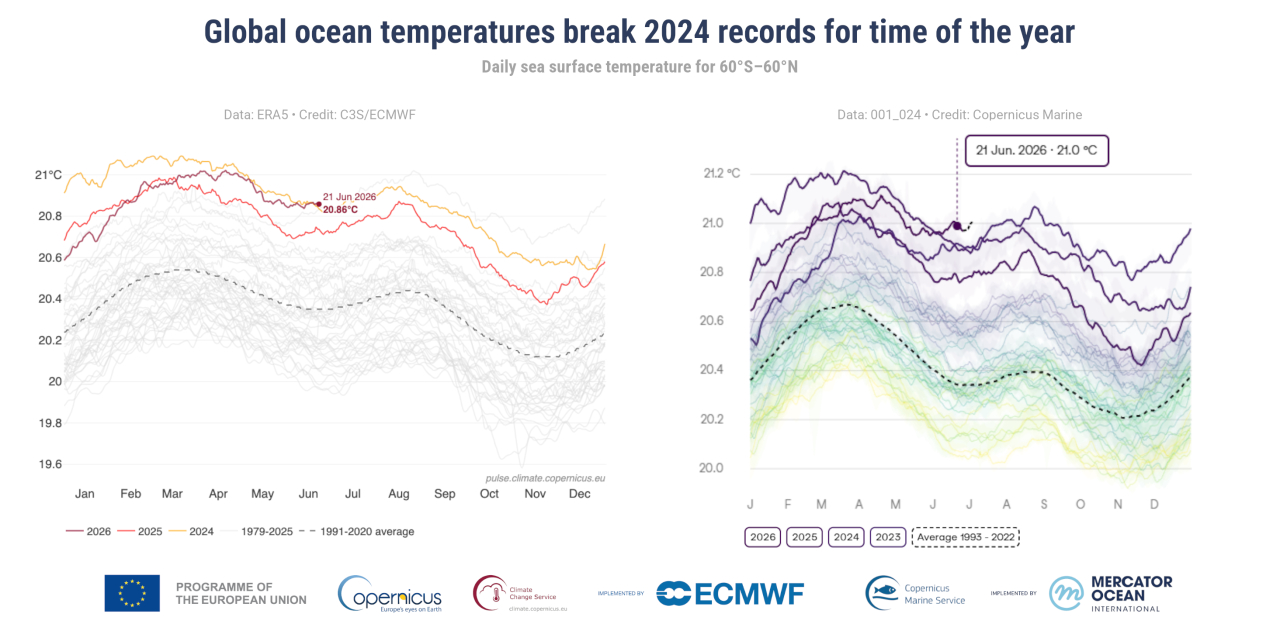
Two Copernicus services have independently confirmed that global sea surface temperatures have broken records for this time of year. Daily data from the Copernicus Climate Change Service exceeded the 2024 levels on 21 June, reaching 20.86 °C, higher than the 20.83 °C recorded in 2023 and 2024. Data from the Copernicus Marine Watch Service show temperatures of 21.0 °C on 21 June, beating the 2023 and 2024 records by 0.1 °C. This unprecedented warming is linked to the onset of El Niño (announced by the WMO and declared by NOAA on 11 June) and to record-breaking sea surface temperatures in the North Pacific; consequences are anticipated for weather patterns, the global climate and marine ecosystems.

0
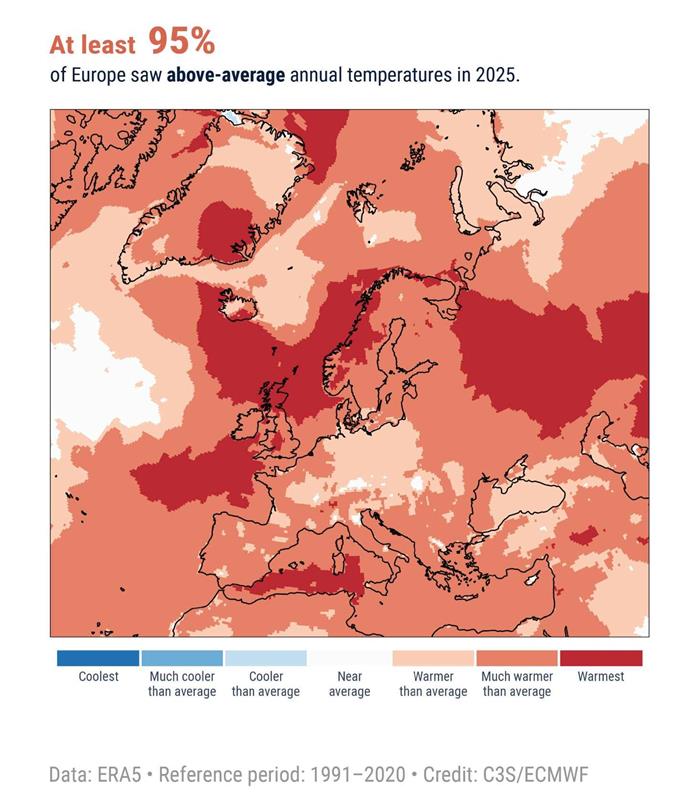
95% of Europe experienced above-average annual temperatures in 2025

Rapid warming in Europe is reducing snow and ice cover, while very high air temperatures, drought, heatwaves, and record ocean temperatures are affecting regions from the Arctic to the Mediterranean. These are the main findings of the State of the Climate in Europe (ESOTC) 2025 report, prepared by the European Centre for Medium-Range Weather Forecasts (ECMWF), which operates the Copernicus Climate Change Service, and by the World Meteorological Organization (WMO). The data show that 95% of the continent recorded above-average annual temperatures last year, and river flows were below average for 11 months.

0

Extreme weather events in 2025 pushed adaptation capacity to its limits

In 2025, climate change drove extreme weather events around the world, disproportionately affecting vulnerable and marginalised communities. In addition, global temperatures were exceptionally high, heatwaves were significantly more intense than 10 years ago, and millions of people were pushed to the limits of their ability to adapt. These are the main conclusions of the 2025 report published by the World Weather Attribution initiative, whose experts believe that ‘drastically reducing fossil fuel emissions remains the key policy for avoiding the worst impacts of climate change’.


0

European State of the Climate highlights record temperatures and heavy rainfall in 2024

The year 2024 was the warmest year in Europe, with record temperatures in almost half of the continent, according to the European State of the Climate 2024, published by the Copernicus Climate Change Service (C3S) and the World Meteorological Organization (WMO). The report highlights 2024 as one of the ten wettest years since 1950 and estimates that storms and floods affected 413,000 people in Europe and at least 335 people lost their lives.

0