Sea surface temperatures have reached record levels for this time of year
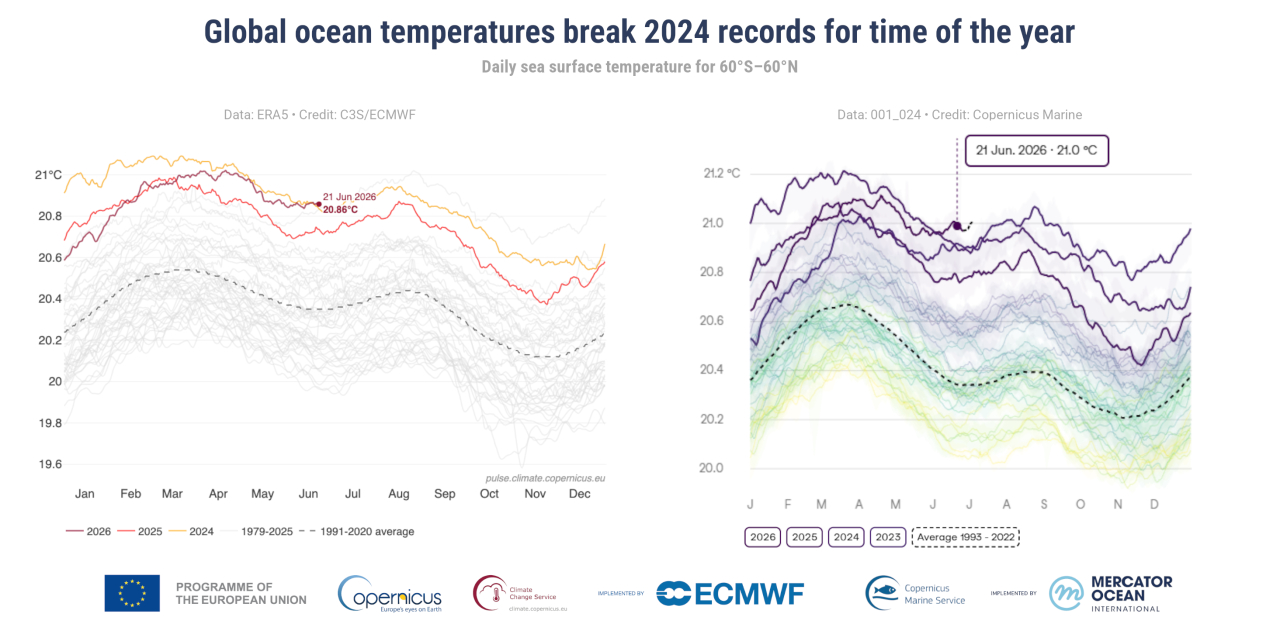
Two Copernicus services have independently confirmed that global sea surface temperatures have broken records for this time of year. Daily data from the Copernicus Climate Change Service exceeded the 2024 levels on 21 June, reaching 20.86 °C, higher than the 20.83 °C recorded in 2023 and 2024. Data from the Copernicus Marine Watch Service show temperatures of 21.0 °C on 21 June, beating the 2023 and 2024 records by 0.1 °C. This unprecedented warming is linked to the onset of El Niño (announced by the WMO and declared by NOAA on 11 June) and to record-breaking sea surface temperatures in the North Pacific; consequences are anticipated for weather patterns, the global climate and marine ecosystems.
Fuente: Copernicus
260701_Alicia Pérez-Porro_mar copernicus
Alicia Pérez-Porro
Marine biologist, responsible for policy interaction and institutional relations at the Centre for Ecological Research and Forestry Applications (CREAF) presente in Belém (Brazil)
The ocean is an integral part of our climate system; understanding the changes it is undergoing and monitoring them is essential to being able to predict, in the short, medium and long term, how these changes will affect us.
In the geopolitical context, the Copernicus marine and climate change monitoring system is a tool that must be preserved and strengthened. Now that one of the major scientific powers – until recently the US – has not only threatened to dismantle its counterpart programme at NOAA, but is also launching a full-scale attack on science and the professionals dedicated to it, it is time for Europe to step up, including in the marine sector.
260701_Carlos García-Soto_mar copernicus
Carlos García-Soto
Researcher at the CSIC (IEO), responsible for the Ocean-Climate System Assessment Unit and collaborator in international United Nations processes on climate change and oceans, including the Climate Change COPs
The data presented by Copernicus are robust because they come from two independent observation systems that reach the same conclusion. Furthermore, the result is consistent with what would be expected in a context of sustained ocean warming, upon which a new El Niño episode is now beginning to take effect. Rather than an isolated data point, this record should be interpreted as the result of the interaction between the natural variability of the climate system and the sustained warming of the ocean due to climate change.
These observations are consistent with a Correspondence published in Nature on 18 June, in which I argued that the main risk posed by future El Niño events may not be a more intense El Niño, but rather an El Niño acting on an ocean that has already accumulated an exceptional amount of heat. In this context, impacts such as marine heatwaves, droughts, floods, wildfires or crop losses – which traditionally tended to be more staggered over time and across regions – may occur increasingly simultaneously, placing greater pressure on ecosystems and on our societies’ capacity to respond.
This paper sets out three priorities for public policy. Firstly, to prepare to cope with simultaneous climate impacts across different regions and sectors. Secondly, to safeguard the recovery times of response systems that are already operating close to their limits. And, finally, to explicitly incorporate persistent ocean heat into climate risk planning and coordination during major El Niño events.
260701_Ángel Borja_mar copernicus
Ángel Borja
Principal Researcher in the area of Environmental Management of Seas and Coasts at AZTI and editor-in-chief of the journal Frontiers in Ocean Sustainability
Globally, data from Copernicus and the CMEMS are amongst the best currently available for the ocean surface, alongside those from the US NOAA; these data can therefore be considered very reliable. They are usually derived from a combination of satellite data, buoys and models, and general analyses of all these sources.
The results reinforce the evidence we have had for a long time, both globally and at a more local level. For example, here in the Bay of Biscay we have data showing warming of 0.1 to 0.25 °C per decade, down to a depth of 100 m, which indicates that the problem is even greater than that illustrated by Copernicus, since the latter’s data only covers the surface. This suggests that the ocean is beginning to warm very rapidly, as such high average temperatures, at such an early stage as late spring, have never been recorded before. The methodology used is sufficiently standardised to conclude that there are no limitations that need to be taken into account in the study.
In any case, the implications are numerous, and the article takes them fully into account. This will accelerate the northward migration of species, leading to the arrival in our waters of subtropical species, including invasive species (as is currently happening with some, such as the alga Rugulopteryx okamurae). All of this has an impact on the services we derive from marine ecosystems (such as changes in fish stocks, protection against extreme events, etc.) and also on human health, the potential for an increase in torrential rainfall, etc., which will require more public and private resources to mitigate the effects. Ultimately, this is simply further evidence that we must take action against climate change by reducing emissions. Turning a blind eye to this is suicidal for our species.
260701_Froila M. Palmeiro_mar copernicus
Froila M. Palmeiro
Researcher at the Institute of Geosciences, IGEO (CSIC-UCM)
Thanks to coordinated climate services such as the Copernicus Marine Environment Monitoring Service (CMEMS), we know that the average ocean temperature has now exceeded normal levels for this time of year for twelve consecutive years. This year we are witnessing a historic record, fuelled in part by the development of the El Niño phenomenon in the equatorial Pacific. This event is expected to be more intense than usual, which has led to the coining of terms such as ‘super El Niño’ or ‘Godzilla El Niño’. Beyond the sensationalism of these labels, El Niño is a cyclical phenomenon with significant local and remote impacts, the influence of which is likely to further increase the global average atmospheric temperature by 2027.
260701_Sergio Moreno Borges_mar copernicus
Sergio Moreno Borges
Technician at the Spanish Institute of Oceanography (CSIC) and researcher with the BIOECOMAC group (University of La Laguna)
This publication alerts us to the current global climate situation and to the possibility of an acceleration in the rise in sea surface temperatures over the coming months and years.
The data presented are based on observations recorded by satellites, ships and in situ sensors, and were analysed independently by two services within the Copernicus programme (C3S and CMEMS), yielding very similar results. This underscores the reliability of the information presented.
As for the implications of these observations, as the authors mention, the upward trend in sea surface temperature, which has been ongoing for years, appears to be accelerating, partly driven by the onset of a new El Niño event. Although there is always a certain degree of uncertainty in any forecast, everything seems to indicate that temperature records will continue to be broken over the coming months and years, accompanied by more intense and less predictable weather events.
The current climate situation is having significant repercussions on every aspect of our lives. For some time now, we have been experiencing numerous events and phenomena that are a direct consequence of climate change – such as desertification, flooding, heatwaves and the disruption of ecosystems – and which directly affect our day-to-day lives. Therefore, the existence of such agencies and research programmes is essential for society, as they act as early-warning systems for these climate events and enable us to be better prepared for the weather scenarios we are likely to face in the near future. Furthermore, they provide key information for making more informed decisions aimed at mitigating this situation in the short, medium and long term.
260701_Javier Lillo Ramos_mar copernicus
Javier Lillo Ramos
Honorary collaborator of the consolidated research group on Terrestrial Global Change and Environmental Geology at Rey Juan Carlos University.
Data from the Copernicus Climate Change Service (C3S) and the Copernicus Marine Environment Monitoring Service (CMEMS) on global sea surface temperatures (SST) for this time of year are extremely worrying. Firstly, because the levels recorded exceed the record levels observed in 2023 and 2024. Secondly, because they confirm the trend towards rising ocean surface temperatures in extrapolar regions in recent years. The unprecedented record set this year may be linked to the combined effect of global warming itself and a particularly intense El Niño event.
Record figures are expected to be reached in the coming months, although the evolution of El Niño within the ocean-atmosphere context of the ENSO (El Niño-Southern Oscillation) could influence this trend. However, should these figures be confirmed, a warmer ocean surface will have a very serious impact on rainfall patterns and heatwaves, leading to a greater occurrence of very intense events with highly irregular spatial and temporal distribution, in addition to the effects on the dynamics of ocean currents, which are governed by water temperature and salinity. Such changes would in turn have severe impacts on ecosystems and fisheries productivity.
260701_Víctor Resco_mar copernicus
Víctor Resco de Dios
Lecturer of Forestry Engineering and Global Change, University of Lleida and researcher at Agrotecnio
Almost all the fossil fuel energy we are burning ends up in the ocean. In other words, the oceans absorb more than 90 per cent of the heat resulting from anthropogenic climate change. Were it not for them, the temperature at the Earth’s surface – where we live – would be even higher. But this does not come entirely free of charge. This increase in ocean heat ultimately boosts the energy with which storms strike, making us far more vulnerable to flooding. It also seriously disrupts all marine life.