Carlos García-Soto

Carlos García-Soto

Carlos García-Soto
Position

Researcher at the CSIC (IEO), responsible for the Ocean-Climate System Assessment Unit and collaborator in international United Nations processes on climate change and oceans, including the Climate Change COPs

Researchers are exploring the possibility of whitewashing marine clouds to alter climate events such as El Niño

Targeted marine cloud bleaching is a proposed geoengineering method to increase the amount of light reflected by clouds and reduce the heat reaching Earth. A US team has taken advantage of a natural experiment that generated this effect—through aerosols produced by the massive Australian bushfires of 2019 and 2020—to study the possibilities and risks of using it to modify an extreme weather event like El Niño. According to the models used in the study, its early application could weaken El Niño, but it could also have unintended consequences, such as altering the timing and increasing the magnitude of the subsequent La Niña event. The work is published in Science Advances.

0

Sea surface temperatures have reached record levels for this time of year

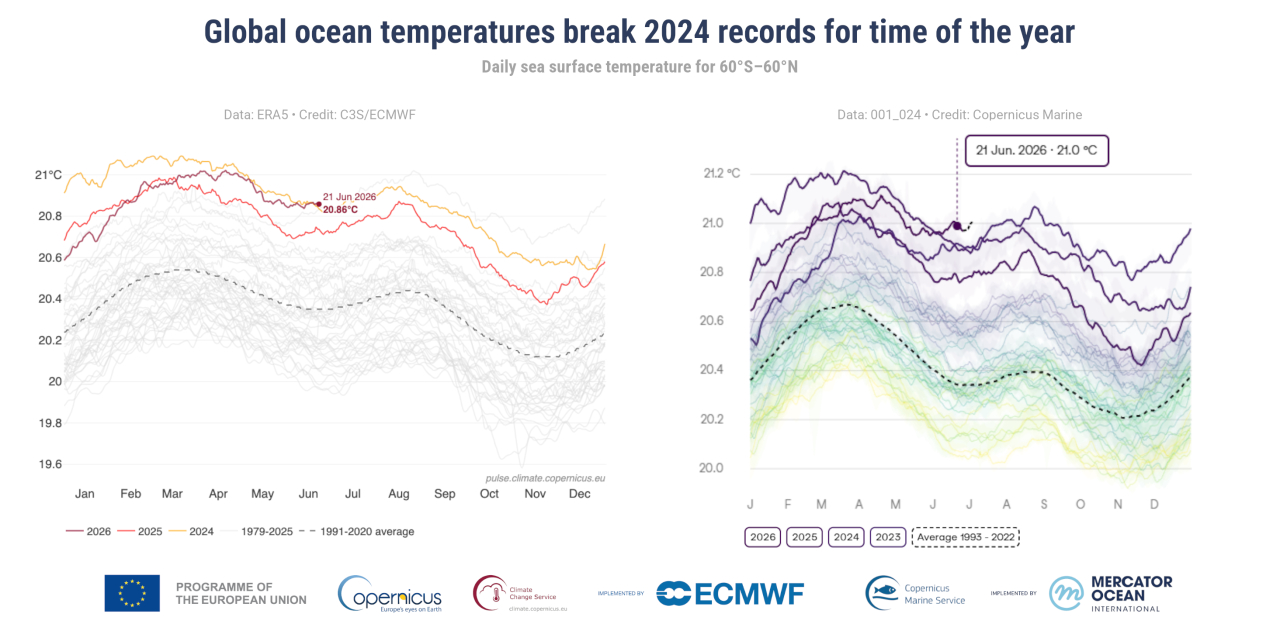
Two Copernicus services have independently confirmed that global sea surface temperatures have broken records for this time of year. Daily data from the Copernicus Climate Change Service exceeded the 2024 levels on 21 June, reaching 20.86 °C, higher than the 20.83 °C recorded in 2023 and 2024. Data from the Copernicus Marine Watch Service show temperatures of 21.0 °C on 21 June, beating the 2023 and 2024 records by 0.1 °C. This unprecedented warming is linked to the onset of El Niño (announced by the WMO and declared by NOAA on 11 June) and to record-breaking sea surface temperatures in the North Pacific; consequences are anticipated for weather patterns, the global climate and marine ecosystems.

0

What happens to the ocean affects the entire planet: towards a Blue COP31

As discussions around a possible “Blue COP31” gain momentum, a recent analysis published in Nature Portfolio warns that record ocean heat, intensifying marine heatwaves and accelerating sea-level rise are beginning to challenge international systems designed for a far more stable climate reality. The analysis proposes several priority actions to integrate the ocean more directly into international climate governance.

1

Marine heatwaves cause an annual decline of almost 20% in fish biomass

New research analysing more than 33,000 fish populations in the northern hemisphere between 1993 and 2021 reveals that chronic ocean warming is driving a long-term decline in biomass of up to 19.8% per year for species in the Mediterranean, North Atlantic and North-East Pacific. At the same time, in the short term, more fish are thriving in cold areas due to the heat, but these increases are temporary and the authors warn that relying on them would lead to unsustainable exploitation. The study, by the National Museum of Natural Sciences (MNCN-CSIC) and the National University of Colombia, is published in Nature Ecology & Evolution.


0

Reactions: Oceans Treaty goes ahead after more than 15 years of negotiations

The deadline passed and after two marathon nights of meetings, the delegations of the UN member states have managed to reach an agreement to make the so-called Oceans Treaty - or BBNJ Treaty, Biodiversity Beyond National Jurisdiction - a reality. New York City has seen the fifth session of this conference bear fruit with an agreement on the wording of the text, seventeen years after the talks began and with negotiations stalled last August due to a lack of agreement. The Treaty aims to protect and regulate the use of areas beyond national jurisdiction, which account for more than 60% of the oceans, or almost half of the planet. Marine genetic resources and how to share these benefits has been one of the main stumbling blocks.

0