Climate change is causing unprecedented sea temperatures in Europe, increasing the risk of destructive events
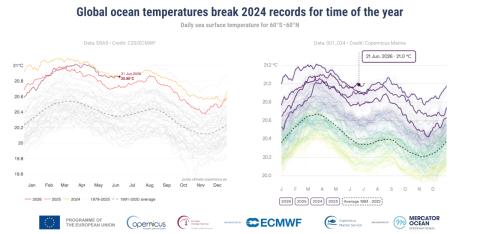
An international team has analyzed sea surface temperatures in the Atlantic Ocean and at various points in the Mediterranean Sea. The analysis, published by World Weather Attribution (WWA), shows that this year's temperatures have been extraordinary, both in their intensity and how early they have reached such magnitude. This behavior is not only having an ecological impact on marine life, the authors state, but could also exacerbate potentially destructive regional climate events like those that occurred in Valencia in 2024.
Borja - WWA mares
Ángel Borja
Principal Researcher in the area of Environmental Management of Seas and Coasts at AZTI and editor-in-chief of the journal Frontiers in Ocean Sustainability
The research follows in the footsteps of previous studies in the same vein, using the same protocols and standards of the WWA (World Weather Attribution). The data used are in the public domain, allowing for the reproducibility of the research. In this sense, I consider the research robust and provides an updated overview of the situation in the Mediterranean and the Northeast Atlantic up to this past summer. This makes it a very timely article for understanding what we are facing.
Overall, the article adds new evidence to what was already known, such as the fact that marine heatwaves have been increasing in recent decades and years and that they have an anthropogenic origin. Regarding the implications of this phenomenon, the authors provide a good overview of practically all of them, including updated literature. For example, in the Horizon Europe project that I coordinate (GES4SEAS), we have published several articles on heatwaves, especially in the Mediterranean, and the conclusions are similar (the authors of this report cite one of our articles).
I find it particularly interesting that the Iberian Peninsula (both on the Mediterranean and the Atlantic coasts) is the region that suffers and will continue to suffer the most from these extreme weather events, since, as the authors state, we will face numerous problems: torrential rains, changes in the species and habitats along our coasts, an increase in invasive species, problems for human health, etc. We have been seeing these effects for some years now, and they will certainly increase, but it seems to be a problem that society doesn't care about and that some populist politicians deny, with the consequences this will have on short- and medium-term decision-making.
In the area where I work, the Basque Country, this year we already had 25°C water temperatures at the end of June, and during the summer it has remained practically at 24°C. Previously, this temperature was only reached sporadically in August. This has drastically changed the seabed, with the disappearance of the underwater landscapes that once defined us and the appearance of many invasive species (I call it the “Invasivecene”), including algae and invertebrates. Furthermore, massive blooms of jellyfish, salps, and other species that damage fishing, aquaculture, and tourism are becoming increasingly frequent.
Regarding the article, I don't see any significant limitations that need to be considered, although they don't mention El Niño, and this year is going to be, or is already being, one of the most intense in history. This could lead to an increase in extreme weather events and heat waves this year and next, depending on the region.
Soto - WWA mares
Carlos García-Soto
Researcher at the CSIC, responsible for the Ocean-Climate System Assessment Unit and collaborator in international United Nations processes on climate change and oceans
The report makes an important contribution by quantifying the extent to which human-induced climate change is intensifying extreme sea surface temperatures in different European regions. The overall signal is clear, but the uncertainty lies not so much in the direction of change as in its regional magnitude. In several of the areas analyzed, especially in the Mediterranean, observations show much more intense trends than those simulated by the report's models. The authors themselves acknowledge this divergence and point out that some of their combined estimates may be underrepresenting the actual change.
When observations and models diverge so significantly, in-situ data and regional knowledge cease to be merely complementary and become integral to the interpretation. Future assessments could be strengthened by more directly incorporating monitoring data and accumulated oceanographic expertise from the studied regions themselves, particularly in the Iberian Peninsula and the Mediterranean. Such programs can help to better understand why certain areas are responding more rapidly than models predict and to connect large-scale trends with locally observed processes and impacts.
Lillo - océanos tptura
Javier Lillo Ramos
Honorary Researcher with the Consolidated Research Group on Terrestrial Global Change and Environmental Geology at Rey Juan Carlos University
This work, developed by researchers from Switzerland, Sweden, the United States, Ireland, and the United Kingdom, contributes to the understanding of the effects of the 2026 heatwaves on European marine waters. Record sea surface temperatures (SSTs) were recorded in the Atlantic and the western Mediterranean in July of this year.
Marine heatwaves (MHWs), defined as sustained periods of abnormally high ocean temperatures, have become much more likely, intense, and prolonged as a consequence of global warming. In addition to the climatic impacts they cause (warmer air and more water vapor in the atmosphere, and therefore a greater likelihood of extreme precipitation events such as cut-off lows), these phenomena have severe and persistent effects on marine ecosystems, amplifying those already caused by the overall climate trend.
Using interpolated optimum sea surface temperature (OISST) time series data (the NOAA—U.S. National Oceanic and Atmospheric Administration—OISST database is a long-term climate data record incorporating observations from various instruments such as satellites, ships, buoys, and floats), the effects of heat waves have been studied in four European maritime zones (two Atlantic and two Mediterranean):
• Celtic Region: Irish Sea, St. George's Channel, Celtic Sea, English Channel, Bristol Channel, inland seas off the west coast of Scotland, and an oceanic extension to the west.
• Bay of Biscay and Iberian Peninsula (BIP).
• Western Mediterranean: includes the Alboran Sea, Balearic Sea, Ligurian Sea, and Tyrrhenian Sea.
• Eastern Mediterranean: includes the Adriatic, Ionian, and Aegean Seas.
The magnitude of the recorded annual warming varies between 1.2°C in the Celtic region, 1.5°C in the BIP region, 2.6°C in the Eastern Mediterranean, and 3.1°C in the Western Mediterranean. Thus, the thermal evolution in these four regions differs, with the warming of the sea surface being more pronounced in the Mediterranean area (where there is an increase well above the average global warming), and even more so in the Western Mediterranean. One of the most relevant conclusions is that, except in the Celtic region, the observed warming is greater than that simulated by climate models. Even using conservative estimates, the warming attributable to human activity is around 2°C in both Mediterranean sectors. Moreover, future projections for these heat waves, in line with the estimated global trend, indicate that they will be warmer.
Bergin et al.
- Peer reviewed
- Report
- Research article