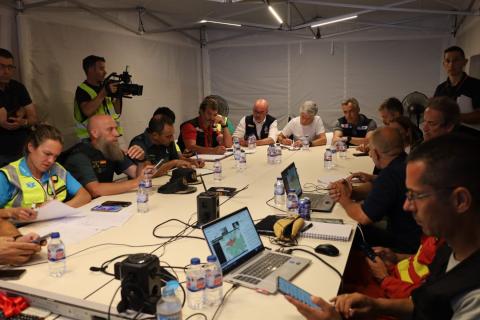
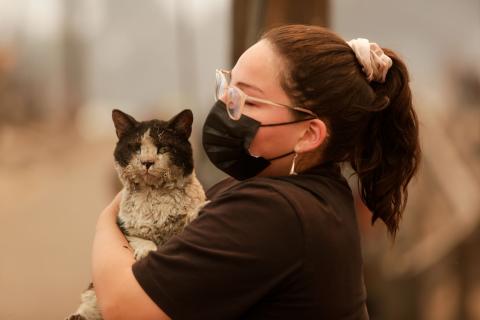
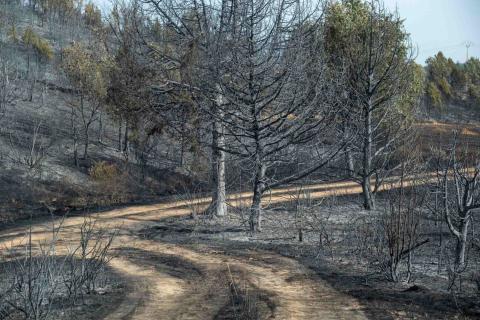
The fires in Ávila, Madrid and Castellón remain out of control, with thousands of people evacuated
The fire in Ávila, which merged with the one in the south-western mountains of Madrid last Saturday and spread to the province of Toledo, remains unstabilised, although it is under control in some areas. Wind gusts of up to 30 km/h will complicate fire-fighting efforts on Monday, according to the Madrid 112 Safety and Emergency Agency. The fire in Ávila is now the largest in Spain’s recent history. Meanwhile, the fire that broke out on Saturday in La Vall d’Uixó (Castellón), which has spread into the Sierra de Espadán Natural Park, has not yet been stabilised either. In total, around 100,000 people have been evacuated or are under lockdown across all the fire fronts.
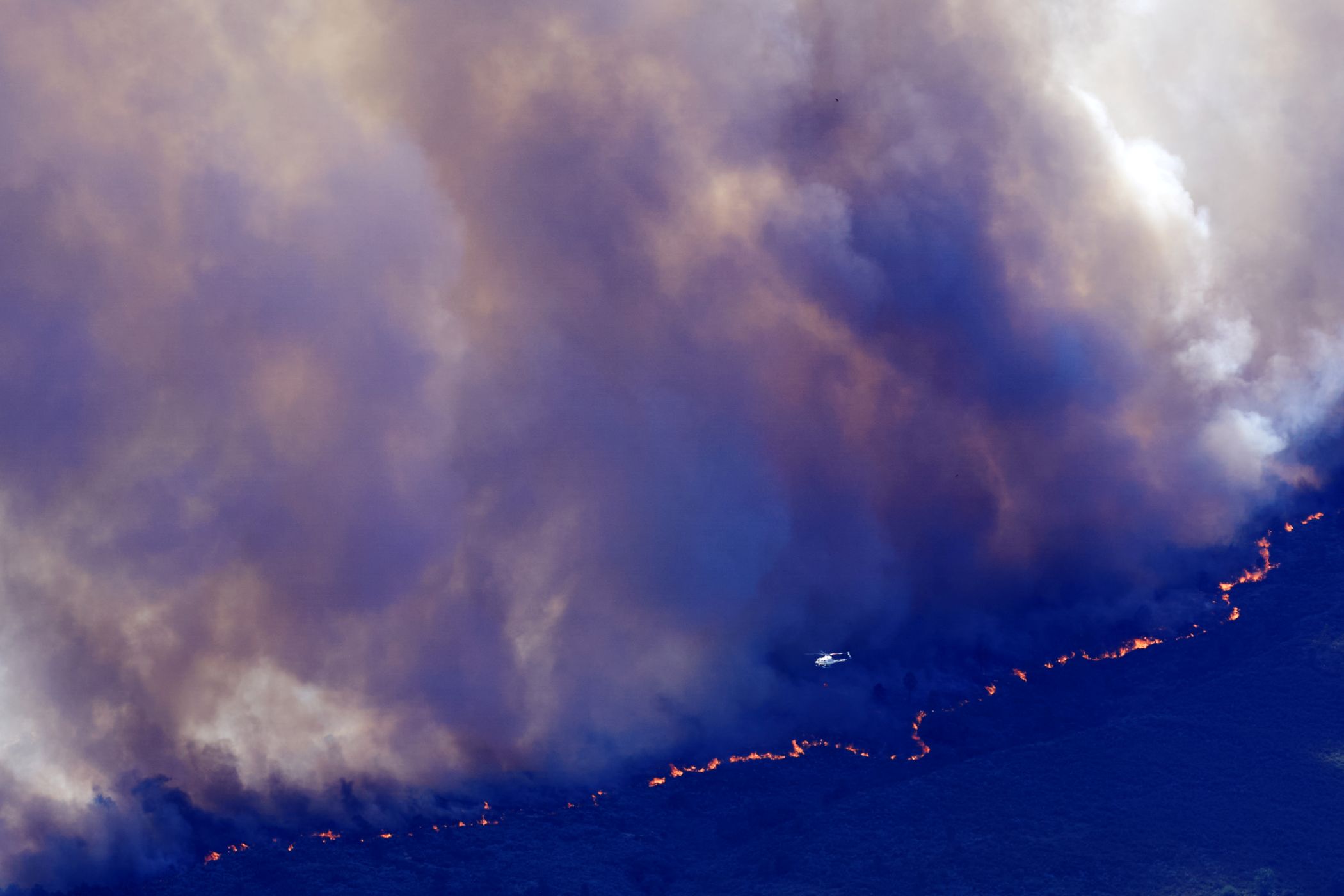
Aerial resources are attempting to bring the active wildfire between the towns of Burgohondo and Navaluenga in Ávila under control this Friday. EFE / Raúl Sanchidrián.
260727_Víctor Resco de Dios_incendios Ávila Madrid Castellón
Víctor Resco de Dios
Lecturer of Forestry Engineering and Global Change, University of Lleida and researcher at Agrotecnio
Why is it proving so difficult to bring under control, on the one hand, the fire in Madrid-Ávila, and, on the other, the one in La Vall d’Uixó?
“We have entered an era of fires that cannot be extinguished. These are fires that burn with the intensity of several atomic bombs and, as such, putting them out is extremely complex. They burn with such intensity because of all the energy stored in the hills, in the form of biomass, and because of all the drying energy in the atmosphere, resulting from the indiscriminate burning of fossil fuels. Added to this are adverse weather and topographical conditions.”
Do we have to get used to this type of fire, which exceeds our fire-fighting capacity?
"I think the question right now is: how many more deaths will it take before effective measures are taken? Last week, in comments to the SMC, I mentioned how we were on the verge of experiencing mega-fires covering 100,000 hectares, and the Burgohondo fire complex has already reached 70,000 hectares. This is the largest fire on the Iberian Peninsula. When a patient suffering from an infection goes to the doctor, they essentially have two options: either to follow the course of treatment prescribed by the doctor or to go without treatment. If they do not take the medication, the infection will probably end up killing them. Right now, we are that patient who is not taking the medication. We must not get used to this situation, as with prevention and other measures we can bring the fires under control.”
What can be done when the fires exceed our fire-fighting capacity?
“If the fire is beyond our fire-fighting capacity, we can tackle the parts that are within our capacity, such as the flanks or the tail. Depending on the circumstances, the only option is to evacuate the area, even for the firefighters, as they are in grave danger.”
Are we prepared to tackle them?
“We can improve by establishing a risk culture and enhancing firefighting intelligence—that is, our analytical capabilities—and by incorporating fire analysts into the chain of command, along with specialists in planning and logistics. Some communities in Spain have already done so, but not all. However, all this will be in vain if we do not manage the fuel load. No one is prepared to tackle fires with the power of 23 atomic bombs – which is the energy released by this complex of fires.”
260727_Jesús S. Notario del Pino_incendios Ávila Madrid Castellón
Jesús Santiago Notario del Pino
Professor of the Department of Animal Biology, Edaphology and Geology of the University of La Laguna
Why is it proving so difficult to bring the fires in Madrid-Ávila and La Vall d'Uixó under control?
“When a fire is so difficult to control, the most common cause is usually a combination of the following factors: (i) a high load of plant fuel; (ii) very unfavourable weather conditions (high temperatures, low relative humidity, strong and dry winds); (iii) steep and/or rugged terrain, to which we must add (iv) homes, towns or housing estates (i.e. the urban-forest interface), which are usually a priority target for evacuation and fire-fighting efforts, forcing a variable amount of resources to be diverted, even if only temporarily”.
Do we have to get used to this type of fire, which exceeds our fire-fighting capacity?
“If the issue of fuel load is not addressed, I think we’re going to have to get used to it. As many forestry specialists and engineers often say: what we don’t manage ourselves, the fire will manage. The problem is that the fuel load has grown significantly over recent decades, mainly as a result of the exodus from rural areas, and something like this cannot be easily resolved in the short term; I do not believe there are any miracle solutions (nor any cost-effective ones) for a problem of this magnitude.”
What can be done when the fire exceeds the firefighting capacity?
“Remove fuel wherever feasible so that, when the fire front arrives, there isn’t much left to burn and the intensity of the fire is reduced, making it possible to tackle it. On paper it seems simple, but in practice it can be extremely complicated due to the high speed at which the fire spreads (which sometimes overcomes defence lines with great ease), as well as the creation of secondary hotspots caused by the emission of incandescent embers (sparks) that spread through the air; these can cross those lines and endanger firefighting personnel.”
Are we prepared to tackle them?
“From a distance, I get the impression that we are not entirely prepared. In fact, one need only look at our immediate geographical neighbours (Portugal, France, Italy, Greece) to realise that this is a supranational problem.”
Conflicts of interest: “I declare, on my own responsibility, that my position and professional details are as stated in this message, that I have no conflict of interest whatsoever in this matter, and that I have not used any artificial intelligence tools to answer these questions. My answers are based solely and exclusively on my own judgement, drawn from my professional experience.”
Cristina Santín Nuño - incendios lunes 27 julio
Cristina Santín Nuño
Tenured Scientist and Honorary Associate Professor at the Joint Research Institute for Biodiversity (University of Oviedo–CSIC–Principality of Asturias) and Swansea University (United Kingdom)
Why is it proving so difficult to bring under control, on the one hand, the fire in Madrid-Ávila and, on the other, the one in the province of Castellón?
“When such extreme fires occur – due to their scale, intensity, danger and, furthermore, the fact that they are happening simultaneously – it is, to a large extent, the fires themselves that dictate how the situation unfolds. No matter how many fire-fighting resources are mobilised, it is not always possible to tackle them directly or extinguish them whilst certain weather conditions and fire behaviour persist. It is important for the public to understand that fire-fighting resources have their limits. In these situations, teams try to contain the fire where possible, guide its progress, make the most of opportunities offered by the terrain or changes in the weather and, above all, protect the population.”
Do we have to get used to this type of fire that exceeds our fire-fighting capacity?
“Unfortunately, we have to accept that these incidents may become increasingly frequent and dangerous, as we have already been observing in recent years. We can and must focus on prevention to reduce the likelihood of major fires occurring and limit their severity, but we will not be able to prevent them all. Current climate conditions and the nature of many of our landscapes favour the outbreak of extreme fires. We must work together to mitigate this risk, but transforming the landscape and minimising the impact of climate change are long and complex processes. In the meantime, we must be prepared to respond when these fires do occur.”
What can be done when fires exceed our firefighting capacity?
"When a fire exceeds firefighting capacity, the absolute priority must be the safety of the public and the emergency services themselves. At such times, the objective cannot always be to immediately extinguish the entire fire front, but rather to protect inhabited areas, organise evacuations or lockdowns, reduce exposure to smoke, and take advantage of any safe opportunity to contain the fire’s advance. In this incident, around 100,000 people have had to be evacuated or placed under lockdown. Although there has already been one fatality (in Manises), the scale of the emergency highlights the importance of civil protection systems functioning effectively and of the public following official instructions.”
Are we prepared to deal with them?
“It is very difficult to be fully prepared for emergencies of this magnitude, but there are areas where progress has been made and many others where we still need to improve. It is essential to strengthen prevention, regional planning, coordination between authorities, early warning systems, civil protection and public education. We must also talk about shared responsibility: the authorities have a key responsibility, but society as a whole must be aware of the risks, keep themselves informed, prepare basic self-protection measures and, above all, always follow the instructions of the emergency services.”