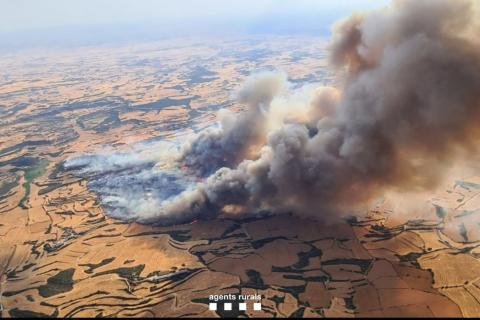
Smoke from wildfires is associated with more emergency room visits for migraines and headaches, according to a study
A team from Canada analyzed nearly one million emergency room visits for migraines or headaches that occurred between 2010 and 2023 in two Canadian provinces during the peak wildfire season. Their analysis shows that the presence of small particles less than 2.5 microns in diameter (PM2.5) from wildfire smoke was associated with an increase in emergency room visits for migraines and headaches. The study is published in JAMA Network Open. In Spain, the Ministry of Health has published health recommendations for action in the event of wildfires. The Community of Madrid, with several active fire fronts, has shared this video with safety and protection tips.
Belvis - Incendios
Robert Belvís
Clinical Head of the Headache and Neuralgia Unit at the Neurology Department of the Hospital de la Santa Creu i Sant Pau in Barcelona and coordinator of the Headache Study Group of the Spanish Society of Neurology (SEN)
The work is of good quality. It aligns with the evidence, as exposure to wildfire smoke had already been assessed as a factor in exacerbating migraines and other primary headaches in previous Australian, North American, and Korean studies.
Smoke likely carries particles capable of activating the trigeminovascular system, which is the main system that triggers headaches.
This study analyzes nearly one million emergency room visits for headaches in Alberta and Ontario (Canada) over 13 years (2010-2023) and observes that on days with wildfires, there were more emergency room visits for migraines and other primary headaches.
It is not a descriptive study, but rather analyzes the concentration of airborne particles with an aerodynamic diameter equal to or less than 2.5 microns (known as PM2.5) on days with and without wildfires in these provinces, and observes that on days with wildfires, there are more emergency room visits for headaches. It is, therefore, a case-control study, which lends greater statistical strength to the final result than a mere descriptive study.
With just an increase of 5 micrograms per cubic meter of exposure (of PM2.5), emergency room visits increase by 6%.
This conclusion is strategically important for emergency services in countries like ours, where wildfires are a summer scourge.
[Regarding possible limitations] The sample size does not mitigate some limitations, such as the pre-existing headaches in the patients who sought medical attention.
The proximity of patients and emergency services to the wildfires within these two large provinces, Ontario and Alberta, was also not analyzed.
Finally, not all wildfires release the same type of particles into the air, depending on the type of forest burned, human-made structures burned, or vehicles (containing chemical substances), etc. However, as an approximation it is a very accurate study.
Irimia - Incendios
Pablo Irimia
Neurologist specialising in the diagnosis and treatment of headaches
The article uses impeccable methodology and is published in a high-impact journal. The authors analyze the influence of exposure to certain particles released by wildfires as a trigger for severe primary headaches requiring emergency room care. They observe an increase in the proportion of patients visiting the emergency department related to the presence of these fire-released particles. The underlying idea is that inhaling these particles could trigger intense headache attacks.
Limitations: When discussing primary headaches, many types of pain are included. Each type of primary headache has different causes, and finding a common trigger within such a heterogeneous group is surprising. That said, what they might have in common is the trigger of stress. The fire could increase people's anxiety and could be responsible for the development of a more intense headache attack than usual. Experiencing a catastrophic situation firsthand can sometimes cause people to interpret symptoms they normally experience as more serious, requiring them to go to the emergency room so their doctor can confirm that it is a primary headache.
Dales et al.
- Research article
- Peer reviewed
- Non-randomized
- People