The wildfire in Los Gallardos (Almería) has left at least 13 people dead
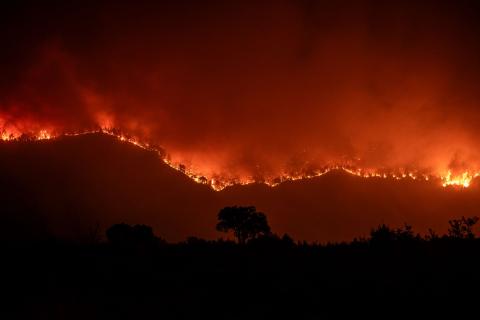
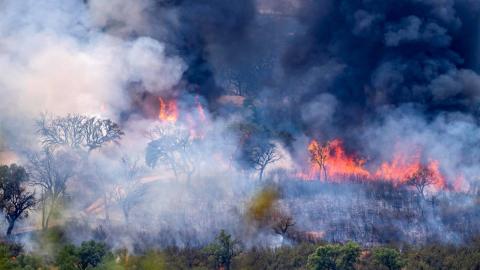
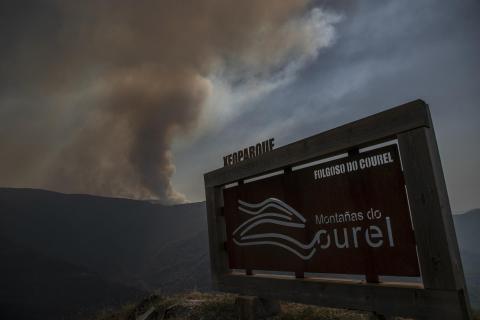
The wildfire in Los Gallardos (Almería), which broke out on Thursday evening, has so far claimed 13 lives. Initial investigations suggest that a fallen power line may have been the cause of the fire. The blaze has burnt more than 3,000 hectares and has left 1,400 people displaced.
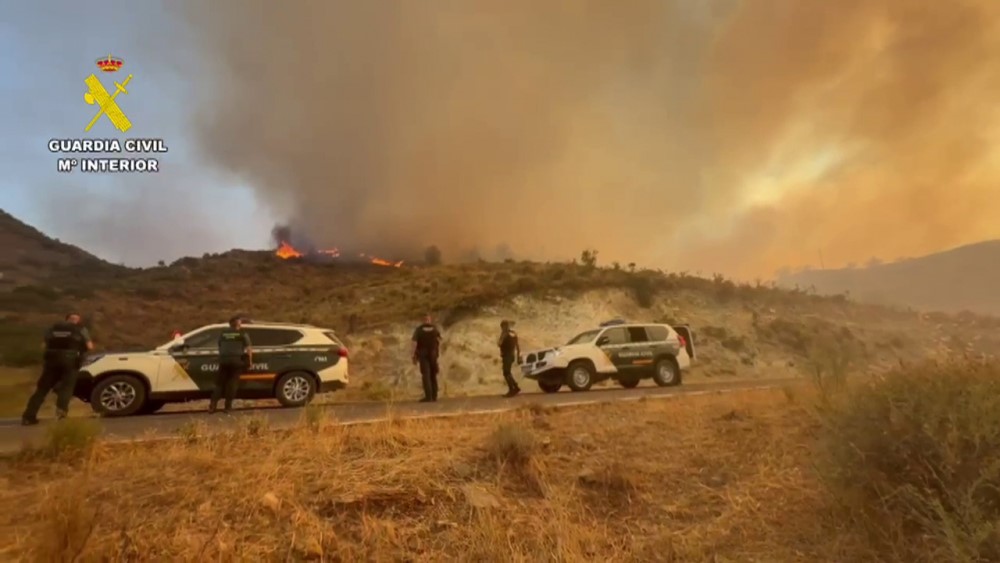
Autor: Carlos Barba/EFE
Gustavo Saiz - incendio Almería
Gustavo Saiz
Forestry engineer and senior scientist at the National Institute for Agricultural and Food Research and Technology (INIA-CSIC)
This fire, like so many others, cannot be explained by a single factor. The origin of the fire (the ignition) – which in this case appears to have been caused by a power line – is one thing. The spread and progression of the fire are quite another.
In this instance, there appears to have been a particularly unfavourable combination of very dry, continuous vegetation, exceptional temperatures, a prolonged absence of rainfall, extremely low atmospheric humidity (around 10 per cent during the most critical hours of the day), strong winds (gusts which appear to have reached 55–70 km/h), and a topography that favours rapid fire spread (the Sierra de Bédar has rugged terrain – ravines). The region had been experiencing an intense heatwave for several weeks. From what I can see, maximum temperatures of around 42 °C were recorded, along with numerous consecutive days above 35 °C, with very warm nights preventing the vegetation from regaining moisture. In this area, just a few weeks without rain during the summer are enough for fine fuel to reach very high levels of flammability.
Taken together, these conditions have created a scenario of extreme risk, in which an initially localised fire can very quickly develop into a major wildfire whose behaviour is difficult to control. Yes, everything seems to point to this being a fire with extreme behaviour. The rapid spread forced mass evacuations and led to people being trapped, which are characteristic of very high-intensity fires. The 2017 Pedrógão fire in Portugal is a tragic example of an equally catastrophic fire with numerous fatalities, although that incident had distinct characteristics. There, the fuel load was much greater.
At present, it cannot be stated that the fire is due to a lack of scrubland clearance. Nor can the opposite be stated until the Andalusian Regional Government reports on the preventive measures carried out in that area.
Fernando Ojeda - incendio almería
Fernando Ojeda
Professor in the Department of Biology (Botany Section) at the University of Cádiz and researcher with the 'Ecology, Evolution, and Conservation in Terrestrial Ecosystems' (ECOTER) group
Over 3,000 hectares have been burnt, and that’s a massive amount. There have been bigger fires, but this covers a huge area. It’s not normal for fires of this scale to occur in Mediterranean landscapes. In most cases, with fires of this magnitude – for example, the one in Pedrógão Grande in Portugal in 2017, which claimed 64 lives, many of whom were trapped in their cars whilst trying to flee – what is actually happening? The local vegetation is burning with great intensity. Many areas of our landscape have been afforested to prevent desertification, creating a uniform landscape of pine trees at the expense of less visually striking vegetation, such as esparto grasslands or other scrubland. In the east, these are Pinus halepensis, a native species that has undergone significant artificial selection through domestication and is highly successful. They are veritable powder kegs. They burn with such intensity that they become unstoppable hotspots; moreover, their cones burst open like embers and spread the fire even further. Mega-fires are associated with forest plantations, as I explained in an article in The Conversation.
María Barbosa - incendios
María Barbosa
Guillermo Rein incendios EN
Guillermo Rein
260710_urbano fra paleo_incendio los gallardos
Urbano Fra Paleo
Member of the working group of the European Academies' Science Advisory Council (EASAC) author of the report, member of the science and technology advisory group (E-STAG) of the United Nations Office for Disaster Risk Reduction (UNDRR), retired professor at the University of Extremadura, member of the Academia Europaea (The Academy of Europe) and associate researcher at the Institute for Studies on Conflicts and Humanitarian Action (IECAH).
Marcelino Núñez - incendio almería
Marcelino Núñez
Regional Representative of the State Meteorological Agency (Aemet) in Extremadura
Thomas Smith - incendio almería
Thomas Smith
Theodore Keeping - incendio almería
Theodore Keeping
Víctor Riera - incendio almería
Víctor Riera
Project technician at the Pau Costa Foundation
All I know about this fire is what I read in this morning’s news; from what I can gather, it seems the victims tried to flee the fire via an unmarked route.
That said, it is worth remembering that most incidents where people become trapped or accidents involving those not involved in fire-fighting operations occur during evacuation. The clearest example was the accident in Pedrogão (Portugal) in 2017 — although in this case it was an extreme fire, the victims were trapped on a road, possibly due to the traffic congestion caused by the fire itself. In the same year, there were other victims who also died whilst trying to flee one of the fires in Galicia. However, whilst we were still reeling from the events in Pedrogão, in Huelva the only access route to Matalascañas was cut off due to the fire in Moguer, with access routes gradually reopening as the situation allowed. For all these reasons, the instructions and recommendations of the relevant authorities must always be followed, and people must stay informed about the current situation, whether there is a fire nearby or not.
Another lesson learnt from these incidents is whether we are truly aware of our surroundings, and whether people living in vulnerable areas (such as scattered farmhouses in the hills, which by their very nature have difficult access) really understand the risk to which they are exposed every summer. In 2012, during the Ojén (Málaga) fire — which burnt more than 8,000 hectares, most of it during a single night of strong winds from the land — there was also one fatality, a person who returned home after being evacuated. This twofold problem — the urban-forest interface, where forest fires intersect with the urban fabric, and the lack of awareness regarding fire risk — is not unknown to INFOCA. In 2015, Miguel Ángel Catalina, former director of the Málaga Provincial Operations Centre, gave a presentation addressing these very issues (direct public outreach, including foreign residents, and what people living in these areas should know). Furthermore, in complex areas, drills are often carried out to review self-protection plans and improve coordination between response teams.
Ferran Dalmau–Rovira incendio Almería
Ferran Dalmau–Rovira
Based on the official information available to date (15:45 on 10 July 26), the following can be stated:
- The fire broke out on 9 July 2026 in the municipality of Los Gallardos (Almería).
- From the very outset, the fire behaved in an extreme and highly intense manner, fuelled by high temperatures, low humidity and strong winds. There were simultaneous fires in Andalusia, which has placed a strain on the emergency services.
- The evacuation of various housing estates and villages was ordered.
- The fire affected several roads and severely hampered travel and evacuation operations.
- The latest official figures confirm 12 fatalities and several injuries. Search and identification efforts are ongoing. Twenty-three people remain missing.
- Some of the victims were found inside burnt-out vehicles, whilst others were found outside after attempting to flee on foot.
- Forensic teams and the Civil Guard are continuing to identify all the victims.
- The judicial investigation into the cause of the fire remains open and no official cause has yet been determined.
Hypotheses and information pending confirmation. The following points have been reported in various media outlets or mentioned by public officials, but it is not yet possible to confirm them as fully substantiated facts:
- That the cause of the fire was linked to a fault or the collapse of a power line.
- That a significant proportion or all of the victims were foreign nationals.
- That some people deviated from the recommended evacuation route and took alternative paths.
- The exact sequence of movements made by the victims before they became trapped.
- The specific circumstances in which each of the deaths occurred.
- The definitive reconstruction of the fire’s behaviour during the critical minutes.
- It will be the technical and judicial investigation that will confirm or rule out these hypotheses.
Considerations regarding safety during a wildfire:
This incident once again highlights a widely recognised principle in wildfire emergency management: the level of safety depends to a large extent on where people are located when the fire front reaches the area.
In general terms, the order of safety can be summarised as follows:
- Maximum safety: remaining in fire-resistant buildings located within a consolidated built-up area, provided the authorities have not ordered an evacuation. These environments offer a lower fuel load, better conditions for emergency services to intervene and greater protection against thermal radiation.
- High safety: remain inside a fire-resistant building located outside the built-up area, provided it meets adequate self-protection standards and evacuation is not possible or has not been ordered.
- Intermediate situation: remaining inside a vehicle within an urban area may offer temporary protection against radiant heat, embers and smoke. On roads or tracks, this is effective for a limited time. However, the vehicle does not constitute a safe refuge when it is directly exposed to the front of the flames or is immobilised.
- Maximum vulnerability: travelling by road or on foot in the vicinity of a wildfire exhibiting extreme behaviour. The speed of spread, sudden changes in wind direction, loss of visibility due to smoke, falling trees or power lines, and blocked roads can rapidly turn an escape route into a high-risk situation.
For all these reasons, whenever possible, it is preferable to remain in a suitable shelter or to evacuate early, following only the instructions and routes established by the emergency services, and avoiding making individual decisions once the fire has reached an extreme stage.