Recommendations for watching the upcoming solar eclipse safely and enjoyably
There are just a few days to go until 12 August, when we’ll be able to enjoy the first of the three eclipses we’ll see in Spain. This is a total solar eclipse — the Moon will completely cover the Sun’s disc — something not seen on the Iberian Peninsula since 1912. Experts from different regions of Spain with extensive experience in observing eclipses offer their recommendations. Choosing the right viewing spot, using approved eclipse glasses, coping with the heat and respecting the natural environment are key to observing the eclipse safely and enjoying the experience.
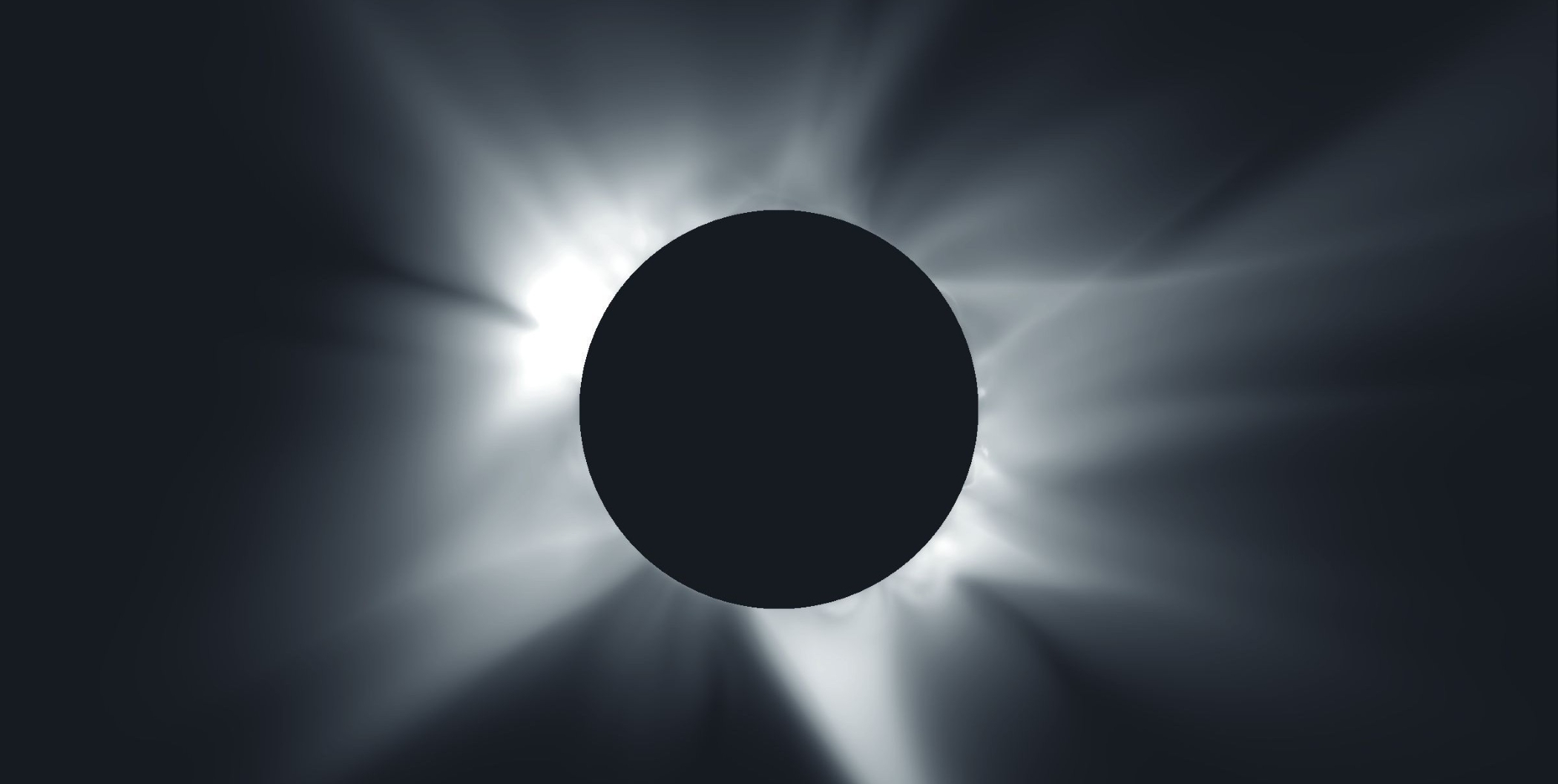
The Ministry of Science, Innovation and Universities (MICIU) has used the La Palma supercomputer to predict the solar corona during the total solar eclipse on 12 August. The Canary Islands Institute of Astrophysics (IAC) has developed the simulation in collaboration with the research group Predictive Science Inc. Source: MICIU-IAC.
Marcos Pérez Maldonado - recomendaciones eclipses 3.8
Marcos Pérez Maldonado
Eight tips for a memorable viewing experience:
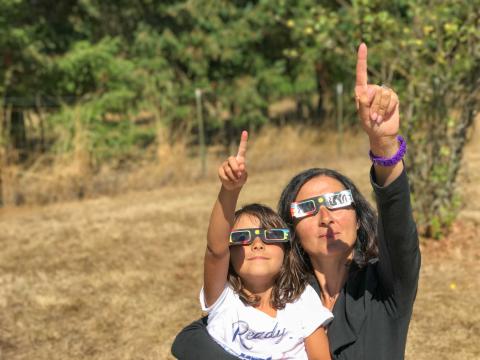
- Don’t get too hung up on eclipse glasses, but never look directly at the Sun without them. The image of the eclipsed Sun is tiny and static. The interesting things happen all around us: changes in the intensity and colour of the light, the shadows cast by the foliage, a drop in temperature, and the behaviour of the wildlife around you – especially humans.
- Taking good photos of the eclipse is difficult and requires specialised equipment. If you want to capture a memento of the experience, set your mobile phone or camera to record your reactions and those of your companions during the moments of maximum eclipse.
- Avoid using telescopes or binoculars unless you have the necessary filters and experience in solar observation. Never leave these instruments unattended.
- Choose your viewing spot taking into account the needs of those with you, particularly older people, people with disabilities and children.
- In anticipation of traffic jams and long waits, bring sun cream, insect repellent, a parasol, food, water, warm clothing for the evening, any medication you may need and something to keep you entertained.
- Avoid places where there is a risk of falling and, above all, areas near cliffs or steep slopes.
- Bear in mind that mobile phone coverage may be lost in areas with large crowds.
- Respect the local community and the natural and cultural heritage. Avoid walking through crops and any activity that could cause a fire. And remember that the fruit belongs to someone.
Mª Ángela del Castillo Alarcos - recomendaciones eclipse 3.8
Mª Ángela del Castillo Alarcos
This event has not occurred on the Iberian Peninsula since 30 August 1905 (there was another in 1912, but it was a total annular eclipse), although we have had partial eclipses and two annular eclipses. That is why there is so much excitement surrounding this major event. The path of totality will move from west to east across the north of the peninsula, reaching as far as the Balearic Islands. Cities such as Madrid and Barcelona will not be within the path of totality, so they will observe the eclipse during the partial phase, as will the rest of Spain.
The first partial phase will last around 55 minutes until the Sun is completely covered by the Moon and darkness falls, as if night were falling, but this will be very brief: in the central zone, totality will last barely two minutes (1 minute 49 seconds), whilst to the north and south of the central path of totality, the duration of totality will be even shorter. Once this period has passed, daylight will return, and the second partial phase will begin until the Moon has completely moved away from in front of the Sun. This will only happen in the westernmost regions, because in the rest of the country, towards the Mediterranean, as the Sun sets earlier, it will already have disappeared below the horizon by the time the second partial phase begins.
To view it properly – as it will be very close to the horizon during totality – you should find a spot free from obstructions such as houses or mountains, and two or three days beforehand, test the location by watching the Sun set to ensure that the chosen spot offers a clear view at the specified time. Every town and city in Spain (including the Canary Islands) can look up an infographic on the National Geographic Institute’s website containing all the local timing details (IGN Eclipses), which will also provide information on the next solar eclipses that, fortunately, we will be able to see from Spain in the coming years (a total eclipse on 2 August 2027 and an annular eclipse on 26 January 2028).
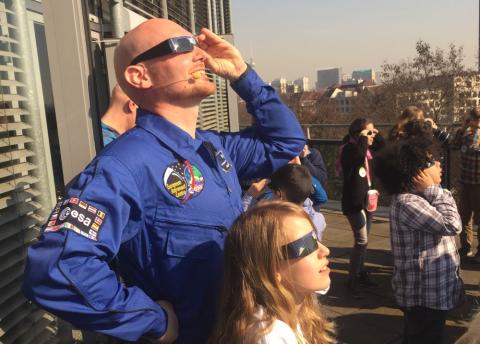
To observe the eclipse, it is essential to use eye protection, given that we now know how dangerous the sun’s rays can be to our eyesight, even though during the eclipse the Sun will be very close to the horizon and its brightness will appear less dangerous. Approved eclipse glasses (ISO 12312-2) bearing the European Community’s CE mark are ideal, as, as well as being very inexpensive (€2 or €3), they offer maximum protection. These should be used during the first and second phases of the eclipse. As soon as the Sun is blackened and obscured by the Moon, the glasses should be removed so you can enjoy the darkness and the solar corona that will appear around the Sun’s disc – the only way to see this faint corona, which is otherwise impossible to observe (apart from using coronagraphs at astronomical observatories or solar space telescopes).
It is very important that children are protected when watching the totality; they may take their glasses off and put them back on, bend them or throw them on the ground, which could damage them. That’s why a good tip is to make a hole in the arms of the cardboard glasses and tie a small string or elastic through it so that when they take them off, they hang around their neck; or, for a really fun touch, get a cardboard mask of an animal or children’s character – the sort with eye holes – and stick the glasses onto the back of the mask, which will be held in place by the elastic band it usually has.
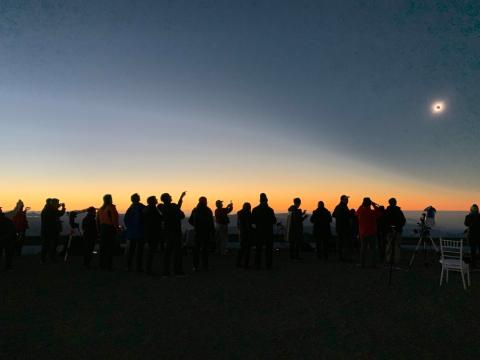
All that remains is to hope for clear skies and enjoy an event of this calibre, which will make us feel as though it’s night in the middle of the day, allow us to admire the solar corona – the only way to observe it – and see some stars and planets alongside the Sun. Also, sometimes, when the Moon’s edge (known as the lunar limb), just before it covers the Sun, has gaps between mountains or craters, and the Sun’s rays escape through those gaps, forming pearls of light or a flash known as the ‘diamond ring’—another spectacle we’ll see if it occurs.
Alejandro Sánchez de Miguel - recomendaciones eclipse 3.8
Alejandro Sánchez de Miguel
EMERGIA post-doctoral research in the Sky Quality Office
Recommendations:
- Don’t miss it. 99.99 per cent isn’t enough. Only 100 per cent is enough to see the spectacle in its entirety and for it to last at least 30 seconds.
- Get your eclipse glasses or find out how to view the eclipse indirectly as soon as possible. Otherwise, there may be local shortages, even if not on a large scale. Even if the eclipse isn’t 100 per cent total in your region, if you want to see the partial eclipse, you’ll need eclipse glasses. No other method of direct viewing is safe. None.
- Go to your viewing spot at least the day before and make sure you’re prepared with enough food and water. Do not drive during the two hours the eclipse is taking place, even if you’re not interested in the eclipse. There is a high risk of drivers becoming distracted.
- Check the weather forecast.
- Watch the eclipse from outside urban areas if you’re going to see totality, as streetlights may come on during this phase. Check that there are no obstacles in your line of sight.”
David Galadí Enríquez - recomendacones eclipse 3.8
David Galadí-Enríquez
Coordinator of the Scientific and Advisory Committee for the Eclipse Trio and lecturer in the Department of Physics at the University of Córdoba
You must protect your eyes when observing the Sun’s disc. A solar eclipse is dangerous not because it is an eclipse, but because it involves the Sun. Any direct gaze at the Sun’s disc when it is not obscured requires protection. You may only – indeed, I would say you must – look at the Sun without protection during the few seconds that the total phase of the eclipse lasts, whilst the Sun is covered by the Moon. From locations where the eclipse is not total but partial, there is never a safe time to look at it without protection.
Only certified eclipse glasses (ISO 12312-2) provide safe protection. Any other method is unsafe and must be avoided. There is no need to wear the glasses the whole time whilst watching the partial phases of the eclipse. It is enough to look at it occasionally, and in the meantime, observe all the other things happening around you: changes in temperature, changes in lighting, in the shadows…
You can set up additional experiments based on the pinhole or ‘camera obscura’ effect: project the image of the partially eclipsed Sun using objects with holes (slotted spoons, sieves, cardboard with holes punched in it, gaps between the leaves of a tree, etc.). It’s safe, spectacular and great fun.
Photographing a solar eclipse is a complex task that is only within the reach of experienced photographers. Many of them will take spectacular photos and videos. The general public would be well advised not to attempt to capture the phenomenon using basic equipment such as mobile phones and without prior experience: the results will be poor and they will miss out on the personal experience of witnessing the eclipse. We must focus our attention on the stars, the universe and our surroundings, rather than on a mobile phone with which to take a poor-quality photograph.
Anyone planning to travel should do so in good time – ideally with a day’s buffer – and should also avoid setting off immediately after the phenomenon has ended, as there will be major traffic jams.
Begoña Nicolás - recomendaciones eclipse 3.8
Begoña Nicolás
Assistant Professor in the Astronomy and Astrophysics Section of the Department of Applied Mathematics at the University of Santiago de Compostela
List of recommendations:
- Approved eclipse glasses (ISO 12312-2:2015) must be worn throughout the partial phase.
- Check whether the totality phase will be visible in your area and at what times (you can do so here).
- You may only look directly at the eclipse without approved glasses during the totality phase. In some locations, the totality phase is very short, so it is recommended that you set a timer with an alarm to alert you before it ends, to avoid damaging your eyesight.
- As the eclipse will take place shortly before sunset, we should observe it from a spot with a clear view to the west. It is recommended that you find a suitable location before the 12th.
- If you’re travelling to see the eclipse, don’t forget to bring water, sun cream, something to eat… After all, it will be a long summer’s day.
Víctor Lanchares - recomendaciones eclipse 3.8
Víctor Lanchares
Below, I’ll outline a few things which, in my view, should be borne in mind, quite apart from keeping up to date with local authorities’ recommendations on movement restrictions. For example, here in La Rioja, it is forbidden to drive motor vehicles on forest tracks and in nature reserves on 12 and 13 August.
- Within the path of totality, look for a suitable viewing spot. Bear in mind that the eclipse will take place in the late afternoon and the Sun will be low on the horizon. An elevated spot is preferable, but not essential. The most important thing is to have a clear view of the western horizon, free from buildings, trees or mountains.
- If you live within the path of totality, avoid travelling. You will almost certainly be able to find a viewing spot nearby that you can reach on foot. In any case, don’t leave your preparations until the last day and make sure the viewing spot is suitable. You can check it out a few days beforehand.
- Whilst the viewing spot is important, eye protection is even more so. You must not look directly at the Sun, as this can cause serious and irreversible eye damage. It is essential to wear special glasses that are ISO 12312-2 certified. Only when the Moon completely covers the Sun’s disc can you do without eye protection to admire the Sun’s corona.
- As totality sets in, you will not only see the solar corona; you will also notice a drop in temperature and be able to see some stars in the sky. Also pay attention to how the sudden onset of darkness affects your perception of your surroundings and the behaviour of some animals.
Álex Mendiolagoitia - reacciones eclipse EN
Álex Mendiolagoitia
I have observed nine total eclipses and one annular eclipse. Based on that experience and on what I have shared with many people and some media outlets, my recommendations are as follows, given the specific characteristics of this eclipse on 12 August:
- Arrive very early at the observation site, which must be a location with a completely unobstructed view of the west-north-west horizon.
- Only use approved filters to view the eclipse. If you do not have any, project the image onto a sheet of paper using a slotted spoon.
- Bring water, food, a cap, sun cream and a folding chair, as you will be out in the countryside in the middle of August for several hours.
- Do not smoke or light fires, and park your vehicle in such a way that you always leave space for an ambulance or the fire brigade.
- Once the eclipse is over, avoid rushing off, as the traffic jam will be massive. That night is the Perseid meteor shower. It’s better to watch them peacefully in the countryside than to be stuck in a traffic jam.
For the media, more specifically.
- Avoid using mobile data due to network congestion.
- It is forbidden to use spotlights to compensate for the lack of light during totality. The last thing an eclipse-watcher wants is to be blinded by a camera spotlight, preventing them from seeing the eclipse.
- Use only approved Baader-type filters for direct camera exposure. If you do not have one, it is better to film a projection, such as the aforementioned ‘skimmer’ method or one using a telescope operated by an expert.
Salvador J. Ribas - recomendaciones eclipse
Salvador J. Ribas
The recommendations are as follows:
- Plan your trip in advance and have alternative plans in case of bad weather.
- Make sure there is good visibility from the viewing point.
- Check the official websites (for example, the Catalan Government) for designated viewing sites.
- Follow the guidelines and respect the natural environment.
- Find a shaded spot to wait and protect yourself with a hat and sun cream.
- Observe and take photographs safely.
- Take water and basic provisions with you.
- Avoid leaving as soon as the eclipse is over.