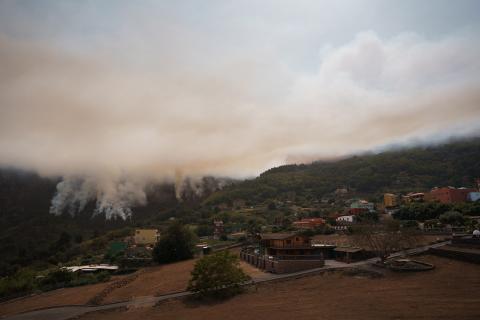
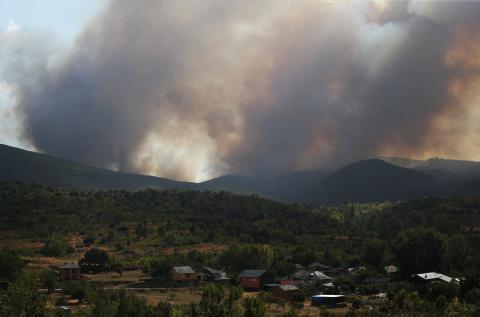
Wildfires in 2025 burned more than one million hectares across the European Union, with nearly half of that area located on the Iberian Peninsula
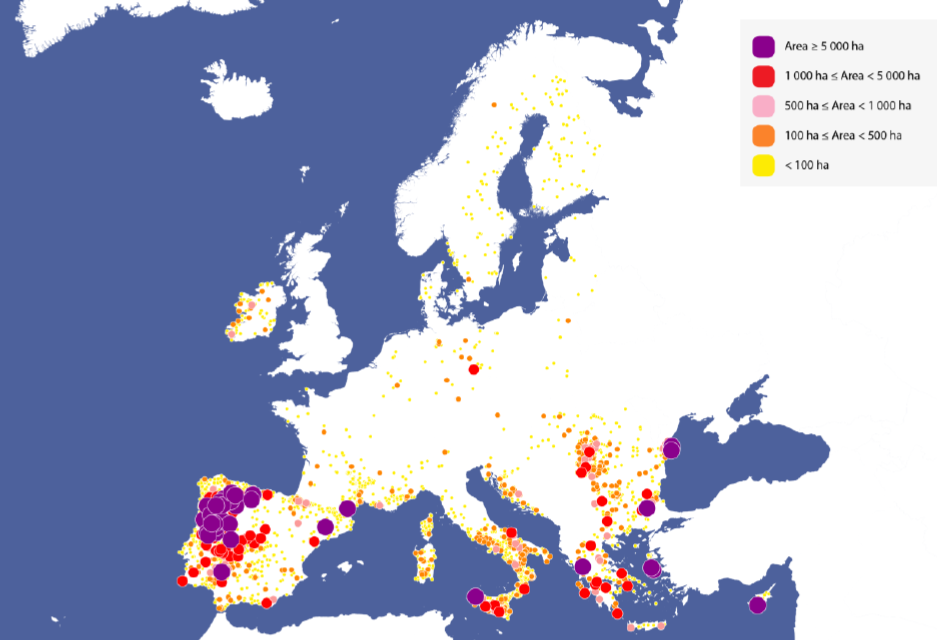
The 2025 wildfire season was the worst the European Union has seen in the last century. According to a report by the European Forest Fire Information System (EFFIS), managed by the European Commission’s Joint Research Centre (JRC), more than one million hectares were burned last year. Some 43% of that figure was burned in the major fires that occurred in Spain and Portugal during the summer. The report also covers the rest of the European continent, the Middle East, and North Africa, resulting in a total of more than two million hectares of burned area.
Victor Resco - incendios forestales
Víctor Resco de Dios
Lecturer of Forestry Engineering and Global Change, University of Lleida and researcher at Agrotecnio
The report indicates that records for burned area were broken in 2025. However, it is worth noting that the reference period is relatively short, as it only includes data from the 21st century. In the 1990s, for example, nearly half a million hectares burned in Spain, which far exceeds the figure for 2025. Therefore, although the claim of a record in burned area is certainly exaggerated, it is true that we are seeing an uptick in burned area. That is, we observed declines in burned area after the 1990s, due to increased investment in firefighting, improvements in training, and advancements in fire suppression strategies and tactics. However, that trend is reversing because today’s fires burn with greater intensity than in previous decades: there is increasingly more fuel (i.e., greater connectivity between forest areas), coupled with climate change that dries out vegetation and increases atmospheric instability. It is true that, at over 40,000 hectares, the Uña de Quintana fire has become the largest fire in Spain since ministerial statistics began in 1968. These data confirm that we are entering an era of fires that cannot be extinguished, as we warned several years ago.
The report focuses on protected areas and demonstrates how they are being disproportionately affected by fires: protected areas account for 19% of the land area but represent 39% of the burned area in the European Union. This necessitates a rethinking of the management of these protected areas and the incorporation of the growing risk they pose from the perspective of wildfires. The type of vegetation most affected in Spain was scrubland, which accounted for nearly half of the burned area, followed by broadleaf forests (such as oak, chestnut, etc.) and holm oak forests, which together make up more than 15% of the burned area. These data once again debunk the eco-myth that eucalyptus and pine trees are primarily responsible for the burned area. What we have seen this year is merely a preview of the future that awaits us if we continue to neglect fuel management: climate change is becoming increasingly intense and leaves little room for inaction. Studies indicate that we can significantly reduce the likelihood of catastrophic fires, as has already been done in other parts of the world, if we implement preventive management on approximately 5% of forest land.
Eduardo Rojas - incendios forestales
Eduardo Rojas Briales
Lecturer at the Polytechnic University of Valencia and former Deputy Director-General of the FAO
Is the report of good quality?
“The report is timely given the challenging summer in the northwest of the Iberian Peninsula, as well as in other countries. However, experts point out the annual variability that exists between years and the need to use long time series—at least spanning a decade—to identify underlying trends, given the stochastic nature of wildfires and the masking effect that years that appear excellent compared to others that are very difficult, such as this one, can create.
The first consideration is that, especially when looking back, the same types of land must be compared in order to compare the results. Until recently, only forested areas (in Spain, forested land) were recorded globally via the FAO, whereas this report includes all land areas, including non-forested areas, agricultural land, and other vegetated zones.
Let’s look at where the bulk of the burned areas have been in the three regions studied (Europe, the Near East, and North Africa): Ukraine, Spain, and Portugal account for 60% of the total burned area among the 46 countries studied. The most affected country is Ukraine due to the war it is enduring, with 660,000 hectares burned; this is a case that should be treated separately, especially given the exceptionally high number of fires. Next is Spain with 401,000 hectares, of which only 103,000 (25.6%) are forests, the rest being grasslands and scrubland. And third is Portugal with 284,000 hectares, of which only 11% are forests.
It is therefore true that the fires have covered a larger area than usual, but they have affected non-forested land in virtually all countries that have experienced significant fires relative to their size. In other words, fires are increasingly occurring in non-urban areas and not just in forests. With the exception of some Nordic countries like Finland or Sweden, where the burned area is very small (around 1,000 hectares out of more than 20 million hectares), in the rest of the countries the burned forest area has been less than 25% and, in many cases, below 10%.
In the case of Spain, it is also worth noting that a total of nine years (1975, 1978, 1981, 1985, 1986, 1989, 1991, 1994, and 2022) exceeded 2025 in terms of burned forest area, especially considering that the forest area has increased by 7 million hectares (+59%) between 1970 and the present; therefore, the potentially affected area is considerably larger, much like an increase in traffic accidents proportional to the total kilometers traveled by the vehicle fleet. In 2025, the forested area burned 7 times less per hectare than the deforested area, which continues to shrink due to the increase in forested area (forest).
Another aspect to consider is that the report (unlike the MITECO report for 2025) includes all fires that occurred, including those resulting from prescribed burns. And in both cases, if a fire is deemed desirable by firefighting authorities and is not actively extinguished, it would also be counted.
It is noted that Germany has reached an unprecedented level of forest fires, even though the area affected is barely 1,500 ha (<0.1% of its forests), whereas the former East Germany suffered fires covering more than 5,000 hectares per year prior to reunification.
It should also be noted that 39% of the burned area was part of the Natura 2000 Network, even though this network accounts for only 23% of the total forest area, which would confirm Resco’s recent findings regarding a higher incidence of fires in protected areas.
Finally, regarding the apparent lengthening of the fire season, it should be noted that, as can be seen in the graph showing the temporal distribution of fires, there are two peaks—March and July–August—which, although close together, do not overlap. The first corresponds to temperate-climate fires following frosts and before budbreak—fires that shepherds in the Cantabrian region take advantage of to burn, since doing so in summer would not be feasible, a custom that has been lost in the Spanish Pyrenees but not in the French Pyrenees. And the second is linked to the Mediterranean summer.”
What are the consequences of so many and such large fires?
“First, the fact that fires are spreading to urban areas (Los Angeles, January 2025; Tres Cantos, August 2025), agricultural lands (Ukraine and Russia, July 2010), scrubland, and grasslands—and must therefore be addressed as wildland fires and not just forest fires. Climate change is undoubtedly a cause, but not the only one, and it is highly likely that rural abandonment and depopulation are even greater factors (at least in the Mediterranean), along with structural issues such as the small-scale farming that prevails throughout southwestern Europe.”
What strategies can be adopted to prevent this from happening?
“There is broad consensus among specialists that the repressive approach has run its course, just as in health policy the emphasis on providing health services is ineffective if the population does not adjust its lifestyle, or a purely policing approach to situations of social exclusion. Investing more resources in firefighting is a headlong rush that leads nowhere and, according to the firefighting paradox, the gains made through increased resources will be more than offset by the collapse of those resources in a mega-fire. More proactive approaches and policies are needed in both the areas of forest fires and biodiversity.
The solution lies in reclaiming the management of rural and peri-urban areas, including the landscape, and integrating fire risk into all land-related activities by addressing structural problems such as smallholdings, the separation of land management and ownership, modernizing public forest management, boosting demand for wool, biomass, and the natural and sustainable products the land offers, and overcoming the systemic “free-riding” on forests and rural areas imposed by urban society—a phenomenon highlighted by the demographic collapse of inland regions and wildfires. Consider just two examples:
- Forests are extending the useful life of reservoirs, but hydroelectric fees go toward investments in irrigation rather than to the mountains; and when hydroelectric plants are decommissioned, the land is not returned to the landowners—mountain municipalities—nor do water bills return anything to the forests, but rather to wastewater treatment plants, water treatment plants, canals, etc. in accordance with the principle of full cost recovery set forth in the Water Directive, which currently lacks the necessary services.
- Forests offset 20% of Spain’s CO2 emissions, but they can only enter voluntary carbon markets if new forests are planted, meaning that areas of our country that were never deforested now face a new burden (maintaining carbon stocks) without receiving the slightest recognition under the ethically highly questionable principle of additionality.”
Fernando Ojeda - incendios forestales
Fernando Ojeda
Professor in the Department of Biology (Botany Section) at the University of Cádiz and researcher with the 'Ecology, Evolution, and Conservation in Terrestrial Ecosystems' (ECOTER) group
Many Mediterranean ecosystems are pyrophilic. In other words, they are not only resilient to fire, but their biodiversity and functionality depend on the recurring presence of fires. Many plant species have developed mechanisms for survival and regeneration that are triggered only by fire. This interdependence extends to wildlife, which finds vital ecological niches in landscapes shaped by fire. However, the positive relationship between biodiversity and fire is delicate and depends on a precise balance in the fire regime. The scale of the 2025 wildfires, with nearly 700,000 hectares affected across Spain and Portugal, deviates from this balance and is truly alarming. The European Commission’s JRC-EFFIS report suggests climatic factors (fire weather index) as explanatory factors for this magnitude. However, the extent and severity of a fire depend not only on the weather, but also on the continuity and flammability of the vegetation the fire encounters in its path. Anthropogenic modifications to the landscape through extensive and homogeneous forest plantations, primarily of pine and eucalyptus, have created a highly dangerous architecture of combustible biomass.
The JRC-EFFIS report indicates that the land cover types with the largest burned area in Spain and Portugal are not coniferous forests—which include forest plantations—but rather what is termed “other natural land,” which includes scrublands and grasslands. This appears to contradict the previous statement. However, we know that forest plantations are associated with the highest levels of fire severity, which facilitates the ignition of adjacent vegetation and, above all, compromises natural post-fire regeneration. For much of the 20th century, natural environment management in the Iberian Peninsula prioritized afforestation and reforestation over structural diversity in the natural environment. This has led to a loss of landscape heterogeneity and biodiversity associated with an increase in highly flammable biomass, heightening the risk of catastrophic fires, especially under extreme conditions of aridity and high temperatures. Understanding that landscape homogenization is a determining factor in the extent and severity of fires is essential for transitioning toward a land management approach that reduces the vulnerability of our ecosystems and strengthens their resilience and functionality in the face of the new climate scenario.
Sedano, F. et al.
- Report