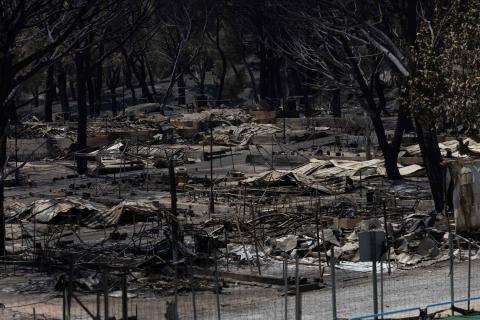
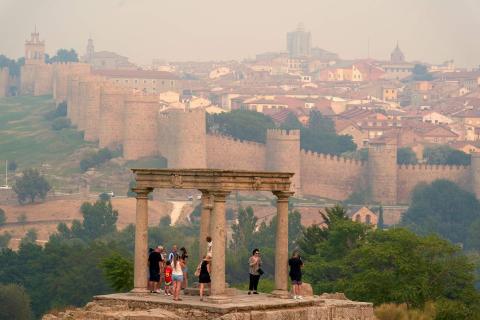
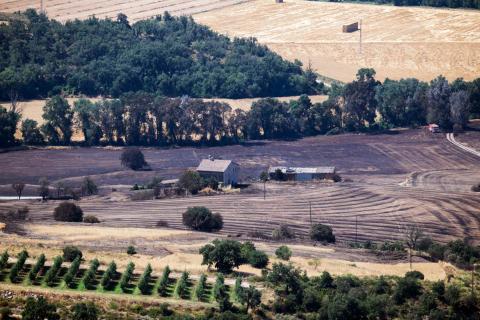
Babies born in Spain will now experience twice as many extreme weather events linked to wildfires as their grandparents did
A study published in the journal Environmental Research Letters estimates that babies born in Spain in 2025 will experience 7.3 more years of extreme weather conditions conducive to wildfires. The exposure for their grandparents, born in 1950, will be half that figure: 3.7 additional years. According to the authors, the vast majority of this increase is due to climate change rather than rising life expectancy. Limiting global warming to 1.5 °C, in line with the Paris Agreement, would reduce Spanish young people’s lifetime exposure to these conditions by more than a year, compared with current policies.
Cristina Santín - incendios abuelos EN
Cristina Santín Nuño
Tenured Scientist and Honorary Associate Professor at the Joint Research Institute for Biodiversity (University of Oviedo–CSIC–Principality of Asturias) and Swansea University (United Kingdom)
Does the press release accurately reflect the study?
“Yes. In addition to these figures, I think it is also interesting to look at the data presented for Spain, as it is one of the European countries most affected by the increased risk of wildfires associated with climate change: in our country, the increase in exposure to extreme weather conditions conducive to wildfires for a person born in 2025, compared with someone born in 1950, will not be three years, but 7.3 years – that is, more than double the European average”.
Is the study of high quality? Are the conclusions backed by solid data?
“Yes. This study uses a methodology that has been extensively tested in research into how the climate and climate change affect fire risk. For me, its main novelty or appeal lies in the fact that they have placed these figures in the context of the lifespan (life expectancy or lifetime) of two generations: the generation now aged around 70–80 and the one that has just been born. In doing so, they highlight the vast intergenerational inequality caused by climate change: the generations that have contributed most to it are the ones who will suffer the least from it.”
How does this study fit in with the existing evidence?
“It aligns very well with everything science has taught us so far. Climate change is an undeniable key factor in the worsening of the conditions that lead to wildfires, not only in Spain and Europe, but almost everywhere in the world.”
Are there any significant limitations to bear in mind?
“I am not a climatologist, so I cannot comment on the methodology or the technical aspects. But, as I have already said, the methodology is standard and widely validated and used, and the group of authors is highly reputable.”
What are the implications for the real world?
“The implications are that climate change will make life more difficult for the children and grandchildren of those who have contributed most to it, but the good news is that the future is yet to be written and that, together, we can work to reduce these negative impacts.”
Víctor Fernández - incendios abuelos EN
Víctor Fernández-García
Lecturer in the Department of Engineering and Agricultural Sciences at the University of León
It comes as no surprise that climate change is driving the weather conditions that favour wildfires. We scientists have been quantifying this for years and it is abundantly clear. For example, in the Mediterranean region, the period of extreme risk has lengthened by one month over four decades; nights offer less and less respite; and heatwaves that were once exceptionally rare are no longer so. In this regard, it has been well demonstrated that the extreme weather conditions associated with the 2025 wildfires on the Iberian Peninsula are now expected to occur approximately once every 13 years, compared with less than once every 2,500 years in a pre-industrial climate. The summer of 2026 has once again broken records, being the hottest summer on record in Spain, surpassing the record set in 2025.
What is novel about the work by Pietroiusti and colleagues is that it puts all this into a scale that is easy to understand: that of a human lifetime. Rather than speaking solely of degrees or meteorological indices, it tells us how many additional years younger generations will have to live with extreme fire conditions. The study estimates that, for a person born in 2025 in Spain, every additional degree by the end of the century would translate into around 448 more days of exposure to extreme fire conditions over the course of their life.
It is important to note that the study does not predict how many fires there will be, but rather how the weather conditions are changing, making it easier for fires to start and spread, and more difficult to control them. The actual risk also depends on other factors (such as the quantity, continuity and flammability of vegetation and other fuels in the area, sources of ignition, and the exposure of people and property). In this regard, these findings serve as yet another wake-up call to get to work on mitigating climate change and, at the same time, to take action on all those other risk factors over which we have greater capacity to act at a local level.
Eduardo Rojas Briales - incendios abuelos
Eduardo Rojas Briales
Lecturer at the Polytechnic University of Valencia and former Deputy Director-General of the FAO
Does the press release accurately reflect the study?
“Yes, the press release accurately reflects the content of the article to which it refers.”
Is the study of good quality? Are the conclusions supported by robust data?
“The article is of high quality and the conclusions are consistent with the data obtained. However, the severity of fires is determined by many factors other than temperature and heatwaves.”
How does this work fit in with existing evidence?
“There are many other determining factors beyond temperatures or heatwaves. National, regional or global policies to combat climate change may progress more quickly or more slowly depending on many factors, including technological advances, patents, cooperation, and other conflicts that hinder progress, etc., which are difficult or even impossible to predict. There are other key factors affecting the Earth’s climate, such as tropical ocean currents (El Niño and La Niña), volcanic eruptions, solar cycles, etc., which mask the final outcome of the specific climate in every part of the planet at any given time. Higher temperatures mean, at least in the Mediterranean region, increased rainfall, which can mitigate one of the most significant factors contributing to wildfires: drought.
The growth of forest areas—in terms of both extent and density (hectares and m3/ha)—and their structure is, in many cases, a more significant factor in the severity of fires than the specific temperature. Higher temperatures lead to more lightning strikes, particularly in the case of dry thunderstorms; however, these are characterised by a high degree of randomness, as we have seen in the current season compared with the previous one in Spain.
Although, unfortunately, the latest ten-year series on wildfires in Spain published by MITECO are not available, we can see that if we compare the last two periods—1996–2005 and 2006–2015— the number of fires has fallen by 37 per cent and their total area by 12 per cent in Spain over a period when climate change was already fully apparent, with 2003 being a particularly notable year. We are aware of many fires that occur at low temperatures, both in North America and, for example, the Espadán fire (1981) in December; the tramontana fires in Girona, which, although they occur in summer, are characterised by low temperatures; or the largest fire in Spain until a few years ago, the Ayora fire (September 1979), which was caused by a lightning strike triggered by a cold front.”
What are the implications for the real world?
“By focusing solely on one variable (temperature), the specific implications are limited.”
Pietroiusti et al.
- Peer reviewed
- Research article