A study attributes the “extreme” weather conditions that fuelled the fires in Spain and France to climate change
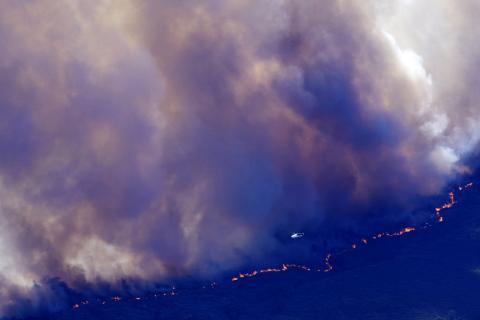
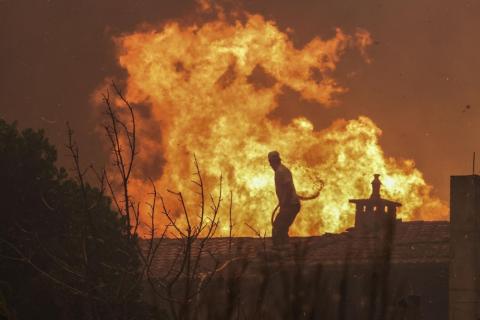
Human-induced climate change has made the ‘extreme’ weather conditions that fuelled the recent wildfires at least twice as likely in France and 20 times as likely in Spain, according to a new analysis by World Weather Attribution (WWA). The team analysed historical weather observations and used the Daily Severity Index (DSR), which incorporates heat, drought and wind conditions and reflects the difficulty of extinguishing a fire. The researchers examined the seven-day period with the highest DSR in south-western France and central Spain, where the fires occurred, and compared it with simulations of a pre-industrial climate. According to the study, under current climate conditions, events of this intensity are projected to occur once every 20 years in south-western France and once every six years in central Spain.
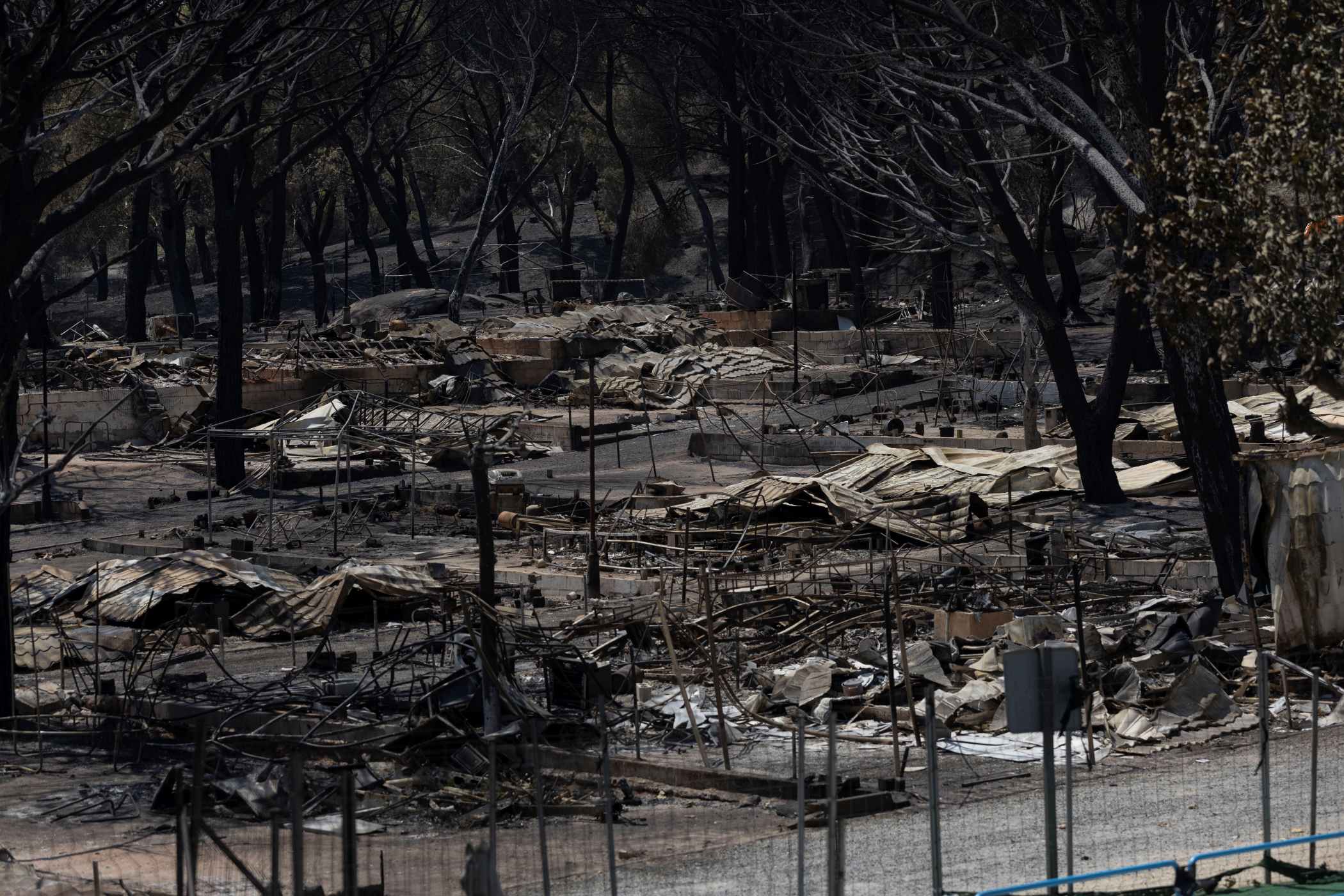
Damage caused by the fire in the western mountains of Madrid. EFE/Rodrigo Jiménez.
260731_Maria Jose Sanz_WWA incendios
María José Sanz
Scientific Director of the BC3 Basque Centre for Climate Change
The forest fires in south-western France and central and eastern Spain are unusually intense – they are mega-fires. This study indicates that climate change and forest management have a clear impact on changes in the behaviour of these fires.
In both France and Spain, the fires are of extraordinary magnitude; the areas ravaged by fire since the start of 2026 in both countries far exceed 100,000 hectares. They have been fuelled by the climatic conditions preceding the events, characterised by a prolonged lack of rainfall and temperatures close to, and at times exceeding, 40 °C during several consecutive heatwaves. In Spain, January 2026 was the wettest in the last quarter of a century, which encouraged abundant vegetation growth, followed by an unusually hot and dry spring and summer which drastically reduced soil moisture and dried out the biomass, leading to a build-up of fuel in forests, scrubland and grasslands – areas which, in many cases, have been neglected in rural areas.
Due to their intensity and scale, these fires are affecting not only ecosystems but also the population, who are being displaced and suffering the loss of their possessions and, in some cases, their livelihoods. They also affect health and are responsible for emissions of pollutants, particularly particulate matter (PM2.5), forcing thousands of people in other cases to remain confined to their homes due to poor air quality.
The evidence suggests that we are living in a new paradigm, in which these fires are now set to become our reality. Prevention through adaptive management tailored to these new circumstances, early warning systems, and cooperation in managing their control and extinguishing ‘must’ form part of this, if we are to preserve our well-being.
Gustavo Saiz - WWA incendios España Francia EN
Gustavo Saiz
Forestry engineer and senior scientist at the National Institute for Agricultural and Food Research and Technology (INIA-CSIC)
According to a new analysis by World Weather Attribution, human-induced climate change has significantly intensified the major wildfires that have recently devastated vast areas of central Spain and south-western France. The fires, described as among the worst ever recorded in both countries, have claimed several lives, destroyed thousands of homes and forced the evacuation of more than 300,000 people. The analysis examines historical weather patterns to assess how fire-prone weather conditions have changed over time. To do this, the researchers used a Daily Severity Rating (DSR), which incorporates heat, dryness and wind conditions, and reflects the difficulty of extinguishing a fire once it has started. The researchers analysed the seven-day period with the highest DSR in the regions where the fires occurred.
The report states that climate change has led to extreme weather conditions conducive to the occurrence of these fires. Under current climate conditions, such high-intensity fires are expected to occur approximately once every six years in central Spain and once every 20 years in south-western France. This demonstrates that climate change is not only intensifying individual fires but is also increasing their synchronisation across all regions, thereby exacerbating the humanitarian and environmental consequences.
Science is, by its very nature, very cautious when it comes to establishing causality. This scientific caution is particularly evident in the field of climate change science, despite the wealth of evidence of a climate crisis that has accumulated over recent decades. Attribution studies, such as those by the WWA, are not based on opinions or viewpoints, but apply rigorous methodologies and only publish results when the scientific evidence is robust. It is an approach designed not to exaggerate in the slightest: if something cannot be proven with a high degree of certainty, it is simply not claimed. That is why, when such a rigorous and cautious organisation concludes that, under current climate conditions, high-intensity wildfires are expected to occur approximately once every 20 years in south-western France and once every six years in central Spain, or that the conditions that fuelled the wildfires in Spain and Portugal in 2025 are 40 times more likely due to climate change, this is not an exaggeration: it is, if anything, a conservative estimate.
A report such as this is only published if the evidence is solid. The fact that the most cautious scientific community is issuing such a stark warning should not only alarm us, but spur us to act now, by cutting emissions and preparing our ecosystems and societies for the stark reality that is already upon us.
Víctor Riera - WWA incendios España Francia EN
Víctor Riera
Project technician at the Pau Costa Foundation
The article analyses the magnitude of the extreme events associated with the recent wildfires in Spain and France, using an existing protocol (Philip et al., 2020) and a well-established index as a benchmark (e.g. Calheiros et al., 2020; Silva et al., 2023). Furthermore, it compares the results with a climate 1.4 °C cooler, representing a world without human-induced warming (based on Forster et al., 2026). The team concludes that, whilst the expected return period for these events is somewhat unusual, the intensity of the DRS index has increased by >40% for both countries compared with a climate that is 1.4 °C cooler, attributing this to the combination of a very wet winter—with high precipitation levels that promote vegetation growth—and an extremely hot summer, leaving a large amount of dead fine fuel available to fuel these fires. It also analyses trends in soil moisture and surface temperature relative to the historical time series to clarify the influence of these drought conditions on fire risk.
Whilst other specific variables have not been considered – such as synoptic conditions and their impact on local weather, or whether this year we are facing truly anomalous conditions – the article provides a thorough review of the literature and current data, prompting us to reflect on whether we are facing an anomalous year or a genuine trend that is becoming increasingly common. It goes on to review the literature on changes in land use, which have increased the population’s vulnerability, and the effects of fires on air quality, with a direct impact on our health. The article is, above all, a wake-up call in the wake of recent events – events which are not only historically significant in their own right, but which have also occurred simultaneously and earlier than usual in terms of seasonality – warning of the consequences these extreme events will have both for the populations directly affected (evacuations, losses, exposure to smoke) and for the rest of the population (carbon emissions, pollution, land management).
Eduardo Rojas - WWA incendios España EN
Eduardo Rojas Briales
Lecturer at the Polytechnic University of Valencia and former Deputy Director-General of the FAO
Is the research of high quality?
“The research is based on meteorological and atmospheric analyses carried out in record time. It is limited to this aspect of the fires, without taking into account others such as topography, fuel load and continuity, ignition, or the complex situation posed by an urban-forest interface fire such as the one in western Madrid.
It is claimed that meteorological severity was 20 times greater than in pre-industrial times. However, there is a lack of detailed meteorological data from that period, and it is only through indirect evidence that we can ascertain the average temperature, but not the fluctuations that occur over relatively short timeframes such as heatwaves (7–10 days).
There is talk of extremely low rainfall in July, ignoring the fact that south of the 40th parallel – where the major fire in western Madrid occurred – average July rainfall has been negligible for as long as records have been kept (INM 1931–60), that is, less than 10 mm for the month as a whole.”
How does this fit with the existing evidence?
“All data on the area burnt comes from Copernicus, which essentially identifies the perimeter of the fire very quickly, but does not cross-check this against land-use data, nor does it assess areas within the fire that have only been superficially burnt—such as stubble fields in cereal crops, which obviously do not result in the loss of forests. It should be noted that in 2025—cited as a record year in Spain—Copernicus reported 400,000 hectares, but MITECO subsequently reduced the area to 300,000 hectares of forest, of which only one-third—that is, 100,000 hectares—was actually forested.
It is not possible to attribute causes to the fires within such a short timeframe, as these are merely working hypotheses put forward by the security forces or even media reports, which will take time to be confirmed or refuted.
The very nature of an urban-forest interface fire in an area with a high number of scattered dwellings in rural/forested terrain – following another recent fire that claimed a significant number of lives and had a considerable impact on tourism in Spain – entails, on the one hand, significant social and media pressure and, on the other, the obvious risk that the fire will be left unattended during the crucial initial hours, making it impossible to extinguish within a reasonable timeframe – a situation that has more to do with prioritising people and homes over forest and agricultural areas”.
What are the implications for fire management?
“Firefighting specialists recognise that global warming and the increased instability of the atmosphere exacerbate critical weather conditions should a spark end up causing a forest fire. But for this to happen – and, above all, for it to develop into a mega-fire – it is necessary that the fire is not tackled (or cannot be tackled) correctly at the outset in an area with substantial resources, and that there is an irresponsible vertical and horizontal continuity of combustible material ready to burn.”
Are there any significant limitations that need to be taken into account?
“Relying solely on meteorological analyses without considering the specific conditions of the fire and the affected area, as well as the management of the fire-fighting operation.”
Francisco Doblas - WWA incendios España Francia EN
Francisco J. Doblas-Reyes
ICREA Professor, Director of the Earth Sciences Department at the Barcelona Supercomputing Center
The report is the result of a preliminary analysis of the role that human-induced climate change has played in the occurrence of the July 2026 wildfires in Spain and France. The analysis is limited because the attribution of these extreme events focuses on the meteorological conditions that give rise to wildfires and, more specifically, on the Daily Severity Rating (DSR) indicator. Furthermore, it provides a detailed description of the progression of these fires, as well as the vulnerability and exposure (which are essential for analysing both impact and risk) of local and regional societies and ecosystems, thereby helping to understand the significant challenges caused by the combination of climatic and non-climatic factors.
The results indicate that climate change plays a significant role in the conditions that favour the occurrence of these events. Of course, there is a degree of uncertainty in these results which can only be reduced by combining them with results from alternative attribution methods, as has been done for other events. However, the figures themselves are not as important as the repeated evidence of the influence that climate change has on the weather conditions conducive to the occurrence of major wildfires.
It seems important to highlight the impact these fires have had on human health, both in the affected areas and in more remote regions, due to the combination of very poor air quality and recurring heatwaves, the characteristics of which are also influenced by climate change.
One of the report’s key messages is the complexity of the causes of these events. Against a backdrop of ongoing climate change and its impact on physical factors such as rising temperatures and declining soil moisture, it seems clear that there is an urgent need to coordinate efforts to reduce vulnerability and exposure with actions to adapt to climate change. Of course, this must always take into account the limits of adaptation and the possibility that the decisions taken may lead to maladaptation.
Clair Barnes et al.
- Research article