The rapid spread of extreme fires can lead to long-term changes in vegetation
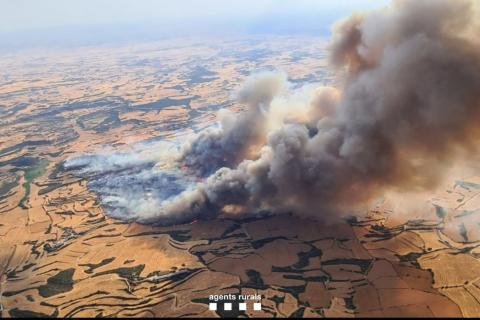
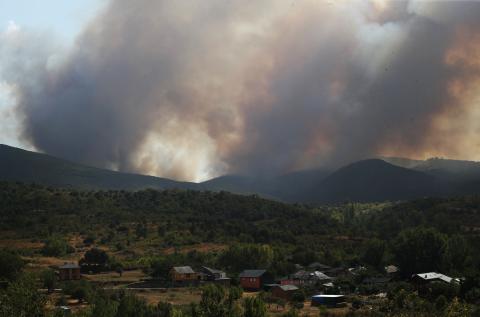
A study published in Science Advances has shown that areas affected by extreme wildfires – characterised by rapid spread and great difficulty in extinguishing them – have lower tree cover and reduced resilience compared to less intense fires, which may lead to long-term changes in vegetation. The team analysed 32.1 million hectares of coniferous forest in Canada and the western United States that were affected by fires between 2012 and 2023. Of this area, more than a third was burnt by extreme fires. In these cases, they observed that the faster the fire front advances, the greater the size and severity of the fire and the greater the distance from seed sources for the surviving trees, paving the way for long-term changes in vegetation.
Fernando Ojeda - incendios Norteamérica
Fernando Ojeda
Professor in the Department of Biology (Botany Section) at the University of Cádiz and researcher with the 'Ecology, Evolution, and Conservation in Terrestrial Ecosystems' (ECOTER) group
The article shows how fires in coniferous forests in the boreal and mountainous regions of North America are becoming increasingly extensive, severe and are spreading at a faster rate. Despite the methodological limitations arising from the exclusive use of satellite data and its relatively coarse spatial resolution – as the authors themselves acknowledge – the results are compelling. The increase in days of extreme weather due to climate change, combined with the higher tree density caused by decades of total fire suppression, has created the perfect conditions for mega-fires to occur in these boreal and mountainous coniferous forests. To reverse this trend, the authors propose restoring low-severity fires through tree thinning and the use of prescribed burns.
This study invites reflection on the situation regarding fires on the Iberian Peninsula. The massive afforestation of pine trees during the second half of the 20th century has resulted in extensive, homogeneous conifer plantations—in many cases with high tree densities associated with a neglect of management—within a Mediterranean landscape where fire—a different kind of fire—is an intrinsic component of the ecosystem. It is true that the peninsula has native pine forests (such as the natural stands of Pinus pinaster or P. halepensis), but 20th-century management ‘domesticated’ and propagated them, carrying out afforestation on an unimaginable scale to convert the countryside into timber plantations, whilst neglecting the long-term consequences. If we add to this abundance of fuel the increase in days of extreme weather due to climate change, the result was predictable: uncontrollable mega-fires. It is not just how much burns, but how it burns. These continuous forest stands destroy the natural mosaic, homogenise the landscape and impoverish biodiversity. And, when they burn, they destroy the resilience of the land. Admittedly, they proved highly productive. The question is: for whom?
José Pipo - incendios Norteamérica
José V. (Pipo) Roces-Díaz
Professor at the University of Oviedo, researcher at the Joint Institute for Biodiversity Research (IMIB) of the CSIC-University of Oviedo
Often, what concerns the scientific community regarding global change is not (just) the scale of the changes, but the speed at which they are occurring. This applies to many processes, from the rate of species extinction to the accumulation of CO₂ in the atmosphere.
Indeed, in recent years (and weeks), during some particularly problematic episodes of forest fires, we have heard reports in the media of incidents where the fire is moving very quickly and spreading at abnormally high speeds. This is particularly worrying when those speaking about it are the people directly involved in firefighting, for obvious reasons.
A group of fire scientists, with extensive experience in analysing forest fires, their ecology and their impacts in North America, also focuses on speed in this study. In this case, they seek to identify relationships between the speed at which fires spread and some of their other characteristics (for example, their environmental effects). To this end, they have compiled data on nearly 3,500 fires that have occurred over more than a decade in the western and boreal regions of North America, in forested areas dominated by coniferous species. It is worth noting that this extensive study area generally includes territories where fire is, by nature, a key and frequent element in the functioning of ecosystems.
The dataset they use appears robust and encompasses a wide range of environmental conditions; however, despite this heterogeneity, the pattern of the results seems fairly consistent. Overall, they find a positive relationship between the rate of spread and the severity of the fire, which is a good measure of the fire’s impacts. In other words, fires that spread more rapidly are also, a priori, associated with more severe impacts.
Extreme-behaviour fires are becoming increasingly frequent across much of the planet and are even being observed in areas where they had never previously been recorded (or where they were very rare). They therefore constitute one of the main concerns of the scientific community. This is due both to their effects on society (for example, loss of life and material property) and to their impacts on ecosystems, their ecological functioning and their natural values. This study adds another piece to the puzzle of understanding these fires: it is not only the extent of the burn or the intensity of the fire that matters, but also the speed at which they spread, as all these variables are interrelated.
Eduardo Rojas Briales - incendios norteamérica
Eduardo Rojas Briales
Lecturer at the Polytechnic University of Valencia and former Deputy Director-General of the FAO
Are the research findings supported by robust data?
“The article is of high scientific quality and methodologically sound, and is consistent with other research in the same geographical area. It is written in a precise and objective manner.”
Are there any limitations to the analysis?
“There are limitations to the approach, as it does not pay sufficient attention to variables other than climatic ones (such as historical factors, for example). Throughout North America, the indigenous population, from the time of their arrival—which coincided with the end of the last ice age—carried out systematic controlled burns across the entire territory. It was white colonisation that brought these burns to a halt for reasons such as the spread of disease, confinement to reserves, conflicts, the erosion of rights, and so on.
This led to more than a century of neglect of prescribed burning and the indigenous peoples’ traditional knowledge, resulting in forest management being limited to intensive exploitation, where access was minimal but neither reforestation nor subsequent silvicultural treatments were carried out. The increase in fires gave rise to a systematic fire suppression policy from the 1960s onwards.
Added to all this were policies regarding strictly protected areas, where fuel accumulation was even greater, particularly as a result of the campaigns in the late 1980s to save the spotted owl, which prohibited logging across vast tracts of land.
At the same time, the effects of climate change reached North American forests in the 1980s and 1990s, bringing severe infestations of bark beetles (coleoptera), which led to enormous accumulations of dead fine fuel—the ideal fuel for megafires. It should be noted that, unlike in Europe, the influence of the sea is felt only on the Pacific coast and in Alaska. In the rest of boreal North America, the climate is much drier during the growing season than in Eurasia, both in terms of precipitation and ambient humidity.
The observation period used in the article (between 2002 and 2021) is relatively short for this type of analysis, probably due to a lack of precise data of the required quality.
Regarding the trend towards a concentration of the largest burnt areas in a very small number of fires, this had already been predicted 20 years ago as part of the FIRE PARADOX project, highlighting that a policy focused solely on fire suppression is not only costly but also has very limited scope.
Finally, it should be noted that the national forest inventories of Canada and the United States do not confirm a reduction in stocks of forest biomass in either country to date.”
How do these findings relate to fires in Spain?
“Spain has a different climate and a much higher population density, which means the study’s conclusions cannot be directly applied. It is true, however, that climate change is extending the windows of opportunity for large fires, so maintaining managed land by reducing vertical and horizontal continuity is key.
The fact that North America is the continent with the highest incidence of lightning strikes as a cause of fires is of particular relevance to the mountainous interior of Spain, especially in the north-east, where this cause lies behind many of the largest fires and requires greater attention due to its clear upward trend”.
How do tree species (conifers in this case) influence the spread of fires or subsequent recovery?
“In boreal climates, conifers are the most mature (climax) species due to their resistance to the cold, whilst the few species of broad-leaved trees either colonise humid areas or play a purely pioneer role (birch), which is somewhat less pronounced in North America due to lower ambient humidity.
On the other hand, a significant proportion of North American boreal forests consist of larch (Larix), which is considerably less combustible. One specific point in the article is the mention of a single species (Populus tremuloides) as a possible alternative. However, it does not consider that a determined expansion beyond its natural range might be highly forced and could entail other types of risks, including a possible lack of viability.”
Coop et al.
- Research article
- Peer reviewed