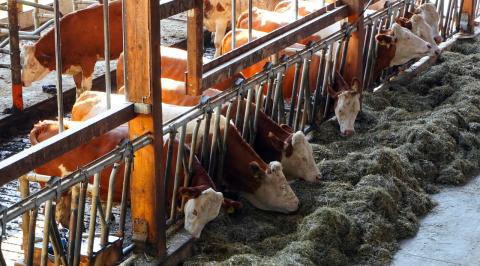
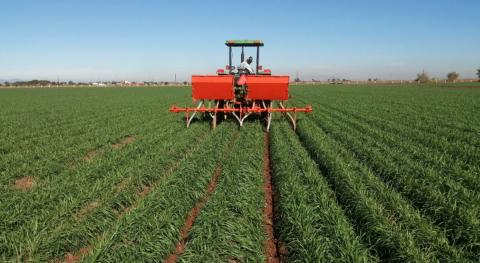
A study calculates how agricultural employment will change due to the transition to healthier and more sustainable diets
The adoption of plant-based diets could reshape agricultural employment worldwide. This is the main conclusion of an international study that estimates that by 2030, between 5% and 28% less agricultural labour would be needed, i.e. between 18 and 106 million fewer full-time jobs. The countries most affected would be those with agriculture based largely on livestock farming, while others, especially low-income countries, could need between 18 and 56 million more workers to grow fruit, vegetables, legumes and nuts. The study is published in The Lancet Planetary Health.
Fernado Pinto - Lancet empleos agricultura EN
Fernando Pinto Hernández
Professor of Applied Economics at Rey Juan Carlos University
The study makes a contribution of remarkable methodological quality by analysing how the global transition towards more plant-based diets could alter the structure of agricultural employment. The work combines detailed inventories of labour requirements with a global biophysical model of food systems, offering a country-by-country map of possible changes in labour demand. This approach has the merit of quantifying a phenomenon that has been little explored (the relationship between dietary transformation and the structure of rural employment), although it should be read as a simulation exercise, not a prediction. The model does not incorporate the price, productivity or technological substitution responses that characterise the real dynamics of labour and agricultural markets.
In general terms, the authors conclude that the reduction in intensive livestock farming would decrease overall labour demand by between 5% and 28%, while the expansion of horticulture could generate between 18 and 56 million new jobs. This shift in labour reflects a process of reallocation rather than a net loss, provided that there is capacity for adaptation and well-designed transition policies. The magnitudes are consistent with historical evidence of structural changes in agriculture, where improved productivity and mechanisation have reduced employment but increased value added and income.
For Spain, the impact would likely be limited, given the high degree of mechanisation, productive diversification and the lower relative weight of extensive livestock farming compared to other countries. However, some regions could experience significant adjustments. The key will be to combine sustainability and efficiency: accompanying the transformation of the food system with technological innovation, job training and trade liberalisation, avoiding rigid regulatory approaches that distort resource allocation or compromise the competitiveness of the agricultural sector.
Tomás García - Lancet empleos agricultura EN
Tomás García Azcárate
Agricultural economist specialising in the Common Agricultural Policy and agricultural markets, associate researcher at CEIGRAM, member of the Advisory Council on European Affairs of the Community of Madrid and of the Committee of Experts of Foro Agrario
Is the study of good quality?
‘The study is interesting and original, as it rigorously addresses a topic that has not been addressed before, at least to my knowledge: the labour consequences (or labour needs) of a global change in diet, a change that would undoubtedly have positive consequences for the sustainability of the planet.’
What are its limitations?
"Both in the introduction and in the conclusions, important limitations of the work are not made explicit. It is an academic exercise that does not incorporate into its methodology the technological change that will reduce labour needs or the impracticality of a change of this magnitude. Nor do they mention the other side effects that a change of this magnitude would have on the environment, such as (among others) the increase in water requirements generated by new crops, in particular fruit and vegetables; the necessary investments; or the environmental impact on the territory of the decline in extensive livestock farming."
What repercussions will this change have for Spain?
Encouraging a change in diet is an important element of the necessary climate change adaptation and mitigation strategy, but the article demonstrates its limitations and highlights one of the obstacles standing in its way.
As an intellectual and academic exercise, it is therefore of interest, even in the case of Spain. Its results confirm the need for a complex, multisectoral and multifactorial sustainability strategy to make what is necessary possible."
Carlos Astrain - Lancet empleos agricultura EN
Carlos Astrain Massa
Director of the Forestry and Agrosystems Division of the Navarre Government's public company “OREKAN Gestión Ambiental de Navarra” (Navarre Environmental Management),
The work carried out by the authors and presented in this article responds to an important global treatment of agricultural and livestock production data, as well as the labour involved in the different areas of the primary sector, from the perspective modelled by the future assumption of healthier and more sustainable diets by the world's population. All of this is based on the premises established by the SDGs (Sustainable Development Goals) in terms of climate change mitigation scenarios.
The work carried out is very well supported by a significant number of countries analysed, productive economic sectors involved and variability in the diets explored. On this basis, it can be said that the work is consistent, well argued and provides reliable results based on the hypotheses and calculations established.
Indeed, the changes that would be expected in the labour force needed to maintain desirable and environmentally sustainable diets at the global level are consistent with the results of studies carried out in smaller areas, including results and recommendations already at our local level in various reports by the European Union itself. In our diet as high-income countries, there is an excess of animal protein and vegetable protein should be reinforced, or consequently, as the article in question states, and to put it very simply, there should be a shift of the productive workforce from livestock farming to vegetable production, and even towards the disappearance of part of the former. For all these reasons, the article suggests proposing policies that will advance the challenges that this theoretical near future will present us with.
But fortunately or unfortunately, depending on how you look at it, the human population does not respond as automatically as the models do. And it does not do so because many other seemingly simple issues interfere and, as they are interrelated, alter the initially expected results. Other economic aspects in addition to those included in the article, as well as other cultural and social issues intrinsic to each geographical area of the planet, and the adoption of other simultaneous political measures applied in other areas, may cause us to rethink the scenario presented.
An obvious example would be the reduction to below 5% of workers currently employed in the primary sector in Europe, as established by the model; this would lead to a loss of food sovereignty for the entire continent, placing us at the mercy of third-party imports in a vital issue such as feeding the population. And all this in a current geopolitical situation of total uncertainty in which strategic alliances are being redefined under new protectionist perspectives. See the clause introduced by the US government in its recent trade agreement with China to purchase huge quantities of soya, which alters everything that would theoretically be established.
We could also discuss the possible migration of people from countries categorised as low-income to high-income countries, rather than remaining as the workforce needed in their own countries to stimulate the production of animal and vegetable protein, as established by the models for low-income countries. And it goes without saying that the Global Agenda against Climate Change established by the United Nations is in a weak position to continue to meet its objectives.
For all these reasons, despite the strength of the work carried out by the authors of the article and their correct conclusions about the results they obtain, these may be far removed from what the current global geopolitical scene in which we are immersed ends up establishing; let us hope, always for the good of humanity as a whole.
Conflicts of interest: ‘I have no conflict of interest whatsoever with the subject of the article, the journal or the authors. The opinion expressed herein is solely my own and does not necessarily reflect that of the company I work for.’
Yiorgos Vittis et al.
- Research article
- Peer reviewed
- Modelling