The heat stored in the oceans has reached its highest level, according to the latest Copernicus report
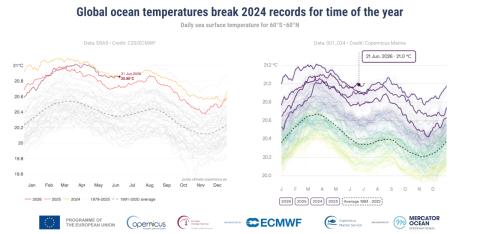
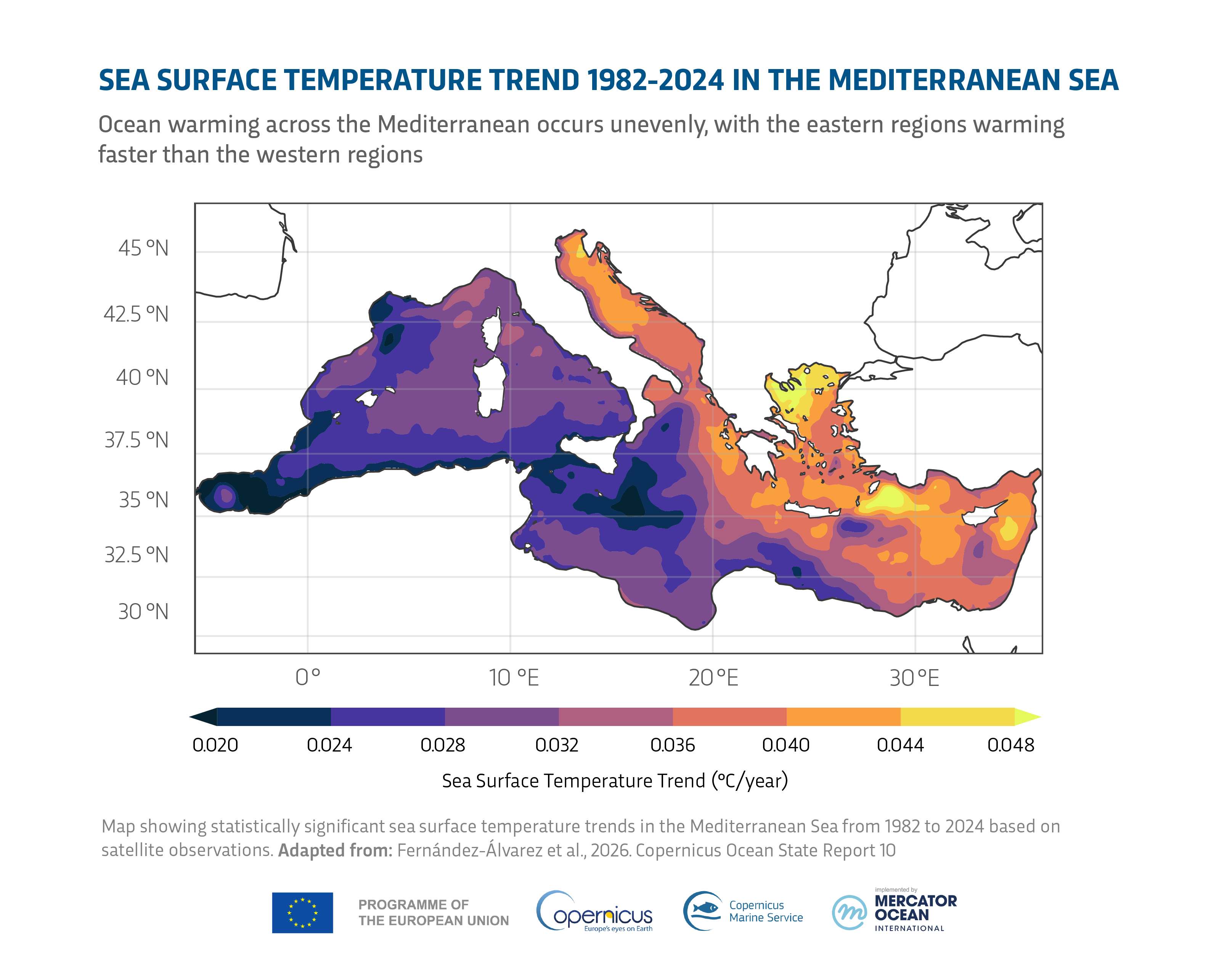
The tenth edition of the Copernicus State of the Ocean Report warns that the oceans are warming at an alarming rate, with consequences for marine life, coastlines and communities around the world. Produced by Mercator Ocean International with contributions from 125 specialists from various countries, the report uses satellite, in situ and modelling data to show that global ocean warming has been accelerating since 1960 and reached its highest level in 2025. With regard to Spain, the report highlights the impact of Storm Louis in late February 2024, which brought waves exceeding eight metres in some places, widespread power cuts, serious disruption at two ports and one fatality. As for the Mediterranean, although sea levels are rising at a similar rate in both the western and eastern Mediterranean, the rate of acceleration in the eastern part is much more pronounced, according to the report.
Copernicus Ocean State Report.
Carlos García Soto - informe océanos Copernicus EN
Carlos García-Soto
Researcher at the CSIC, responsible for the Ocean-Climate System Assessment Unit and collaborator in international United Nations processes on climate change and oceans
The value of this tenth edition of the Copernicus Ocean State Report (OSR10) lies not only in documenting an ocean undergoing change, but also in demonstrating how much our ability to interpret those changes improves when we have sustained observations and different ways of measuring them. The transition from knowledge to action is, in fact, one of the report’s central themes. But translating this into decision-making requires taking into account the differences across scales, locations and types of risk: a global or regional trend does not, in itself, determine how its consequences will play out on a specific coastline.
Global trends indicate the direction in which the ocean is changing; risk is often determined at a local scale. The Mediterranean illustrates this clearly. Sea-level rise is neither uniform nor linear: the western Mediterranean has seen an acceleration since the start of this century, whilst the eastern Mediterranean has shown a more variable trajectory and a recent acceleration; furthermore, local trends may temporarily deviate from the basin-wide trend. Storm Louis provides further evidence of this. Langosteira and Tarragona both exceeded their historical 99th percentile thresholds for wind and wave heights, but the impacts differed: in Langosteira the episode was more prolonged, lasting some 33 hours, whilst Tarragona experienced a shorter but more intense period. The orientation of the ports and the configuration of their breakwaters account for much of this difference. The same extreme event does not necessarily pose the same risk when local conditions change.
In this regard, the factsheet entitled ‘Spain’ should be read as an example of knowledge in action, not as a representative summary of everything the report itself reveals about the ocean surrounding Spain. The OSR10 also contains an improved indicator of surface temperature extremes for the Iberian Peninsula–Bay of Biscay–Ireland region, which combines various observational products and explicitly incorporates their uncertainty; it also analyses local sea-level trends in Barcelona, Ibiza, Mallorca and Melilla. Furthermore, in the Mediterranean context, it records an increase in the number of marine heatwave days, with 2024 seeing the highest number of such days in the last two decades and an average temperature 1.23 °C above the 1982–2024 reference period.
Therefore, one of the report’s most useful lessons for adaptation is that translating ocean knowledge into decisions is not simply a matter of filtering a global signal down to the local level. It requires linking broad trends to observations, infrastructure and conditions specific to each location. Ocean change may be global; the way in which it translates into risk — and many of the decisions needed to address it — is necessarily regional and local.
Ángel Borja - Copernicus calor océanos EN
Ángel Borja
Principal Researcher in the area of Environmental Management of Seas and Coasts at AZTI and editor-in-chief of the journal Frontiers in Ocean Sustainability
The report is a continuation of the reports that Copernicus has been publishing over the last 10 years. The data used are in the public domain and allow the research carried out to be replicated. In this respect, I consider the research to be robust and to provide an up-to-date picture of the state of the oceans, both globally and locally. This makes it a very timely article for understanding what we are facing. However, it is true that the data analysed appear to cover the period up to 2024 (at least that is what is stated in most cases), whilst in 2025 and 2026 the situation has continued to worsen in areas such as sea-level rise, extreme events and heatwaves, as recently highlighted in reports by the European Environment Agency, the UN’s World Ocean Assessment and the World Weather Attribution report, which analyses data right up to the start of this summer.
Overall, the report adds, in a structured manner, new evidence to what was already known – namely, that marine heatwaves, extreme weather events and sea-level rise have been increasing in recent decades and years, and that these phenomena are anthropogenic in origin. As for the implications of these phenomena, the authors provide a good overview of many of them, using language that is accessible to the general public.
I find it particularly interesting that they highlight sea-level rise in the western Mediterranean and certain extreme events we have experienced on the Iberian Peninsula. We have been observing these effects for several years now, and they are certainly set to increase (as they did in 2025–2026), but it seems to be a problem that society tends to downplay (for example, the combined problems of rising sea levels and extreme weather events, which are eroding the Mediterranean coastline, and yet there are still those who insist on rebuilding in places that are undoubtedly set to disappear). It is possible that all this will be exacerbated next year, with the Super El Niño that has formed in the Pacific and is having significant consequences for resources and assets in many parts of this ocean, but which we know will eventually spread to the entire global ocean.
With regard to the report, I do not see any significant limitations that need to be taken into account.
Copernicus
- Report