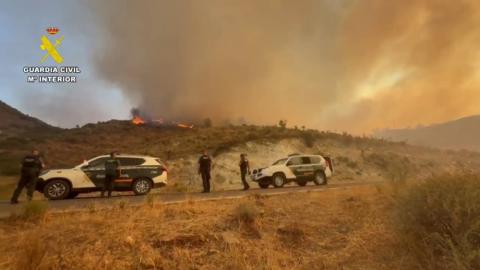
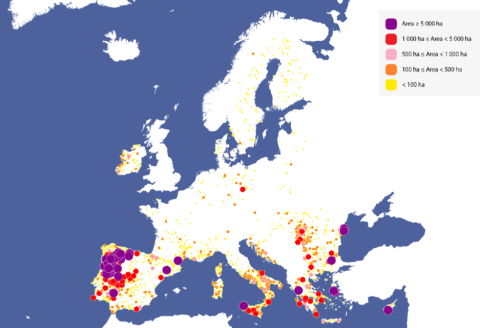
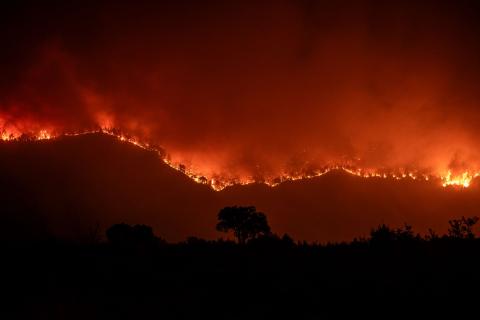
So far this year, almost 120,000 hectares have been destroyed by fire in Spain – one of the highest figures recorded for this time of year
Data from the Copernicus European Forest Fire Information System (EFFIS) show that, as of 22 July, 119,458 hectares have been burnt in Spain. The average number of hectares burnt from 2006 to 2025 up to this date stands at 35,736 hectares. The fire in the Sierra Norte de Guadalajara, which has scorched more than 30,000 hectares and is still active, together with numerous fire fronts in other provinces and the fire in Los Gallardos (Almería), in which 13 people died, have caused the total area burnt to soar.
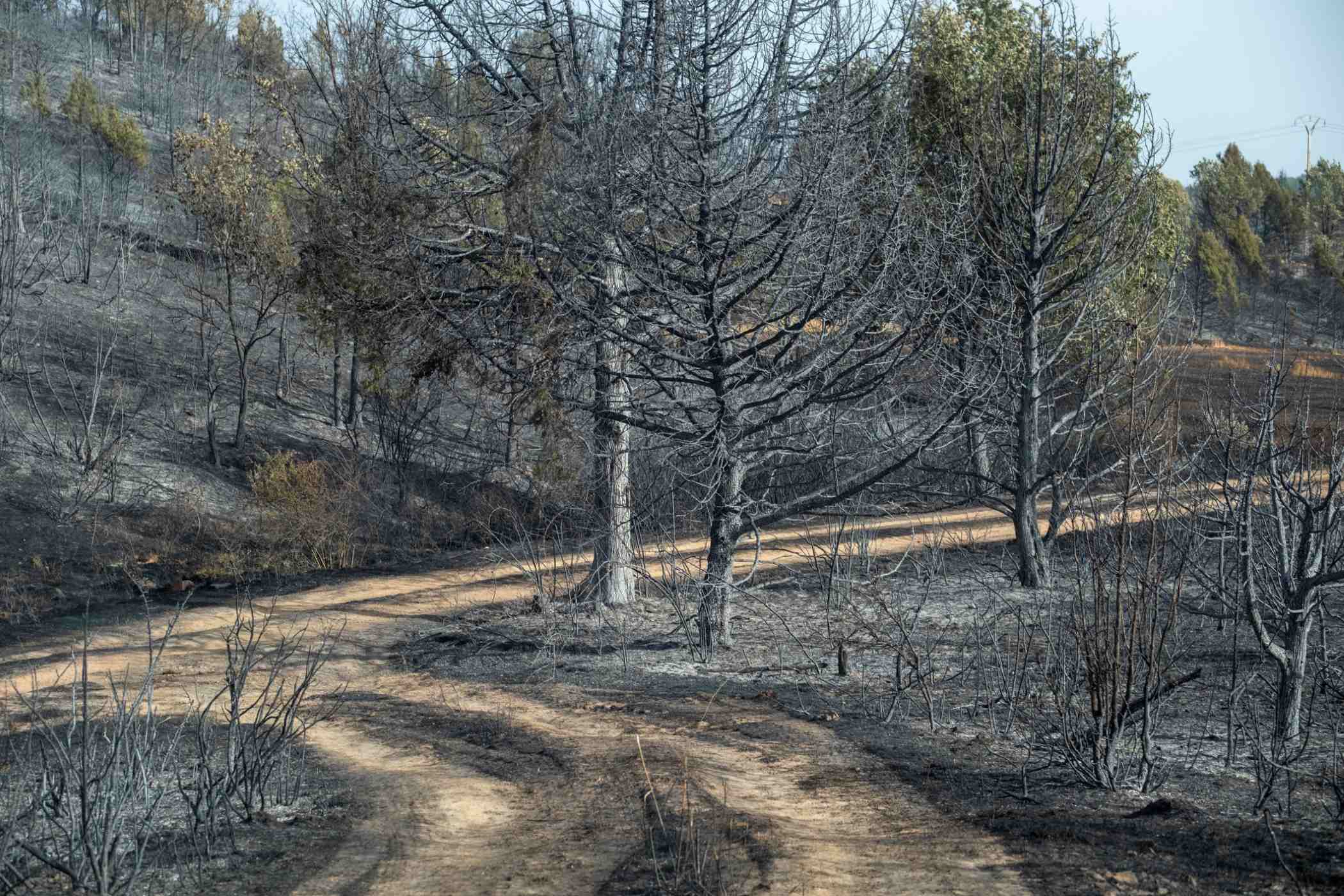
View of the wildfire that broke out in Selas (Guadalajara). EFE/ Nacho Izquierdo.
Víctor Resco - incendios julio EN
Víctor Resco de Dios
Lecturer of Forestry Engineering and Global Change, University of Lleida and researcher at Agrotecnio
July isn’t even over yet, and in Spain almost 120,000 hectares have been burnt so far this year. Did you expect a summer like this?
“We know that the area burnt is increasing and will continue to do so. It’s worth noting that we haven’t yet reached a record figure. In other words, although over the previous decade the annual average was 100,000 hectares burnt throughout the summer, what we have seen in the 2022 and 2025 seasons has been an increase in the area burnt; and in 2022, for example, the area burnt was greater than it is at this point in the year.
We can predict that the area burnt will continue to increase in the coming years if no action is taken, because the intensity of the fires is increasing. The areas where we are likely to see the greatest increases in the area burnt are mountainous, high-altitude regions, which traditionally did not burn because they were very damp. We are talking about areas such as the Pyrenees, the Central Mountain Range, or the Cantabrian Mountains, to give just three examples. As fuel accumulates due to rural depopulation, and as that fuel becomes increasingly dry due to climate change, we will face a greater likelihood of megafires, or extreme fires, because it is in these areas that the greatest accumulations of fuel are found.
Although it is difficult to predict exactly how far this might go, before long we will no longer be able to rule out nightmarish scenarios such as those currently unfolding in California or Australia, with fires or fire complexes covering hundreds of thousands of hectares or even a million hectares. Last year, for example, we saw several fire fronts, each covering tens of thousands of hectares, which, had they merged (and some came very close to doing so), would have resulted in fire complexes of over 100,000 hectares – and that is the situation we currently find ourselves in.”
What has gone wrong with prevention?
“Planning and implementation have failed in the area of prevention. We know what we have to do: we have to manage, at the very least, around one million hectares, and we have to do so intelligently, across different scales. At national or regional level, we need to create containment corridors to break the potential continuity of these mega-fires that can burn tens or hundreds of thousands of hectares.
At the mountain range level, we must focus on strategic management points where fires can spread rapidly, including fire and fuel management as a key aspect within protected areas as well. And at the local level, we must concentrate on municipal prevention plans to protect villages, housing estates and homes scattered throughout the countryside.”
What are your forecasts for the rest of the summer?
“The rest of the summer will be determined by weather conditions and the sources of ignition. For example, last year, from 8 August onwards, a series of fire fronts broke out simultaneously because we experienced a series of thunderstorms that provided numerous ignition points, and this had been preceded by a heatwave that had dried out the fuel.
Therefore, if this year sees a repeat of the scenario involving thunderstorms, combined with heatwaves, we can expect a summer similar to last year’s – or worse – if several fire fronts converge, as we mentioned earlier. Historically, the Mediterranean region has suffered its worst fires in early July and the north-west in August, so we can expect a shift in the fires from the east towards the north-west (although some Mediterranean autonomous communities, such as Andalusia, have also suffered mega-fires in September). However, if it starts to rain and dampen the fuel, we will see the fire season go into hibernation, at least for a few weeks.”
Eduardo Rojas - incendios julio EN
Eduardo Rojas Briales
Lecturer at the Polytechnic University of Valencia and former Deputy Director-General of the FAO
July isn’t even over yet, and almost 120,000 hectares have already been burnt in Spain. Did you expect a summer like this?
“As far back as our records go, July is the worst month – with very few exceptions – as it is when the days are at their longest and, as a result, there is less chance of dew and the lowest monthly rainfall of the year, as well as a steeper angle of the sun’s rays and less cloud cover. The week beginning 4 July 1994 was by far the one in which the most hectares were burnt in Spain.
From October 2024 to April this year, we experienced a very wet period across the whole of Spain, meaning the load of dry herbaceous vegetation is considerable, given that this was followed by three extremely dry months. At least in dry years, the amount of available herbaceous vegetation is much lower. On the other hand, we are seeing an increase in non-typical forest fires (urban-forest interface: Los Gallardos, Almería; Guadalajara and Aragón), several of which are linked to the cereal harvest in a year of bumper crops, where there are fears of crop loss due to fire, which may lead to a higher incidence of fires caused by combine harvesters. On the other hand, if the harvest takes place, the fuel load is reduced and the land could also be ploughed to create discontinuity in the stubble, given that the lighter the fuel, the faster the fire spreads.
Furthermore, Copernicus estimates tend to overstate the area burnt, as they overlook areas within the perimeter that do not burn for various reasons, as well as non-forested areas (agricultural, urban, infrastructure, reservoirs, etc.). In fact, MITECO confirmed last year that of the 400,000 hectares reported by Copernicus, only 300,000 were forested, of which 100,000 were wooded; thus, despite it being one of the worst years since 2000, the natural expansion of woodland in our country—estimated at at least 130,000 hectares a year—plus reforestation efforts more than make up for even a year like last year in terms of forest area.”
What has gone wrong with prevention?
“It must be remembered that prevention — which is the key to this challenge — has two meanings: the strict or administrative sense, and the comprehensive sense. The first is limited to ensuring sufficient personnel, observation systems, high-quality meteorological monitoring tailored to the local area, monitoring of fuel moisture (indicator species), water reservoirs, accessible roads, clearing of forest tracks, maintenance of firebreaks, and so on. The second also addresses the very widespread state of neglect of forest areas, particularly those located in drier, unprofitable regions that are highly prone to fire, as well as the prevalence of smallholdings, abandoned crops in the process of becoming forest stands, scrubland and grassland—which, in the majority of cases, have been abandoned.
In the first area—which is the one the authorities refer to when asked—we are in reasonably good shape, except for meteorological observations, where the zoning is not detailed enough in mountainous areas—at least in the Mediterranean region—to enable, in the event of a fire, the prediction of wind conditions over the next 6–8 hours and the avoidance of unnecessary risks to firefighting personnel. Meteocat, by contrast, provides the Generalitat’s firefighters with a high level of detail and reliability. Furthermore, as soon as one enters protected areas, the network of forest tracks ceases to be adequate and thus hinders access to the hills in the event of a fire, as was evident at the end of August last year in the Sierra Norte de Guadalajara, where forests at an altitude of 2,000 metres were left to burn simply because they were inaccessible, which is why environmental regulations and the requirement for fire access routes to undergo environmental impact assessments must be reviewed, given that, in the case of projects with far greater environmental impact, ways are sought and found to mitigate them (for example, the expansion of the Port of Valencia).
But the real bottleneck lies in prevention in the broadest sense, where rural depopulation is the central problem – in terms of both its demographic dimension and that of agriculture and livestock farming – and where it is imperative to integrate fire management into the CAP in order to build resilient regions. Vast areas such as those affected this year in Guadalajara and Aragón are characterised by minuscule population densities typical of Lapland or Siberia, despite being surrounded by Spain’s most densely populated areas; moreover, almost the entire population there is retired. As Marta Corella, former mayor of Orea, rightly points out, ‘a village that does not smell of wood will smell of smoke’. We are mistaken if we think we can leave a considerable part of our territory in limbo and without any management. What we are seeing is the backlash from this lack of judgement, exacerbated by the dream of a wild landscape that has not existed here, at least not for the last 500,000 years, since humans first mastered fire.”
What is your forecast for the rest of the summer?
“There’s no sign of an improvement in weather conditions for the time being, although the average suggests that August usually brings an improvement in terms of rainfall — though also a higher risk of lightning — longer nights and less direct sunlight. We must also bear in mind that the drought currently affecting France is on an epic scale and that we might not be able to rely on resources from other countries if the situation worsens in our region. On a positive note, Portugal is having an average year and we hope it does not get any worse.”
Juan Caamaño - incendios julio EN
Juan Caamaño
Head of Training at the Pau Costa Foundation
July isn’t even over yet and almost 120,000 hectares have already been ravaged by fire in Spain. Did you expect a summer like this?
“Yes, we did expect it; it was one of the lessons learnt from last year. We can no longer rely on winter or summer rains to ensure a quiet fire season as we used to. The extremely intense and widespread heatwaves we’re experiencing are what’s triggering these fires and these extreme fire seasons that we’ve been facing since 2021, starting with the two fires in the Sierra Culebra – which burnt more than 60,000 hectares – and the one in Navalacruz, which burnt a further 20,000 hectares.
For me, that was the real turning point, which was cemented last year by what we experienced in August and what we are already experiencing in July. It is the heatwaves that are the real drivers of these extreme fires, not droughts as they were in the past.”
What has gone wrong with prevention?
“The concept of ‘prevention’ in the context of wildfires is a highly complex issue that must address many different levels: social factors, land-use management, regional and local plans, the concept of self-protection within our society, and so on… This cannot be tackled from one year to the next; it requires a way of understanding risk that fosters a culture at all levels – social and political – which prioritises prevention in all its dimensions, as I mentioned earlier. This takes time and a cultural shift in how we face the risks we encounter as a society. The idea of clearing the woodland is a very, very simple concept for an extremely complex structural problem.”
What are your predictions for the rest of the summer?
“The further into the summer we go, the worse it will get, as more fuel will be added to the equation, although it already seems that all the conditions are in place, judging by the patterns observed in many places; because as long as it doesn’t rain, the condition of the fuel will continue to deteriorate.
All we can do is keep an eye on the wind and the dry thunderstorms, which can cause the number of fires to multiply in a very short space of time and overwhelm the emergency services. These two factors are what will truly determine how the fire season ends. We still have two tough months ahead of us.”
Cristina Santín - incendios julio EN
Cristina Santín Nuño
Tenured Scientist and Honorary Associate Professor at the Joint Research Institute for Biodiversity (University of Oviedo–CSIC–Principality of Asturias) and Swansea University (United Kingdom)
July isn’t even over yet, and almost 120,000 hectares have already been ravaged by fire in Spain. Did you expect a summer like this?
“Following the catastrophic season of 2025, 2026 is shaping up to be difficult as well. Last year we had very hot and dry conditions at the start of summer, but a very wet spring and a relatively mild July, which helped to delay the peak of the fires until the extraordinary heatwave in August.
This year, 2026, we’ve had a very wet winter, but a relatively dry spring and a very dry June, meaning that residual moisture has been lost more quickly and the heatwaves we’ve experienced so far are already fuelling the spread of the fires.
In this respect, 2026 is looking more like 2022, which was also one of the worst years for fires in recent decades. That year, an extremely dry winter and a meteorological drought that the spring rains failed to reverse contributed to the wave of fires arriving earlier than in 2025, with around 200,000 hectares burnt by 22 July (according to EFFIS).
What has gone wrong with prevention?
"What is happening now is not just a matter of failures in prevention. Of course, improving prevention is a priority and, although more is indeed being done in this regard in the wake of the latest catastrophic waves of fires, we must demand, as a society, that even more be done. But I believe it is also important to understand that, however effective prevention measures may be, the risk of major fires is increasing.
This is due to a combination of factors: in large parts of Spain today, there is more vegetation and, above all, a greater continuity of fuel, mainly due to the abandonment of traditional land uses in rural areas; furthermore, this vegetation spends more days a year ‘ready to burn’ because of climate change. As I say, we live in a Spain with a higher risk of major wildfires and we must accept this and prepare to minimise the impacts they may bring.”
What is your forecast for the rest of the summer?
“The heatwave we are currently experiencing should end in a couple of days, which would, in principle, provide some respite, at least from a meteorological point of view. As for the rest of the summer, according to the AEMET, it is expected to be warmer than normal, but there is no clear forecast regarding rainfall, and how all this will affect fire activity is unclear at the moment.”
Víctor Fernández - incendios julio EN
Víctor Fernández-García
Lecturer in the Department of Engineering and Agricultural Sciences at the University of León
July isn’t even over yet and almost 120,000 hectares have already been ravaged by fire in Spain. Did you expect a summer like this?
“Unfortunately, summers like this are becoming increasingly predictable. Short-term factors, such as a rainy spring, are combined with long-term factors. The latter include changes in land use, which have led to a significant build-up of vegetation across the landscape, and climate change, which results in higher temperatures and more extreme weather events. With regard to the climate, a recent study estimated that the weather conditions that fuelled last summer’s severe fires were previously expected to occur once every few centuries, but could now happen every 15 years.”
What has gone wrong with prevention?
“Many things are going wrong, but above all, there is a lack of forest management. This can be addressed by increasing investment in forest management, but sometimes it doesn’t take much money to reduce risks. For example, little progress has been made in the use of prescribed burning, a viable and relatively inexpensive tool for reducing the amount of accumulated vegetation and creating breaks in the landscape. If there is a lot of fuel, when a fire breaks out it can quickly reach an intensity and scale that are difficult to control. Carrying out small, planned burns during low-risk periods can help prevent much more dangerous fires.”
What is your forecast for the rest of the summer?
‘The outlook for the rest of the summer is not good, because the vegetation is already very dry and there is still a good part of the summer to go. If high temperatures and low humidity coincide again, the risk of further major fires will be high, as we have landscapes with a high structural risk (that amount of fuel and its continuity that I mentioned earlier, as well as a high concentration of villages and homes in areas of some risk).’
Jesús Notario - incendios julio EN
Jesús Santiago Notario del Pino
Professor of the Department of Animal Biology, Edaphology and Geology of the University of La Laguna
July isn’t even over yet and almost 120,000 hectares have already been destroyed by fire in Spain. Did you expect a summer like this?
“Yes. The scale of the fires is getting bigger and bigger. The CREAF in Catalonia tells us that forest cover in Spain has increased by 20 per cent over the last three decades, so there is more and more fuel (the exodus from rural areas is surely behind this), and last winter was very wet. The summer is proving to be very hot, in line with the trend of recent years. It shouldn’t come as too much of a surprise, in my opinion.”
What has gone wrong with prevention?
“Talking about a ‘failure’ is a sensitive issue and can have implications I’d prefer to avoid. The amount of fuel is growing, and there aren’t the resources (or not enough resources are being allocated) to prevent a situation like this. An example: Castile and León has a larger land area than Portugal but only 10 per cent of its GDP. The regional government does not have sufficient resources to prevent major fires across its entire territory. There are opportunity costs (the money that could be allocated to fire prevention is instead channelled into other purposes which, for whatever reason, are considered a priority), and the maintenance and management of woodland require staff and resources; that costs money. Sometimes there hasn’t been a failure as such, but rather a practical impossibility of taking effective preventive action.”
What is your forecast for the rest of the summer?
“It will depend on how temperatures develop and the duration of the heatwaves. If they continue as they have done so far, the situation will surely worsen, as the fuel will dry out even further and that will make everything more difficult. That is what I foresee, but I hope I am wrong.”
Fernando Ojeda - incendios julio EN
Fernando Ojeda
Professor in the Department of Biology (Botany Section) at the University of Cádiz and researcher with the 'Ecology, Evolution, and Conservation in Terrestrial Ecosystems' (ECOTER) group
Unfortunately, I did expect a summer like this in terms of wildfires, and the coming summer won’t be much different. That’s to be expected when vast areas of pine or eucalyptus are planted in a Mediterranean landscape. That is what has been done in many parts of the Iberian Peninsula (including Portugal) since the mid-20th century. If we add to that the extremely high temperatures and extremely low humidity associated with summer heatwaves (one of the manifestations of current climate change), the recipe for disaster is complete.
It is curious that everyone points the finger at the arsonist/idiot/careless person who started the fire, but nobody points the finger at those who planted that vast pine or eucalyptus forest there; in many cases, poorly managed ones. In fact, the link between the extent and severity of the fires and the alarming continuation of pine (or eucalyptus) afforestation across the landscape is rarely mentioned. And yet it exists. The recent fire at La Mierla (Guadalajara, 2026) is a telling example. The environmental damage caused by these plantations predates the fire, but culminates with it.