Nobel Prize in Physics Awarded to Francis Halzen for the discovery of high-energy neutrinos of astrophysical origin and for his “decisive contributions” to the IceCube Observatory
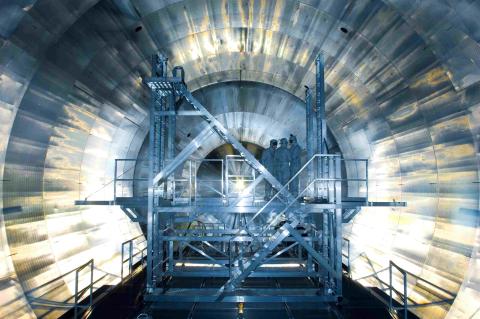
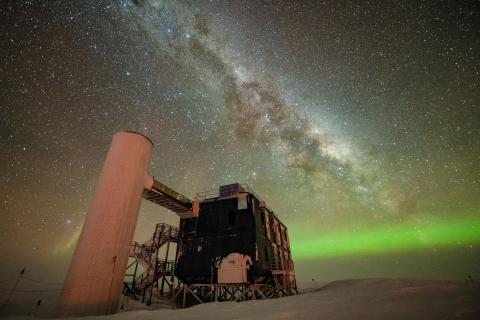
The Royal Swedish Academy of Sciences has awarded the Nobel Prize in Physics to Francis Halzen, the driving force behind the idea of using ice at the South Pole to detect particularly elusive particles known as neutrinos. According to the Academy, his “decisive contributions” have been fundamental to the development of the IceCube Neutrino Observatory: a cubic kilometer of ice equipped with light sensors that allows the scientific community to detect neutrinos originating from extremely high-energy processes in the distant universe, laying the groundwork for an entirely new field of astronomy.
David Alonso-González - Nobel Física 2026
David Alonso González
Researcher at the UAM-CSIC Institute of Theoretical Physics and in the Department of Theoretical Physics at the Autonomous University of Madrid
Halzen’s Nobel Prize recognizes the importance that particle astrophysics—and, in particular, neutrino astrophysics—has gained in recent decades. Neutrinos are extraordinarily difficult to detect due to their weak interactions with ordinary matter, but precisely because of this, they can travel enormous distances without being absorbed or deflected, acting as “messengers” that allow us to observe astrophysical phenomena that cannot be studied in the same way using light.
IceCube, the experiment whose development was spearheaded by Halzen, has succeeded in identifying very high-energy neutrinos—even in the order of PeV (hundreds of times more energetic than the particles we produce in colliders such as the LHC at CERN), and has managed to link some of these neutrinos to specific astrophysical sources, such as active galaxies, opening a new window for studying the most extreme natural particle accelerators in the universe.
The award thus recognizes not only a specific discovery but also a direction that, in my opinion, will become increasingly important for the future of particle physics: studying fundamental physics not only in terrestrial accelerators but also through the detection of messenger particles that reach us from the deep universe.
Nataly Ospina - Nobel Física 2026
Nataly Ospina
Francis Halzen is not only the leader of IceCube and a key figure in neutrino astrophysics, but also one of the leading advocates of multi-messenger astronomy. I believe this recognition is well deserved and marks a very important milestone for all of us working on the detection of neutrinos from astrophysical sources. We are at a decisive stage in this field. Undoubtedly, in the coming years we will witness discoveries that will change the way we understand the universe through neutrinos.
Inés Gil Botella - Nobel Física 2026
Inés Gil Botella
A well-deserved award for Francis Halzen and the entire IceCube collaboration for the discovery of very high-energy neutrinos from astrophysical sources. This recognition highlights the importance of neutrinos, both as fundamental particles and as messengers of the most violent phenomena in the universe. Neutrinos continue to surprise us, and there is still much we do not understand about them.
Undoubtedly, upcoming neutrino experiments currently under construction, such as the DUNE experiment, will help us unravel many of these mysteries.
Juan de Dios Zornoza - Nobel Física 2026
Juan de Dios Zornoza
This is good news for astroparticle physics in general and for neutrino astronomy in particular. And of course, it’s well deserved by Francis Halzen, who was my advisor when I was working as a postdoc on a Marie Curie fellowship in the United States.
Halzen played a decisive role in the construction of Amanda, the first detector of its kind built at the South Pole, and the predecessor to IceCube, which is the largest neutrino experiment currently in operation, also at the South Pole. He has also been instrumental in advancing the projects we’re working on in Europe—first Antares, which operated for several years in the Mediterranean Sea and demonstrated the feasibility of this type of project on the seafloor; and then KM3Net (Cubic Kilometre Neutrino Telescope), which we are currently building in the Mediterranean Sea and which, even though it is still under construction, recently gained widespread fame for detecting the highest-energy superneutrino ever observed—a discovery that made the cover of *Nature*.
This award recognizes Halzen’s work, which has paved the way for the work of many people whose research is now beginning to bear fruit and yield results in experiments that confirm what he predicted.
Bruno Zamorano - Nobel Física 2026
Bruno Zamorano
This award is the crowning achievement of a brilliant career, already marked by numerous accolades, but above all, it is a recognition of the tenacity and determination that—in the spirit of the explorers of the past—took particle physics to the farthest reaches of our planet, thereby opening a new window onto the cosmos.
Juan José Gómez Cadenas - Nobel Física 2026
Juan José Gómez Cadenas
Ikerbasque Professor of Physics at the Donostia International Physics Center (DIPC)
This is an award we have been hoping for for years. It recognizes Francis’s leadership in the construction of IceCube, the massive detector buried beneath the Antarctic ice, which has detected signals from galactic and extragalactic neutrinos, opening up a new field of science: neutrino astronomy.
It is well-deserved and necessary in that it recognizes the importance of basic science.
Carlos Pobes - Nobel Física 2026
Carlos Pobes
CSIC Tenured Scientist of the Q-MAD group at the Institute of Nanoscience and Materials of Aragon (INMA)
I’m focused on other things now, so this has really been quite unexpected—a tremendous surprise and a huge joy. What’s more, it’s been very special that they awarded it solely to Francis Halzen; it’s the first Nobel Prize in Physics in several decades to be awarded to a single person—at least since the 1990s.
It’s recognition of that somewhat crazy idea to build a large telescope at the South Pole. He himself, when they called him today, admitted that he didn’t expect people to support him. He was a visionary with a very special basic science project. Imagine all the work involved in working there under those conditions—drilling 2.5 kilometers through the ice. He had the vision—and also the good fortune—that it would work: just two years after construction was completed, they already had initial indications, and over the past ten years, they’ve been able to confirm the results of that detection of astrophysical neutrinos, in addition to the whole new range of possibilities that’s opening up—the new eyes we now have.
An expansion has already been approved and has been under construction during this latest campaign, and there is also a proposal—which has not yet been approved—to expand and improve the central section in order to detect more neutrinos and collect more data; so Halzen hopes this will help push for the approval of that expansion.
Diego García Gámez - Nobel Física 2026
Diego García Gámez
Neutrinos are particles that interact with matter very rarely, so we need enormous detectors to study them. But that very property also makes them ideal messengers for studying the universe and, in particular, for identifying the astrophysical sources that produce them. Since they are neutral particles and interact very little during their journey, neutrinos reach us without being deflected, and when we detect them, their direction allows us to pinpoint the location in the universe where they were produced. The information they provide is, therefore, complementary to that of other, more common cosmic messengers, such as photons or charged particles like protons. Francis Halzen’s brilliant idea was to use the deep ice at the South Pole as a detection medium and to equip approximately one cubic kilometer of that ice to observe very high-energy neutrinos. Shortly after becoming operational, IceCube succeeded in detecting, for the first time, a population of very high-energy cosmic neutrinos—some with energies vastly greater than those we can achieve in our accelerators—thus opening a new window for studying the most extreme natural accelerators in the universe.
Juan José Hernández Rey - Nobel Física 2026
Juan José Hernández Rey
Research professor at the Spanish National Research Council (CSIC) at the Institute of Corpuscular Physics (IFIC) in Valencia (University of Valencia-CSIC), co-principal investigator of the KM3NeT research team at IFIC and co-leader of the VEGA Group at IFIC
It is a well-deserved award. Professor Halzen, whom we met just two weeks ago, not only proposed the idea of using Antarctic ice as a natural medium for detecting neutrinos, but also pursued this idea with extraordinary determination, even when it was unclear whether a volume of one cubic kilometer would be sufficient to detect the weak neutrino fluxes at those energies.
The “window” into the universe of very high-energy astrophysical neutrinos has gradually opened: first, with the detection of neutrinos coming from all directions, without it being possible to identify their sources; then, with the identification of a transient signal from an active galaxy; later, with the detection of a continuous signal from a nearby galaxy; and, finally, with the identification of neutrinos originating from our own galaxy.
It is, therefore, a tribute to Professor Halzen’s leadership and his determination to overcome a countless series of difficulties and bring to fruition the idea he himself had conceived. It is also a recognition of the IceCube collaboration and its extraordinary scientific, technical, and logistical achievements, and, finally, an endorsement of an entire field: very-high-energy neutrino astrophysics.
More specifically, the Nobel Prize was awarded for the discovery of very high-energy astrophysical neutrinos. The idea that very high-energy neutrinos produced in extremely energetic phenomena in the universe could be observed using large natural bodies of water dates back to 1960. However, the proposal to use Antarctic ice as a detection medium was formulated by Francis Halzen and a collaborator in 1988.
Professor Halzen did not merely propose the idea; rather, with extraordinary leadership and great perseverance, he worked for more than two decades to make it a reality. In 2011, after seven years of construction, IceCube (“the ice cube”) began operating—a detector that occupies more than one cubic kilometer of ice at a depth of over 1,500 meters beneath the surface of Antarctica.
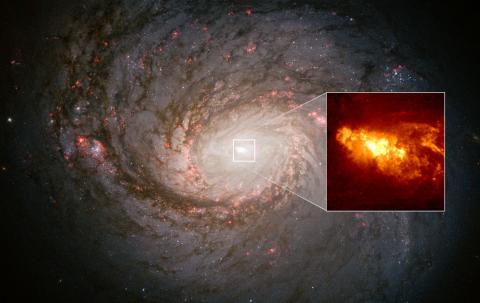
Two years later, in 2013, IceCube made its first detection of very high-energy neutrinos from astrophysical sources located beyond our galaxy, although it was not yet possible to identify their origin. In 2018, a specific source was identified for the first time: a blazar, an active galaxy whose powerful jet of particles points roughly in the direction of Earth. In 2022, IceCube obtained evidence of a continuous neutrino emission from the spiral galaxy M77 (NGC 1068). And a year later, in 2023, it was confirmed that our own galaxy, the Milky Way, is also a source of very high-energy neutrinos.
Sergio Pastor - Nobel Física 2026
Sergio Pastor
The award presented to Francis Halzen is a great recognition not only of his contributions to neutrino astrophysics as the leader of the IceCube collaboration, but also of a discipline in which the staff of the Institute of Corpuscular Physics (IFIC, a joint center of the CSIC and the University of Valencia) plays a very important role through their participation in the KM3Net project. The detection of ultra-high-energy neutrinos from astrophysical sources opens a new window onto astronomy, allowing us to study the universe not only by detecting light at various wavelengths but also by measuring neutrinos or gravitational waves.
This recognition is especially gratifying for our institute, as Professor Halzen has been a member of our international advisory committee for many years and has helped us, through his advice, to improve our research areas and strengthen IFIC’s standing at all levels.
Nuria Rius - Nobel Física 2026
Nuria Rius
Professor at the University of Valencia, former director of the Institute of Corpuscular Physics (IFIC), University of Valencia - CSIC
Francis Halzen leads the ICECube Neutrino Observatory at the South Pole, a pioneering experiment that exemplifies several characteristics of particle physics research: international collaboration, the patience required to achieve observable results, and the need to push the boundaries of what is known—even when it is uncertain what will be found. It is undoubtedly a well-deserved award.
Francis is an excellent, tenacious researcher who has succeeded in opening a new window onto the universe: neutrino astrophysics, which complements our view of space through electromagnetic radiation and gravitational waves. Taken together, multi-messenger astronomy will help us better understand the nature of the universe—an ambition inherent to human beings and the goal of basic science.
Patricia Sánchez-Lucas - Nobel Física 2026
Patricia Sánchez-Lucas
Without a doubt, this award recognizes an outstanding scientist and the leader of IceCube, one of the world’s most successful particle physics experiments, for successfully detecting astrophysical neutrinos in the Antarctic ice.
Today is a day of celebration for the entire neutrino physics community, as this award also recognizes the importance of continuing to study these particles. Everything we still have yet to discover about them will allow us to continue making progress in our quest to unravel the great mysteries of the universe.
Clara Cuesta - Nobel Física 2026
Clara Cuesta
Neutrinos are messengers that reach us intact from extreme cosmic events and provide unique information about them. The 2026 Nobel Prize in Physics honors the IceCube experiment, which has detected them by capturing tiny flashes of light in the ice at the South Pole. For those of us who study astrophysical neutrinos, this is a well-deserved recognition.
Gemma Rius - Nobel Física 2026 EN
Gemma Rius
Tenured Scientist at the Barcelona Institute of Microelectronics (IMB-CNM) of the CSIC and member of the Power Devices and Systems research group
The 2026 Nobel Prize in Physics, awarded to Francis Halzen for leading contributions to the IceCube Neutrino Observatory and the discovery of high-energy astrophysical neutrinos, recognises the transformative role of neutrinos as messengers for exploring the Universe. IceCube, as signaficantly collaborative effort, has demonstrated how increasingly sensitive detectors can open entirely new observational windows on the most energetic astrophysical phenomena.
There is, somehow additionally, an interesting connection with last year’s Nobel Prize, awarded to John Clarke, Michel H. Devoret and John M. Martinis for discoveries concerning macroscopic quantum mechanical tunnelling and energy quantisation in superconducting circuits. Their work helped establish the foundations of modern superconducting quantum technologies. As convergence point, it reflects what can be explored with global collaborative efforts, such as the PTOLEMY experiment we are involved. This experiment aims to detect the Cosmic Neutrino Background through neutrino capture on tritium, requiring the measurement of extremely low-energy electrons with unprecedented energy resolution. In this regard, superconducting transition-edge sensors, operated as cryogenic microcalorimeters, are a key technology being developed towards this goal.
Eventually in my view, these developments illustrate a broader trend in experimental physics: advances in design and fabrication of quantum and superconducting technologies on chip are called to provide precise probes of fundamental questions in particle physics and cosmology, such as pursuing the challenging possibility of directly detecting the relic neutrinos from the early Universe.