The summer of 2026 was the warmest on record in Western Europe
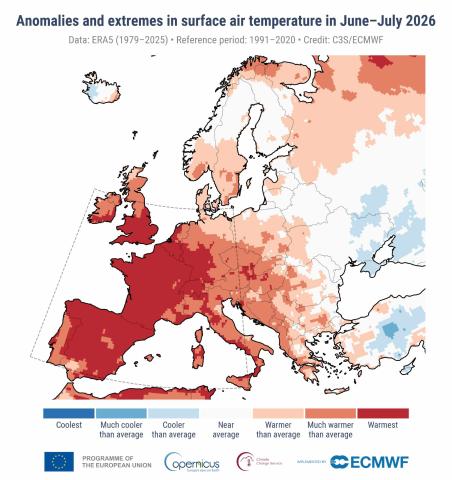
The latest data from the Copernicus Climate Change Service show that this summer in Europe has been characterised by unprecedented heat stress and very low river flows. In fact, in Western Europe, this has been the warmest summer on record and the third warmest across the continent as a whole. The European summer has been characterised by extreme heatwaves and drought conditions, with a record 52 per cent of the continent exposed to very intense heat stress by the end of the season. Furthermore, the exceptional heat persisted well beyond the peak summer months, with daily temperature records also being set in May and September.

Xavier Rodó - Copernicus Calor
Xavier Rodó
ICREA research professor and head of ISGlobal's Climate and Health programme
Is the analysis of good quality?
“Yes, the ECMWF’s Copernicus analyses are the best barometer we currently have for comprehensively monitoring and summarising the current state of the climate in Europe. These types of reports are produced using the greatest possible quantity and quality of available data, and any potential bias — which always exists — is minimal in this case due to the wealth of data, from both surface and satellite stations.”
What would you highlight from the analysis regarding Spain?
“To be honest, given the summer we’ve just had, there’s little to say that would come as a surprise after what we’ve all experienced. This surge in the number and intensity of extreme anomalies is a clear indication of unprecedented changes in Europe’s climate, as many records have been broken—not only locally, but also at regional and continental levels. On the Iberian Peninsula, temperature and hydrological extremes (relating more to evaporation and evapotranspiration than to precipitation, as this is our dry season) are unprecedented in the observational record and clearly point to transitional climatic conditions.
It is worth noting the coincidence and synchrony with the El Niño super-event unfolding in the tropical Pacific this year, which always amplifies global anomalies and those on the Iberian Peninsula in particular; this year, it is clearly doing so in both of the directions mentioned above and will have further effects well into 2027. These conditions have already led to a faster spread and greater extent of forest fires in the Mediterranean region in particular, though not only in the western part.
This convergence is equally unusual in marine heatwaves, thermal extremes manifested in an extremely high number of sweltering nights (and even tropical nights in some cities on the peninsula in late September), record-low river flows across Europe as a whole, and the reduction in permanent ice cover on European glaciers (the Pyrenees and the Alps, for example) —which is not included in the report—”.
Are there any significant limitations that need to be taken into account?
“No, when the patterns and the recorded data are so extremely clear”.
What implications does this have for decision-making?
“It should have significant implications given the urgency and speed of the processes we are observing, which are affecting our region—a climate-sensitive area that is warming at an accelerated rate in a highly uneven manner—but this is already a political issue, and the response is always belated, ill-informed and inadequate.
The impacts mentioned earlier are set to persist for at least a few more months, due to the large amount of heat accumulated in the oceans, the development of El Niño and the drastic effect of reduced soil moisture and accumulated water stress on vegetation and crops, with clear short- and medium-term effects.
Furthermore, there is an increased likelihood of various extreme events that will release all this energy stored in different compartments of the climate system on multiple scales".
261002_Ernesto_verano Copernicus 2026
Ernesto Rodríguez Camino
Senior State Meteorologist and president of Spanish Meteorological Association
The exceptional summer of 2026 in Europe, characterised by unprecedented heat stress and very low river flows, had a clearly felt impact on European society due to its effects on public health in the form of increased mortality and hospital admissions, by a historic drought that severely disrupted river transport flows, restricting commercial navigation on key rivers in Western Europe; by falls in crop yields, mainly due to water shortages; and by contributing to the outbreak of mega-fires. Similarly, some nuclear power stations saw their cooling capacity restricted by low river levels, which also coincided with peaks in electricity demand due to the use of air conditioning. The Copernicus reports and corresponding data are invaluable resources that enable the monitoring of the extreme weather conditions causing these societal disruptions.
It is well known that there has been a general increase in the likelihood of certain climate extremes, such as heatwaves, heavy rainfall, etc., associated with climate change resulting from rising concentrations of greenhouse gases in the atmosphere, caused primarily by the extensive use of fossil fuels. Furthermore, specific studies (such as those carried out by the World Weather Attribution initiative) have made it possible to quantitatively attribute the occurrence and increased intensity of some of these specific extreme events to anthropogenic climate change – notably, some of the most intense heatwaves that affected Europe this summer.
As the climate system continues to warm, there will be an increase in the frequency and intensity of extreme events such as those highlighted in the Copernicus report, which once again underscore the importance of limiting greenhouse gas emissions and building greater resilience to these climate risks that are affecting – and will increasingly affect – our societies. As we have seen this summer, climate extremes tend to occur in combination (high temperatures and droughts) and have increasingly interconnected impacts across different sectors.
Rubén del Campo - Copernicus verano 2026 EN
Rubén del Campo
Spokesperson of the State Meteorological Agency (AEMET)
The Copernicus report is in line with the analyses carried out this summer by AEMET. The summer of 2026 has been the hottest in Spain for at least a century and a half, with no fewer than 61 days of heatwaves between 20 June and 7 September. An unprecedented situation. Furthermore, midsummer conditions began in mid-May and have persisted for much of September, so we can consider that we have had a summer lasting four months or four and a half months.
Moreover, it has been the third driest summer on record, leading to water stress and drought conditions that have raised the risk of wildfires to extreme levels for much of the summer in many areas. Unfortunately, we have seen how these extremely high risks have resulted in major forest fires. Although other non-meteorological factors, such as forest management, play a part in this issue, there is no doubt that anthropogenic climate change is contributing to conditions that increase the risk of forest fires.