COP30 ends with a minimal agreement, leaving out any mention of fossil fuels
One day after the deadline, COP30 in Belém (Brazil) has finally reached a minimal agreement. The text does not mention a roadmap for abandoning fossil fuels, as requested by more than 80 states, including the European Union. The agreement states that countries agreed to accelerate climate action and triple funding for developing countries facing extreme weather events.
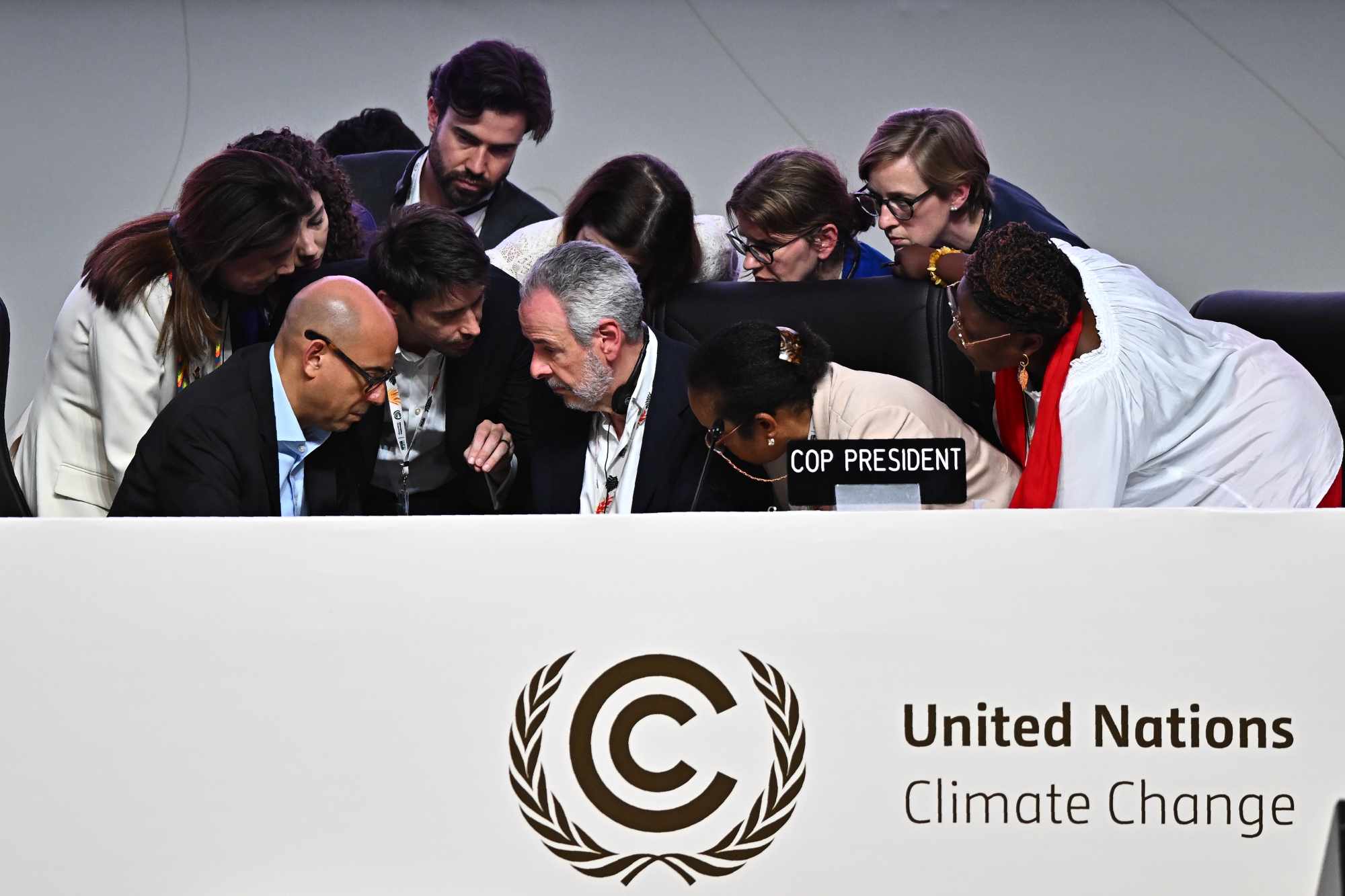
COP30 President André Corrêa do Lago participates in the COP30 plenary session this Saturday at the Hangar Convention Center, where COP30 is being held in Belém, Brazil. EFE/Andre Borges.
Alicia Pérez-Porro - COP30 EN
Alicia Pérez-Porro
Marine biologist, responsible for policy interaction and institutional relations at the Centre for Ecological Research and Forestry Applications (CREAF) presente in Belém (Brazil)
COP30 was supposed to be the COP of adaptation, and all of us who work in this field are leaving Belém with mixed feelings.
On the one hand, we have financing. It is true that it has been agreed to triple the funding allocated to adaptation, but there is a catch to this decision. It has not been agreed that countries will contribute more funding to climate action, i.e. public contributions to climate action will not be tripled; what has been agreed is that the percentage of the funding approved in Baku during COP29 will be increased for adaptation. Although this is good news in general terms, the reality is that mitigation currently accounts for 80% of funding, and tripling the adaptation budget is only a stopgap measure because what is really needed is to triple public funding for adaptation.
On the other hand, we have the Global Goal on Adaptation (GGA). One of the central themes of the discussions on the GGA has been adaptation indicators. We ended COP29 in Baku with a proposed list of 100 indicators that measured, for example, the number of countries that integrated climate adaptation measures into their national plans or the proportion of a country's territory dedicated to agri-food production that uses practices and technologies relevant to climate adaptation (to cite just a couple of examples). Today we ended COP30 with the adoption of a reduced list of 59 indicators and with the discontent of Latin American countries, the EU and the African bloc, among others, who consider that this list does not reflect the realities of many countries, mainly those in the developing world. The African bloc went further and called for the current indicators to be blocked, given their concern that they would be pressured to spend more of their own governments' scarce funds on adaptation, and called for the creation of a specific working group and the transfer of its approval to COP32, i.e. postponing the decision for two years.
But I choose to side with the words of Josep Garriga, a great connoisseur of negotiations with 18 COPs behind him, who says that "in climate change, a defeat can be a victory; there would never have been the Paris Agreement without the failure of COP15 in Copenhagen".
Conflicto de interés: forma parte del comité asesor del SMC España.
Alejandro Caparrós - COP30 EN
Alejandro Caparrós
Professor of Economics at Durham University (United Kingdom), Research Professor at the Spanish National Research Council (CSIC) and Lead Author of the International Cooperation chapter of the IPCC's AR6
The Belém summit has left us with two clear messages.
Firstly, the old leaders are no longer leading and the new ones are not yet in a position to take the reins. Climate negotiations have been led by the European Union and the US over the last few decades, with notable successes when they have pulled in the same direction, as in Kyoto and Paris. The US did not send a delegation to Brazil, and a few days ago the EU announced a red line – the agreement had to expressly mention a path to abandon fossil fuels – which it crossed without hesitation by accepting an agreement with no mention of such a path. On the other hand, in recent months China seemed called upon to fill the leadership vacuum left by the old leaders. Not yet, although its time will come. Although it is no longer really a developing country, it remains aligned with developing countries that have secured a commitment to increase funding for adaptation in the most vulnerable countries. The commitment is modest, but probably more important than the inclusion or exclusion of a reference to fossil fuels with which the EU, the UK and other countries have sought to lead the negotiations.
Second. The time has come to space out the COPs, with one meeting every two years, or two meetings every five years, as Switzerland recently suggested. The loose ends of the Paris Agreement have been tied up and we do not need new declarations; we need to implement the existing agreements. The irrelevance of this COP in the media has been remarkable. The pantomime of last-minute negotiations to save the planet cannot be repeated every year, or it will cease to be credible.
Carlos de Miguel - COP30 EN
Carlos de Miguel Perales
Environmental Lawyer and Lecturer of Civil and Environmental Law at ICADE Law School (Comillas Pontifical University)
Noteworthy positive points include the agreement to accelerate the fight against climate change, the review of trade barriers related to climate change, and tripling funding for developing countries to cope with extreme weather events.
On the negative side, the lack of agreement on the phase-out of fossil fuels undoubtedly stands out. Among other things, it shows the limits of the EU's leadership in the fight against climate change.
Two conclusions can be drawn at this point:
- As usual, the results are less than expected, but progress is still being made, albeit slowly.
- The fight against climate change continues to advance even without the US.
Pep Canadell - COP30 EN
Pep Canadell
Executive Director of the Global Carbon Project and Senior Research Fellow at the CSIRO Climate Science Centre in Canberra, Australia
Beyond the big headlines about new global agreements, or the lack thereof, COP30's most important role was to serve as a deadline for countries to announce their new emission reduction commitments for 2035, the NDCs. This is where countries demonstrate an increase in their ambition, where action takes place.
Unfortunately, the aggregate increase from all countries disappointed yet again, with announced emissions reductions that are not sufficient to ensure the success of the Paris Agreement in keeping global temperatures below 2 degrees. No global pact was made to abandon fossil fuels, but it is each country's NDCs that must respond individually to the global challenge.
A real breakthrough at COP30 was greater recognition of the importance of climate change adaptation and a commitment by rich countries to triple the transfer of money to developing countries to help them adapt to those climate impacts that are already inevitable.
Francisco Doblas - COP30 EN
Francisco J. Doblas-Reyes
ICREA Professor, Director of the Earth Sciences Department at the Barcelona Supercomputing Center
Although the failure to mention the need to phase out fossil fuels in the final document is not encouraging, the fact that progress continues to be made on climate finance is important. However, the technical aspects still need to be finalized so that the Global South can continue on the path of energy transition necessary to reduce its emissions, as well as to adapt to the impacts associated with changes in the climate system.
At the same time, it is important to avoid a colonial perspective and remember that adaptation is not only a challenge for the Global South. The Global North still has much to do, as we have seen in recent disasters. Addressing this challenge, protecting ourselves, and preparing for warming that is already irreversible will require that the social agreement not be diluted and that we accept to dedicate enormous funding.
It is essential to bear in mind that without a sustained reduction in greenhouse gas emissions associated with human activity, the global warming thresholds set in the Paris Agreement will be exceeded in the coming decades. In fact, we are not far from reaching the 1.5°C warming threshold. The fact that there is talk of having reached, or being close to reaching, peak emissions is encouraging, but it confronts us with the reality that there is still a long way to go to reach the real goal, which is to bring these emissions to zero and, preferably, to negative values.
Jesse Abrams - COP30 EN
Jesse Abrams
Senior Research Fellow and one of the UK’s foremost experts in Physical Climate Risk at the University of Exeter
The removal of fossil fuel transition language from the COP30 draft represents a concerning reversal of the limited progress made at COP28. This backsliding comes at precisely the moment when our understanding of climate risks shows we have less room for delay than previously thought.
We’re already seeing floods, droughts, and extreme events intensifying globally, while systemic threats from potential tipping points in Earth systems loom larger. Current risk assessments systematically underestimate these dangers by failing to account for how climate impacts cascade through economic networks and can trigger irreversible changes in systems like ocean circulation.
As geopolitical fragmentation intensifies, particularly with shifts in US climate leadership, we’re likely to see climate action increasingly driven by coalitions of willing nations and industries rather than unified global frameworks. This diplomatic deadlock doesn’t pause the physical climate system. Each year of continued fossil fuel dependence locks in greater exposure to extreme events while increasing the probability of crossing irreversible thresholds - with profound implications for global security and economic stability.
Daniela Schmidt - COP30 EN
Daniela Schmidt
Professor of Earth Sciences, University of Bristol.
We are currently on the path of warming with devastating consequences for many regions, peoples, economies, and ecosystems. This COP has not changed this path, has not increased speed or ambition.
How do we pick ourselves up and, if the governments don’t increase action, bring this to the places where we work, the cities where we live and communities where we are home? Because this is where the action must be when governments fail. No action is no option as too many communities are deeply vulnerable to climate change. While at the moment we are focused on floods, hurricanes, droughts and term these as extreme events, they will become the norm and combine with increases to food prices, displacement and increasing loss of livelihood. Climate change will not stop because we do not acknowledge what needs to be done.
James Dyke - COP30 EN
James Dyke
Associate Professor in Earth System Science, and Assistant Director of the Global Systems Institute at the University of Exeter
COP30 comes ten years after COP21’s achievement of the Paris Agreement, and its objective to limit warming to well-below 2°C. For the Paris Agreement to have had any chance of success, governments – particularly those in rich, industrialised nations - would have needed to accelerate the phase out of fossil fuels at the same time of phasing in the financial support for energy transitions in the Global South. Neither have happened.
In 2024, industrial processes poured a record-breaking 37.4 billion tons of carbon dioxide into the atmosphere, while the amount of climate finance thus far promised is a fraction of what is needed. Despite the host’s best efforts, COP30 will not even be able to get nations to agree to fossil fuel phase out. This shameful outcome is the result of narrow self-interest and cynical politicking.