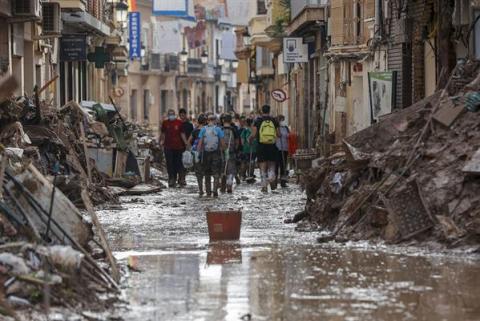
A new study concludes that climate change intensified the flooding caused by the dana in Valencia in 2024
Human-induced climate change amplified the intensity and extent of the rainfall that affected Valencia during the October 2024 dana, according to a new attribution study involving several Spanish research centres. Using climate simulations, the study, published in Nature Communications, shows that present-day global warming conditions increased precipitation intensity by 21 %, expanded the area receiving more than 180 millimetres of rain by 56 %, and raised the total rainfall volume in the Júcar River basin by 19 % compared to a pre-industrial scenario. The authors highlight “the urgent need for effective adaptation strategies and improved urban planning to reduce the growing risks associated with extreme hydrometeorological events in a rapidly warming world.”
2026 02 17 Markus Donat dana EN
Markus Donat
ICREA Research Professor, Climate Variability and Change Group Co-Leader
This study, entitled ‘Human-induced climate change amplification on storm dynamics in Valencia’s 2024 catastrophic flash flood’, uses climate model experiments to place the 2024 DANA episode — which caused the catastrophic flooding in Valencia — under present-day climate conditions and under hypothetical cooler conditions, assuming that human activities had not warmed the climate over the past 150 years. Although it remains uncertain whether, and in what way, the frequency of such weather systems may change in a warmer climate, comparing simulations of the same storm under cooler and warmer conditions makes it possible to estimate the extent to which the storm was intensified once it had developed.
The study concludes that global warming substantially increased both the rainfall totals associated with the storm and the area affected by extreme precipitation. On the one hand, higher sea surface temperatures supply more moisture to the atmosphere, and a warmer atmosphere can hold more water vapour, which subsequently condenses into rainfall, leading to heavier precipitation. On the other hand, the study also identifies feedback mechanisms that enhanced vertical air motion and moisture within the storm, further amplifying its intensity. These mechanisms are consistent with theory; however, the latter — the dynamical amplification of storms — depends to some extent on the model used, and the precise quantification of the intensification could vary if the experiments were conducted with a different model.
Overall, this study makes a highly significant contribution to understanding the processes that amplify episodes of heavy rainfall in a warmer climate, pushing them beyond the threshold of an ‘ordinary’ extreme event and into the realm of disaster.
2026 02 17 Pilar Brufau dana EN
Pilar Brufau
Researcher and Lecturer in the Department of Materials and Fluids Science and Technology at the University of Zaragoza
The study demonstrates a high level of methodological rigour, as it employs a physical attribution approach using the Pseudo-Global Warming method and kilometre-scale convective simulations with the WRF model, enabling an explicit analysis of the dynamical and microphysical processes involved in the intensification of extreme rainfall. In addition, it incorporates an ensemble of 15 CMIP6 models to estimate the climate signal and applies robust statistical testing, further strengthening the reliability of the findings. Its conclusions —a 21 % increase in six-hour accumulated rainfall and a 55 % expansion of the area affected by extreme precipitation under present-day conditions— are physically consistent with thermodynamic theory (the Clausius–Clapeyron relationship) and align with existing scientific evidence documenting the intensification of precipitation extremes in a warmer climate. Nevertheless, the study has important limitations: it examines a single event, keeps large-scale atmospheric circulation fixed (and therefore does not assess changes in the probability of occurrence), and adopts a conditional approach —comparing how the same episode would have unfolded under pre-industrial conditions, rather than quantifying future risk increases.
In terms of its implications, the work reinforces the idea that anthropogenic climate change not only increases total rainfall amounts, but also amplifies the physical mechanisms that make extreme convective events more intense and widespread. This has direct consequences for climate policy and, in particular, for spatial and urban planning: it challenges the assumption of climatic ‘stationarity’ in the design of hydraulic infrastructure, drainage systems and land-use planning frameworks. If sub-daily events may intensify by around 20 % per degree of warming, then IDF design curves and risk maps based solely on historical data are underestimating the real hazard and should be updated accordingly. Studies of this kind provide a robust scientific basis for revising technical standards and regulatory frameworks, strengthening building codes, protecting river corridors and flood-prone areas, incorporating nature-based solutions, and reinforcing adaptation strategies in response to a climate that is already showing clear signs of intensifying hydrometeorological extremes.
2026 02 17 Ernesto Rodríguez Camino dana EN
Ernesto Rodríguez Camino
Senior State Meteorologist and president of Spanish Meteorological Association
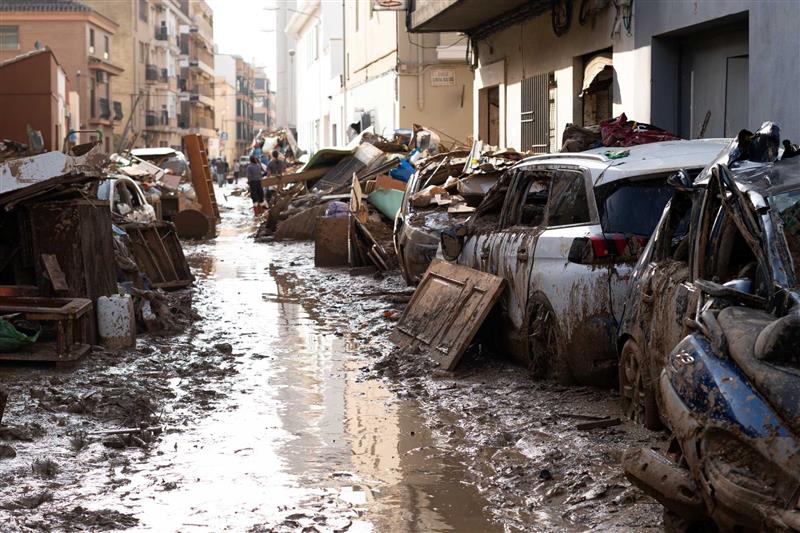
From a communication perspective, not all the impacts of ongoing anthropogenic climate change mobilise society to the same extent. Research in social psychology, communication and public opinion shows that people are more likely to respond when they perceive threats as closer, more tangible and emotionally comprehensible. In this regard, the increasing frequency and intensity of extreme weather and climate events help raise awareness and galvanise public concern about the seriousness of climate change. The October 2024 flooding episode in Valencia —which, in addition to the death toll, produced highly emotive images of widespread destruction— is a clear example of the importance of establishing a direct link between such events and contemporary climate change.
The authors refer to earlier attribution studies of this same episode conducted in near real time by the ClimaMeter and World Weather Attribution initiatives, which were instrumental in establishing from the outset a probabilistic link between the event and climate change. However, those studies —based on observations or pre-computed simulations— lack the level of detail and resolution provided by the present research. By using kilometre-scale simulations and sub-daily analysis, this study enables a more refined understanding of the underlying physical processes. It therefore represents a significant step forward in clarifying the connection between this specific episode and climate change.
That said, the methodology applied —based on the Pseudo-Global Warming (PGW) approach— imposes important constraints on the dynamical aspects of such events, including the trajectories of the cut-off lows that lay at the origin of this particular case. This study thus constitutes a further —highly useful and valuable— step in the attribution of the event, but it will need to be complemented in future by additional research that overcomes the limitations inherent in the PGW methodology.
2026 02 17 María Jesús Romero Aloy dana EN
María Jesús Romero Aloy
Professor in the Department of Urban Planning at the Universitat Politècnica de València (UPV) and Director of the Aquaculture and Environment Research Center (ACUMA)
In my view, this is a scientifically robust study that provides relevant evidence on how anthropogenic warming can intensify extreme rainfall events. The authors compare the event with a pre-industrial scenario using high-resolution modelling and conclude that present-day conditions may have increased precipitation intensity by around 20% and substantially expanded the area affected by extreme rainfall. This approach aligns with existing scientific literature on the intensification of the hydrological cycle in a warmer climate. That said, the study itself acknowledges its limitations: it analyses a single event, and its methodology allows for an assessment of how that event would have differed under other climatic conditions, but it does not establish the probability of occurrence nor can its results be automatically extrapolated to all similar cases.
From the perspective of urban planning and spatial governance, this type of research cannot, on its own, attribute a specific disaster to climate change, but it does strengthen the scientific basis for guiding adaptation policies. In my opinion, its main practical relevance lies in emphasising that planning cannot rely solely on historical records if extreme events are becoming more intense. This supports the integration of future climate scenarios into risk maps, the delineation of flood-prone areas, the design of drainage infrastructure, and urban resilience standards. Ultimately, rather than providing definitive answers about a single episode, the study contributes to consolidating a framework of evidence that justifies more prudent and preventive territorial planning in the face of potentially increasing hydrometeorological risk in Mediterranean regions.
2026 02 17 Jaime Llinares dana EN
Jaime Llinares
Head of the Department of Architectural Constructions at the Universitat Politècnica de València (UPV)
This is a scientifically high-quality study, both in terms of the journal in which it is published and the methodological rigour of the analysis. The work, published in Nature Communications, uses high-resolution convective simulations combined with a physical attribution approach that compares the event under present-day and pre-industrial conditions, allowing a reasoned isolation of the influence of anthropogenic warming. The results, which show increases both in sub-daily precipitation intensity and in the spatial extent of rainfall exceeding critical thresholds, are consistent with well-documented thermodynamic mechanisms and with accumulated evidence from the Western Mediterranean. As a limitation, the authors themselves acknowledge that the analysis focuses on this specific event and not on the future frequency of similar episodes; however, this does not diminish the robustness of the approach or the physical consistency of the conclusions.
From the perspective of territorial and urban planning, the implications are particularly significant. If extreme convective events can intensify and affect larger areas under warming conditions, hydraulic design standards, the sizing of drainage networks, and the delineation of flood-prone areas should incorporate updated climate scenarios rather than relying solely on historical records. In densely urbanised Mediterranean regions, where soil sealing and occupation of potentially flood-prone areas increase vulnerability, studies of this kind provide a necessary scientific basis to strengthen regulatory adaptation. In my view, research like this is essential for anticipating risks and improving urban resilience; failing to integrate this evidence into planning would mean continuing to apply design criteria suited to a climate that is already changing.
Carlos Calvo-Sancho et al.
- Research article
- Peer reviewed
- Modelling