
The deliberate consumption of soil—known as geophagy—is a common practice among animals, either to supplement their diet or as a protective mechanism against intoxication and other digestive issues. For the first time, a research team with Spanish participation has documented this behaviour in Barbary macaques in Gibraltar, particularly during the summer, when tourist numbers peak. This has led the authors of the study, published in the journal Scientific Reports, to hypothesise that the purpose of geophagy is to mitigate the digestive discomfort caused by food provided by visitors.

NASA’s Curiosity rover has found more than 20 organic molecules in clay-rich rocks on Mars, according to a chemical analysis published in Nature Communications. Among them is a nitrogen-containing molecule with a structure similar to that of DNA precursors, according to a press release from the University of Florida. This organic matter may have been preserved for more than 3.5 billion years in Gale Crater, the article states.

A team from the Vall d'Hebron Institute of Oncology in Barcelona has published a study examining the impact of the exposome—changes in lifestyle and environmental factors—on early-onset colorectal cancer through epigenetic signatures. By analyzing methylation patterns in patients, they confirmed previously identified risk factors such as diet, educational level, and tobacco use. Additionally, they identified a significant association with picloram, a widely used herbicide. The results are published in Nature Medicine.

One of the best-known genetic risk factors for developing Parkinson’s disease is carrying variants of the GBA1 gene. A new study published in the journal Nature Medicine compared the microbiomes of 43 carriers of this gene who had not developed the disease with those of 271 Parkinson’s patients and 150 healthy individuals. The results showed, in addition to alterations in the microbiome in the patient group, that 25% of the microbiome of carriers of this gene exhibited alterations, representing an intermediate profile between the other two groups. The results were validated using independent cohorts from the United Kingdom, South Korea, and Turkey. According to the authors, “alterations in the gut microbiome can identify individuals with both genetic and non-genetic risk in the general population who may be progressing toward Parkinson’s disease.”


A US team analyzed the genetic activity of individual brain cells from 15 men and 15 women and found 133 genes that showed consistent differences. Although biological sex explained only a small part of the differences they found when comparing all the brains, variants in many of these genes have been associated with neuropsychiatric and neurodegenerative disorders—such as ADHD, schizophrenia, depression, and Alzheimer's—suggesting that sex differences could play a role in the distinct risk men and women have of developing certain diseases. The authors, however, acknowledge that the sex-related differences in their study could stem from differences in socialization and experience. The results are published in Science.

The European Union is close to passing legislation to facilitate the use of plants edited using CRISPR, a technology that makes it possible to modify the genome of living organisms with precision. The Council of Ministers of the EU is scheduled to deliberate on this legislation on 21 April, and in this article we explain what these techniques are, their potential benefits and risks, and how they will be regulated.
A review of studies conducted by the Cochrane Collaboration analyzed data from 17 clinical trials involving more than 20,000 participants who had been treated with amyloid-targeting drugs—such as lecanemab or donanemab—at a relatively early stage of Alzheimer’s disease. Results at 18 months of treatment show that “the absolute effects on cognitive decline and the severity of dementia were nonexistent or negligible, falling well below the thresholds established for a clinically meaningful difference,” according to a press release. Furthermore, the review concludes that these drugs likely cause more brain inflammation and microbleeds than the placebo.
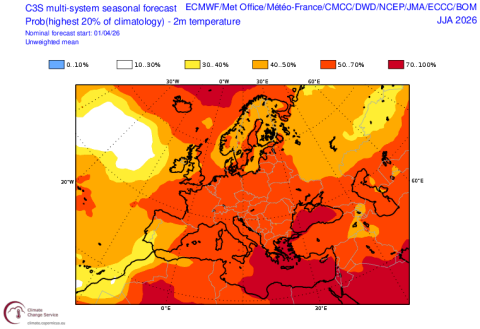
The latest forecasts from the European Centre for Medium-Range Weather Forecasts (ECMWF) suggest that there is a likelihood that the phenomenon known as El Niño will return this year and that it will do so with greater intensity. In Europe, for June through August, the forecast indicates a slight tendency toward below-average precipitation in the northeast of the continent. As for the Iberian Peninsula, temperatures are expected to exceed the top quintile of the seasonal average. Although it is not yet certain that this will occur, forecasts for the coming months will either confirm or rule it out.
A study with Spanish participation has discovered in mice that semaglutide can improve the condition of non-alcoholic fatty liver disease not only through weight loss, but also independently, which would explain why some patients improve with minimal weight loss. “We are not saying that weight loss is unimportant, as many things improve when patients lose weight. But now we know that weight should not be the only measure of success, because GLP-1 drugs will improve liver health regardless of whether the patient loses weight or not,” the authors, who published the results in Cell Metabolism.